. 2023 Jul;17(7):1104-1115.
doi: 10.1038/s41396-023-01425-w. Epub 2023 May 9.

Lysogenic bacteriophages encoding arsenic resistance determinants promote bacterial community adaptation to arsenic toxicity

Affiliations

Lysogenic bacteriophages encoding arsenic resistance determinants promote bacterial community adaptation to arsenic toxicity

Xiang Tang et al. ISME J. 2023 Jul.

Erratum in

Abstract

Emerging evidence from genomics gives us a glimpse into the potential contribution of lysogenic bacteriophages (phages) to the environmental adaptability of their hosts. However, it is challenging to quantify this kind of contribution due to the lack of appropriate genetic markers and the associated controllable environmental factors. Here, based on the unique transformable nature of arsenic (the controllable environmental factor), a series of flooding microcosms was established to investigate the contribution of arsM-bearing lysogenic phages to their hosts' adaptation to trivalent arsenic [As(III)] toxicity, where arsM is the marker gene associated with microbial As(III) detoxification. In the 15-day flooding period, the concentration of As(III) was significantly increased, and this elevated As(III) toxicity visibly inhibited the bacterial population, but the latter quickly adapted to As(III) toxicity. During the flooding period, some lysogenic phages re-infected new hosts after an early burst, while others persistently followed the productive cycle (i.e., lytic cycle). The unique phage-host interplay contributed to the rapid spread of arsM among soil microbiota, enabling the quick recovery of the bacterial community. Moreover, the higher abundance of arsM imparted a greater arsenic methylation capability to soil microbiota. Collectively, this study provides experimental evidence for lysogenic phages assisting their hosts in adapting to an extreme environment, which highlights the ecological perspectives on lysogenic phage-host mutualism.


Conflict of interest statement

The authors declare no competing interests.

Figures

Fig. 1
Fig. 1. Workflow diagram of separate-extraction.
The workflow of separate-extraction of different phage subsets in the microcosm, and we were able to obtain the free phages derived from lysogenic phage and the prophages remaining in the host via this workflow.
Fig. 2
Fig. 2. Changes in the active microbial community.
A The composition of the active bacterial community at the genus level, the abundance is presented as the average percentage of three replicates; B Network analysis of the active bacterial community based on the genus level; C The arsenic species affecting differences in the composition of the active microbial community as revealed by redundancy analysis (RDA); D Dynamics of the copy number of the 16S rRNA gene in soil microbiota during 15-day flooding period. Error bars represent standard deviations of triplicate tests.
Fig. 3
Fig. 3. Changes in the viral population.
A The proportion of phages to all assembled contigs identified as viruses, and this result indicated that VLP can be used to characterize the number of phage; B The composition of the lysogenic phages at the genus level from five samples in three sampling times, the viral contigs containing transposase, integrase, excisionase, resolvase or recombinase were considered as lysogenic phages; C Dynamics of the numbers of prophages and free phages in microcosm during the 15-day flooding period, where the numerical digit up the column indicates the percentage of prophages in the total phages (i.e., prophages and free phages); D Predicted virus-host linkages in the flooding period, where worth noting that the main viral contigs that cannot be annotated is not displayed. Error bars represent standard deviations of triplicate tests.
Fig. 4
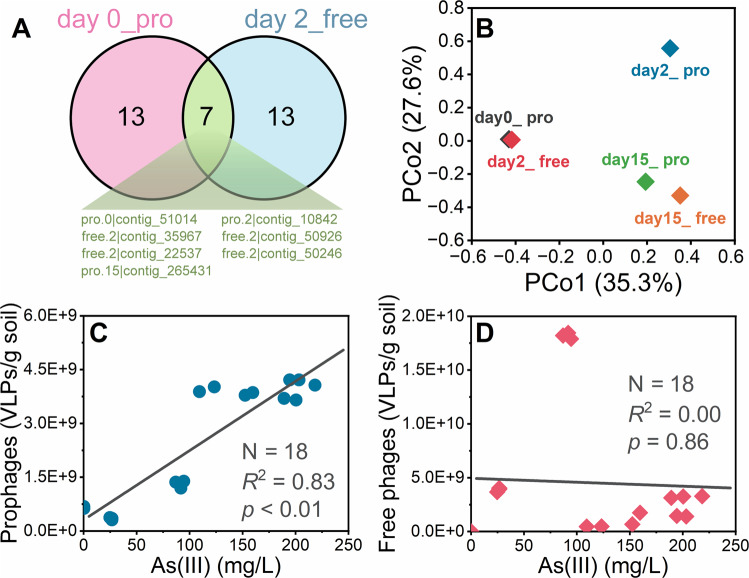
Fig. 4. Similarity of virome composition and the correlation between phage number and As(III) content.
A The shared viral contigs in the top 20 contigs between the prophages on day 0 (day 0_pro) and the free phages on day 2 (day 2_free); B The differences in the composition of the viral community revealed by principal co-ordinates analysis (PCoA) based on Bray–Curtis distances; The correlation between the number of (C) prophages and (D) free phages and the dissolved-As(III) concentration (N = 18).
Fig. 5
Fig. 5. Changes in viral arsM abundance.
A Absolute (gene copies) and (B) relative abundance (per VLP) of arsM in prophages; C The correlation between the relative abundance of arsM in prophages and the relative abundance of arsM in free phages (N = 18).
Fig. 6
Fig. 6. Analysis of the viral arsM.
A The composition of viral arsM taxa at the ASV level, the abundance is presented as the average percentage of three replicates; B The main environmental factors affecting differences in the composition of viral arsM taxa revealed by canonical correlation analysis; C The viral arsM phylogenetic tree based on arsM amplicon sequencing where differently colored spots denote different changing trends; D The correlation between the between-group variations of top 10 ASV abundance and the between-group variations of their putative host, where the between-group variation is the difference between one sample and another sample at the previous point-in-time [e.g., V0-1 (between-group variation between day 1 and day 0) = C1 (relative abundance of ASV or their putative host on day 1) – C0 (relative abundance on day 1)]; E The correlation between the copy number of 16S rRNA gene and the copy number of arsM in prophages.
Fig. 7
Fig. 7. The arsM abundance in soil microbiota and corresponding arsenic methylation capacity.
A Dynamics of the copy numbers of arsM in soil microbiota; B The contribution of arsM-bearing prophages to the increment of arsM in soil microbiota; C The yield of TMAs(III) from different soil after 15-day incubation. Error bars represent standard deviations of triplicate tests.
Fig. 8
Fig. 8. Survival strategy of lysogenic phages and structural equation modeling.
A The presumed survival strategy of lysogenic phages in the microcosm during flooding, in which some of As(III)-induced lysogenic phages maintained the productive life cycle rather than enter a new lysogenic life cycle, and this strategy facilitated the spread of arsM. Error bars represent standard deviations of triplicate tests. B Path analysis showing the direct and indirect effects of the As(III) toxicity on the abundance of arsM in soil microbiota. Indirect effects of As(III) toxicity are mediated through arsM-bearing prophages. Numbers above paths represent standardized coefficients in flooding period. Thickness and color of lines correspond to coefficient magnitude and direction, respectively.

References

    1. Sun CL, Thomas BC, Barrangou R, Banfield JF. Metagenomic reconstructions of bacterial CRISPR loci constrain population histories. ISME J. 2016;10:858–70. doi: 10.1038/ismej.2015.162. - DOI - PMC - PubMed
    1. Weinbauer MG. Ecology of prokaryotic viruses. FEMS Microbiol Rev. 2004;28:127–81. doi: 10.1016/j.femsre.2003.08.001. - DOI - PubMed
    1. Shropshire JD, On J, Layton EM, Zhou H, Bordenstein SR. One prophage WO gene rescues cytoplasmic incompatibility in Drosophila melanogaster. Proc Natl Acad Sci USA. 2018;115:4987. doi: 10.1073/pnas.1800650115. - DOI - PMC - PubMed
    1. Nobrega FL, Costa AR, Kluskens LD, Azeredo J. Revisiting phage therapy: new applications for old resources. Trends Microbiol. 2015;23:185–91. doi: 10.1016/j.tim.2015.01.006. - DOI - PubMed
    1. Mathieu J, Yu P, Zuo P, Da Silva MLB, Alvarez PJJ. Going viral: emerging opportunities for phage-based bacterial control in water treatment and reuse. Acc Chem Res. 2019;52:849–57. doi: 10.1021/acs.accounts.8b00576. - DOI - PubMed

Publication types