. 2023 Sep 1;4(5):374-393.
doi: 10.1158/2643-3230.BCD-22-0139.

HTLV-1 bZIP Factor-Induced Reprogramming of Lactate Metabolism and Epigenetic Status Promote Leukemic Cell Expansion

Affiliations

HTLV-1 bZIP Factor-Induced Reprogramming of Lactate Metabolism and Epigenetic Status Promote Leukemic Cell Expansion

Kosuke Toyoda et al. Blood Cancer Discov. .

Abstract

Acceleration of glycolysis is a common trait of cancer. A key metabolite, lactate, is typically secreted from cancer cells because its accumulation is toxic. Here, we report that a viral oncogene, HTLV-1 bZIP factor (HBZ), bimodally upregulates TAp73 to promote lactate excretion from adult T-cell leukemia-lymphoma (ATL) cells. HBZ protein binds to EZH2 and reduces its occupancy of the TAp73 promoter. Meanwhile, HBZ RNA activates TAp73 transcription via the BATF3-IRF4 machinery. TAp73 upregulates the lactate transporters MCT1 and MCT4. Inactivation of TAp73 leads to intracellular accumulation of lactate, inducing cell death in ATL cells. Furthermore, TAp73 knockout diminishes the development of inflammation in HBZ-transgenic mice. An MCT1/4 inhibitor, syrosingopine, decreases the growth of ATL cells in vitro and in vivo. MCT1/4 expression is positively correlated with TAp73 in many cancers, and MCT1/4 upregulation is associated with dismal prognosis. Activation of the TAp73-MCT1/4 pathway could be a common mechanism contributing to cancer metabolism.

Significance: An antisense gene encoded in HTLV-1, HBZ, reprograms lactate metabolism and epigenetic modification by inducing TAp73 in virus-positive leukemic cells. A positive correlation between TAp73 and its target genes is also observed in many other cancer cells, suggesting that this is a common mechanism for cellular oncogenesis. This article is featured in Selected Articles from This Issue, p. 337.


Figures

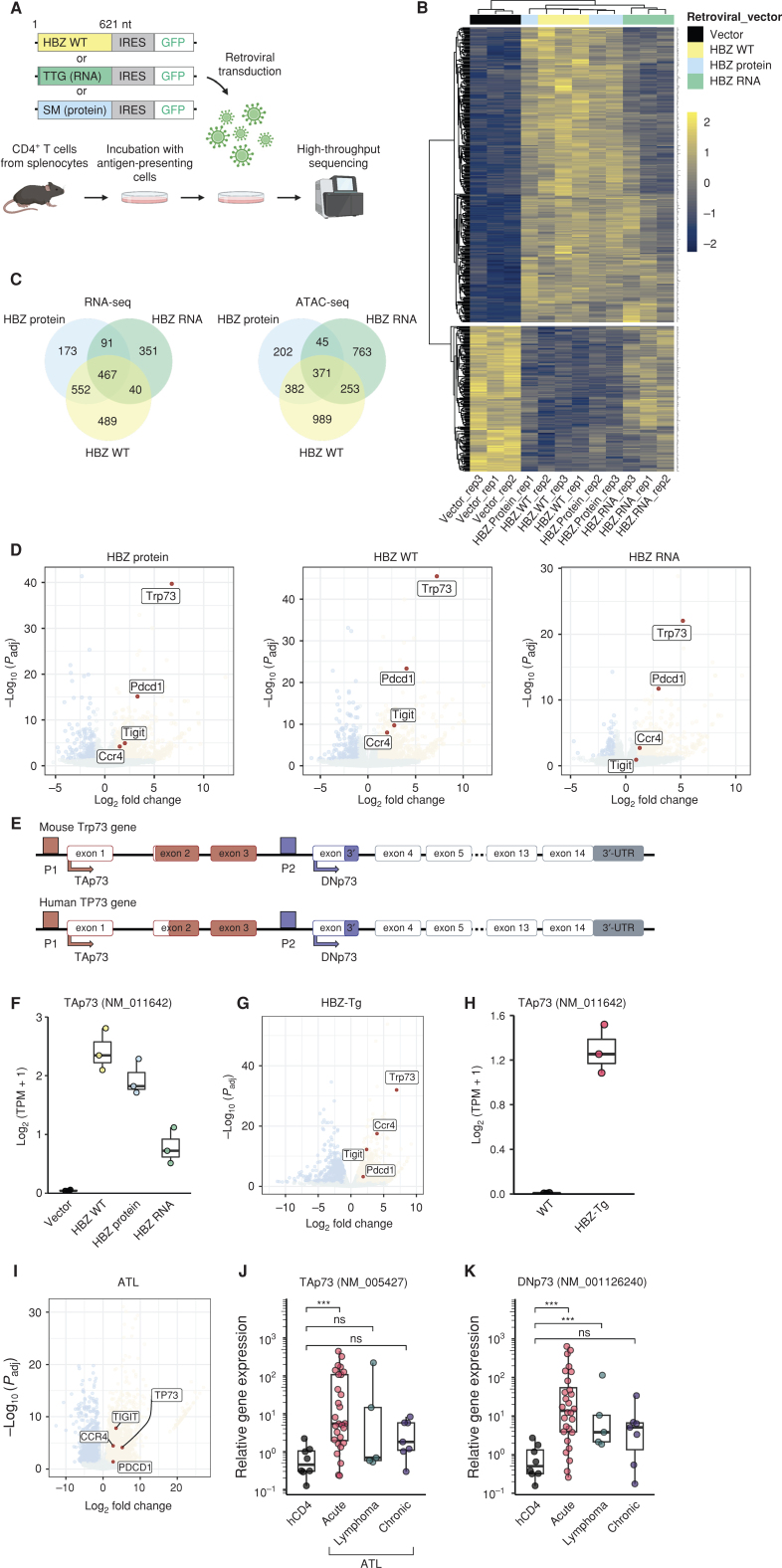
Figure 1. HBZ protein and RNA both upregulate TP73. A, Schematic diagram for retroviral transfer of HBZ into primary mouse CD4+ T cells. Each construct encodes WT HBZ, HBZ RNA (ATG is converted to TTG) or HBZ protein (SM, silent mutations; ref. 5). Created with BioRender.com. B, A heat map of the top 500 differentially expressed genes in HBZ WT and its mutants compared with the vector, calculated from RNA-seq data. C, Shared transcriptomes (left; the number of genes) and open chromatin regions (right) associated with HBZ WT and its mutants are shown in Venn diagrams. D, Volcano plots of differentially expressed genes. Fold change and adjusted P value (Padj) are plotted for genes that are upreulgated (yellow) or downregulated (blue) compared with the vector. E, TP73 gene maps (upper, mouse; lower, human) depicting the major two isoforms, TAp73 and DNp73, and their promoters. F, Transcripts per million (TPM) of TAp73 in the transduced cells (n = 3). G, A volcano plot resulting from RNA-seq that compares the CD4+ T cells of HBZ-Tg mice with those of WT mice (n = 3). H, TPM of TAp73 in HBZ-Tg and WT mouse CD4+ T cells (n = 3). I–K, TP73 expression in ATL. A volcano plot resulting from RNA-seq compares CD4+ T cells of ATL patients (n = 7) with those of healthy donors (n = 10; I). mRNA expression of TAp73 (J) and DNp73 (K) by RT-qPCR in CD4+ T cells of ATL patients (acute type, n = 28; lymphoma type, n = 5; chronic type, n = 7) and healthy donors (hCD4; n = 8). Results are plotted as mean ± SD, using one-way ANOVA followed by the post hoc Steel test (J and K). ***, P < 0.001; ns, not significant.
Figure 1.
HBZ protein and RNA both upregulate TP73. A, Schematic diagram for retroviral transfer of HBZ into primary mouse CD4+ T cells. Each construct encodes WT HBZ, HBZ RNA (ATG is converted to TTG) or HBZ protein (SM, silent mutations; ref. 5). Created with BioRender.com. B, A heat map of the top 500 differentially expressed genes in HBZ WT and its mutants compared with the vector, calculated from RNA-seq data. C, Shared transcriptomes (left; the number of genes) and open chromatin regions (right) associated with HBZ WT and its mutants are shown in Venn diagrams. D, Volcano plots of differentially expressed genes. Fold change and adjusted P value (Padj) are plotted for genes that are upreulgated (yellow) or downregulated (blue) compared with the vector. E, TP73 gene maps (upper, mouse; lower, human) depicting the major two isoforms, TAp73 and DNp73, and their promoters. F, Transcripts per million (TPM) of TAp73 in the transduced cells (n = 3). G, A volcano plot resulting from RNA-seq that compares the CD4+ T cells of HBZ-Tg mice with those of WT mice (n = 3). H, TPM of TAp73 in HBZ-Tg and WT mouse CD4+ T cells (n = 3). IK, TP73 expression in ATL. A volcano plot resulting from RNA-seq compares CD4+ T cells of ATL patients (n = 7) with those of healthy donors (n = 10; I). mRNA expression of TAp73 (J) and DNp73 (K) by RT-qPCR in CD4+ T cells of ATL patients (acute type, n = 28; lymphoma type, n = 5; chronic type, n = 7) and healthy donors (hCD4; n = 8). Results are plotted as mean ± SD, using one-way ANOVA followed by the post hoc Steel test (J and K). ***, P < 0.001; ns, not significant.
Figure 2. HBZ protein alters EZH2 genome-wide distribution and decreases its binding to the TAp73 promoter. A, GSEA plots for mouse CD4+ T cells transduced with WT or mutant HBZ compared with the vector. The normalized enrichment score (NES) and q-value are listed. B, Immunoprecipitation (IP) with anti-Flag antibody (Flag-HBZ) showing interaction between HBZ protein and EZH2 in HEK293T cells. IP was analyzed by SDS-PAGE and immunoblotting (IB). C–E, ChIP-qPCR for EZH2 and H3K27me3 in the TAp73 promoter region. The %Input is shown for WT or HBZ-Tg mouse CD4+ T cells (C), human CD4+ T cells from healthy donors (hCD4) or ATL cell lines (D), and Jurkat cells with stable transduction of WT or mutant HBZ (E; n = 3). F, Histone methyltransferase (HMT) activity on H3K27 among transduced Jurkat cells (n = 3). G and H, Heat maps for genomic regions with enriched ChIP-seq scores for H3K27me3. The score for each region was scaled and clustered based on healthy human donor CD4+ T cells (hCD4; G) or WT mouse CD4+ T cells (H) with transcription start site (TSS) and transcription end site (TES) labeling. In addition to Treg, ATL cells (TL-Om1 and ED; G) and cells from HBZ-Tg mice (H) were analyzed. I, Representative genes found in cluster 2 that were shared between the results from human and mouse cells in G and H, respectively. J, Results of KEGG pathway analysis using the genes in cluster 2 for humans (G). Shared pathways between human and mouse cells are highlighted in red. Statistical values and gene counts calculated by the clusterProfiler are shown. K and L, Scatter plots of mouse cluster 2 genes resulting from combinational analysis of RNA-seq (HBZ-Tg mouse CD4+ T cells relative to WT) and ChIP-seq [relative enrichments in TSS of WT as area under the curve (AUC)] for EZH2 (K) and H3K27me3 (L). Results are plotted as mean ± SD, using Student t test (C) or one-way ANOVA with the post hoc Dunnet test (D–F). *, P < 0.05; **, P < 0.01; ***, P < 0.001; ns, not significant.
Figure 2.
HBZ protein alters EZH2 genome-wide distribution and decreases its binding to the TAp73 promoter. A, GSEA plots for mouse CD4+ T cells transduced with WT or mutant HBZ compared with the vector. The normalized enrichment score (NES) and q-value are listed. B, Immunoprecipitation (IP) with anti-Flag antibody (Flag-HBZ) showing interaction between HBZ protein and EZH2 in HEK293T cells. IP was analyzed by SDS-PAGE and immunoblotting (IB). CE, ChIP-qPCR for EZH2 and H3K27me3 in the TAp73 promoter region. The %Input is shown for WT or HBZ-Tg mouse CD4+ T cells (C), human CD4+ T cells from healthy donors (hCD4) or ATL cell lines (D), and Jurkat cells with stable transduction of WT or mutant HBZ (E; n = 3). F, Histone methyltransferase (HMT) activity on H3K27 among transduced Jurkat cells (n = 3). G and H, Heat maps for genomic regions with enriched ChIP-seq scores for H3K27me3. The score for each region was scaled and clustered based on healthy human donor CD4+ T cells (hCD4; G) or WT mouse CD4+ T cells (H) with transcription start site (TSS) and transcription end site (TES) labeling. In addition to Treg, ATL cells (TL-Om1 and ED; G) and cells from HBZ-Tg mice (H) were analyzed. I, Representative genes found in cluster 2 that were shared between the results from human and mouse cells in G and H, respectively. J, Results of KEGG pathway analysis using the genes in cluster 2 for humans (G). Shared pathways between human and mouse cells are highlighted in red. Statistical values and gene counts calculated by the clusterProfiler are shown. K and L, Scatter plots of mouse cluster 2 genes resulting from combinational analysis of RNA-seq (HBZ-Tg mouse CD4+ T cells relative to WT) and ChIP-seq [relative enrichments in TSS of WT as area under the curve (AUC)] for EZH2 (K) and H3K27me3 (L). Results are plotted as mean ± SD, using Student t test (C) or one-way ANOVA with the post hoc Dunnet test (DF). *, P < 0.05; **, P < 0.01; ***, P < 0.001; ns, not significant.
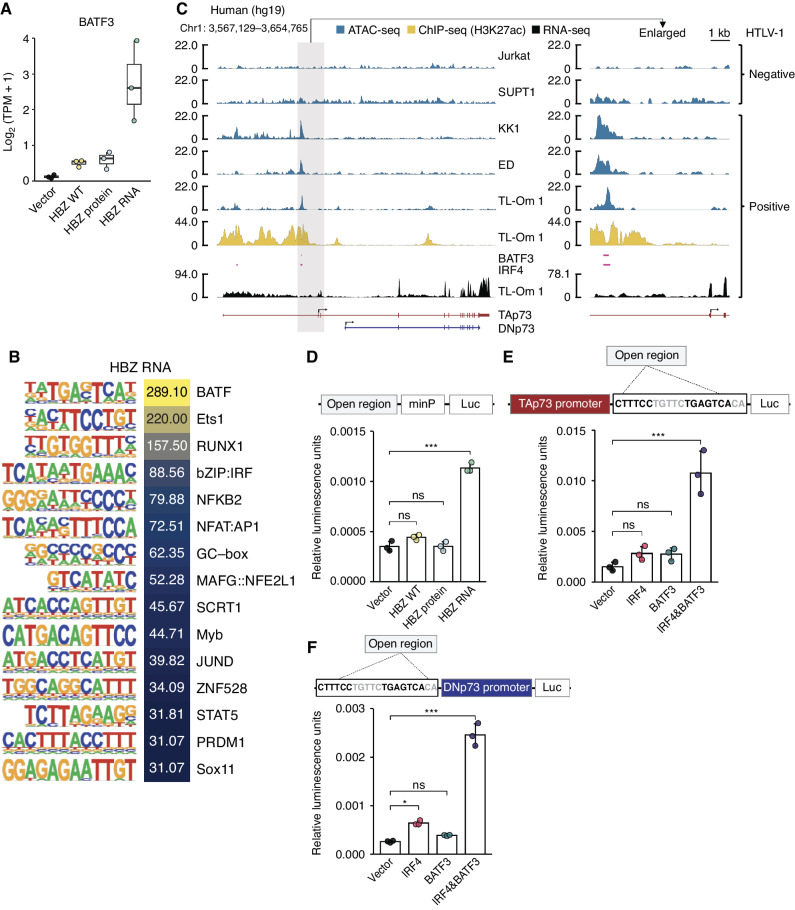
Figure 3. HBZ RNA activates both TAp73 and DNp73 promoters via BATF3-IRF4 transcriptional machinery. A, Transcripts per million (TPM) of BATF3 in HBZ-transduced murine CD4+ T cells (n = 3). B, The top-ranked enriched motifs of HBZ RNA-transduced murine CD4+ T cells with their log2 P values from the findMotifsGenome results (HOMER). C, Chromatin accessibility (ATAC-seq), H3K27ac enrichment, BATF3/IRF4 binding regions (ChIP-seq; SRX2548278 and SRX2548284; ref. 25) analyzed by using the ChIP-Atlas (73), and transcripts (RNA-seq) of the TP73 gene in HTLV-1–negative or –positive human T-cell lines. D, Promoter assays of the HTLV-1–specific open region identified in C (hg19 genome region of chr1:3593076–3594185) with a minimal promoter (minP) in HEK293 cells cotransfected with WT or mutant HBZ. The open region was inserted into pNL3.2.CMV after cloning of the genome region as shown in a schematic of construct. E and F, The IRF4/AP-1 motifs identified within the open region (hg19 genome region of chr1:3593076–3594185) were subjected to promoter assays with IRF4 and/or BATF3 induction: for the promoter of TAp73 (E) and the promoter of DNp73 (F; n = 3). A schematic of the assay construct is shown above the corresponding bar plot. Results are plotted with mean ± SD, using one-way ANOVA with the post hoc Dunnet test (D–F). *, P < 0.05; ***, P < 0.001; ns, not significant.
Figure 3.
HBZ RNA activates both TAp73 and DNp73 promoters via BATF3-IRF4 transcriptional machinery. A, Transcripts per million (TPM) of BATF3 in HBZ-transduced murine CD4+ T cells (n = 3). B, The top-ranked enriched motifs of HBZ RNA-transduced murine CD4+ T cells with their log2P values from the findMotifsGenome results (HOMER). C, Chromatin accessibility (ATAC-seq), H3K27ac enrichment, BATF3/IRF4 binding regions (ChIP-seq; SRX2548278 and SRX2548284; ref. 25) analyzed by using the ChIP-Atlas (73), and transcripts (RNA-seq) of the TP73 gene in HTLV-1–negative or –positive human T-cell lines. D, Promoter assays of the HTLV-1–specific open region identified in C (hg19 genome region of chr1:3593076–3594185) with a minimal promoter (minP) in HEK293 cells cotransfected with WT or mutant HBZ. The open region was inserted into pNL3.2.CMV after cloning of the genome region as shown in a schematic of construct. E and F, The IRF4/AP-1 motifs identified within the open region (hg19 genome region of chr1:3593076–3594185) were subjected to promoter assays with IRF4 and/or BATF3 induction: for the promoter of TAp73 (E) and the promoter of DNp73 (F; n = 3). A schematic of the assay construct is shown above the corresponding bar plot. Results are plotted with mean ± SD, using one-way ANOVA with the post hoc Dunnet test (DF). *, P < 0.05; ***, P < 0.001; ns, not significant.
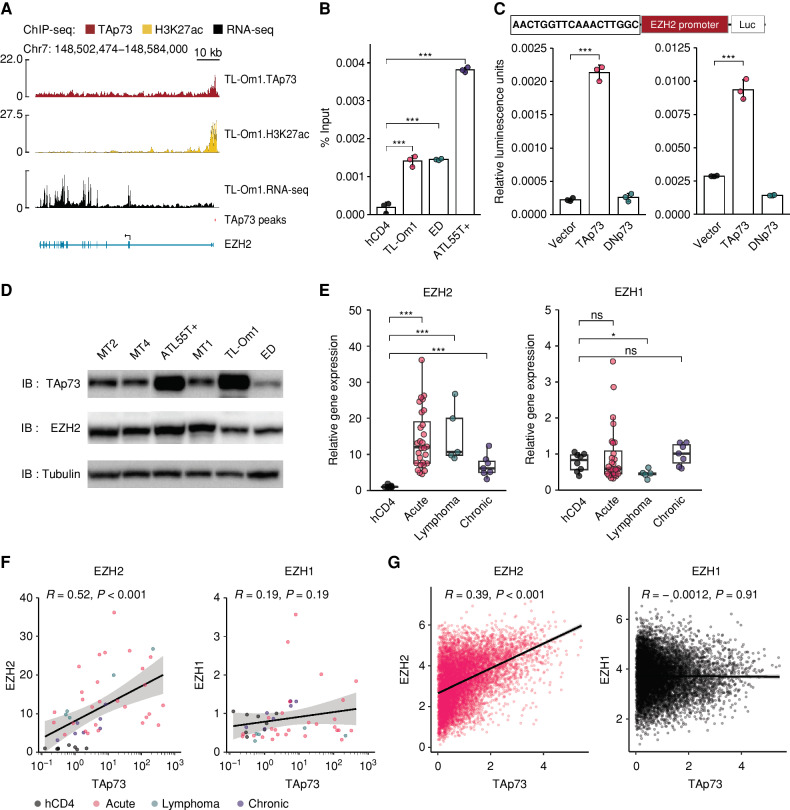
Figure 4. TAp73 transcriptionally induces EZH2 gene expression. A, TAp73 and H3K27ac enrichment (ChIP-seq) and transcripts (RNA-seq) of the EZH2 gene in TL-Om1 cells. Extracted TAp73 peak is shown as a red bar. B, ChIP-qPCR for TAp73 in the EZH2 promoter region of ATL cell lines relative to healthy human donor CD4+ T cells (hCD4; n = 3). C, Promoter assays using the TP73 motif identified within the TAp73 peak by the ChIP-seq experiment shown in A. Relative luciferase activities with the expression of various TP73 isoforms in HEK293 (left) and Jurkat (right) cells (n = 3). A schematic of the assay construct is shown above the bar plots. D, Immunoblots (IB) of TAp73, EZH2, and Tubulin in HTLV-1–infected cell lines. E, mRNA expression of EZH2 (left) and EZH1 (right) by RT-qPCR in hCD4 (n = 8) and ATL cells (acute type, n = 28; lymphoma type, n = 5; chronic type, n = 7). F and G, Correlation between TAp73 expression and expression of EZH2 (left) or EZH1 (right) in hCD4 and ATL cells (F) and TCGA data (G). Results of Pearson correlation analysis are plotted. Results are plotted as mean ± SD, using one-way ANOVA with the post hoc Dunnet (B and C) or Steel test (E). *, P < 0.05; **, P < 0.01; ***, P < 0.001; ns, not significant.
Figure 4.
TAp73 transcriptionally induces EZH2 gene expression. A, TAp73 and H3K27ac enrichment (ChIP-seq) and transcripts (RNA-seq) of the EZH2 gene in TL-Om1 cells. Extracted TAp73 peak is shown as a red bar. B, ChIP-qPCR for TAp73 in the EZH2 promoter region of ATL cell lines relative to healthy human donor CD4+ T cells (hCD4; n = 3). C, Promoter assays using the TP73 motif identified within the TAp73 peak by the ChIP-seq experiment shown in A. Relative luciferase activities with the expression of various TP73 isoforms in HEK293 (left) and Jurkat (right) cells (n = 3). A schematic of the assay construct is shown above the bar plots. D, Immunoblots (IB) of TAp73, EZH2, and Tubulin in HTLV-1–infected cell lines. E, mRNA expression of EZH2 (left) and EZH1 (right) by RT-qPCR in hCD4 (n = 8) and ATL cells (acute type, n = 28; lymphoma type, n = 5; chronic type, n = 7). F and G, Correlation between TAp73 expression and expression of EZH2 (left) or EZH1 (right) in hCD4 and ATL cells (F) and TCGA data (G). Results of Pearson correlation analysis are plotted. Results are plotted as mean ± SD, using one-way ANOVA with the post hoc Dunnet (B and C) or Steel test (E). *, P < 0.05; **, P < 0.01; ***, P < 0.001; ns, not significant.
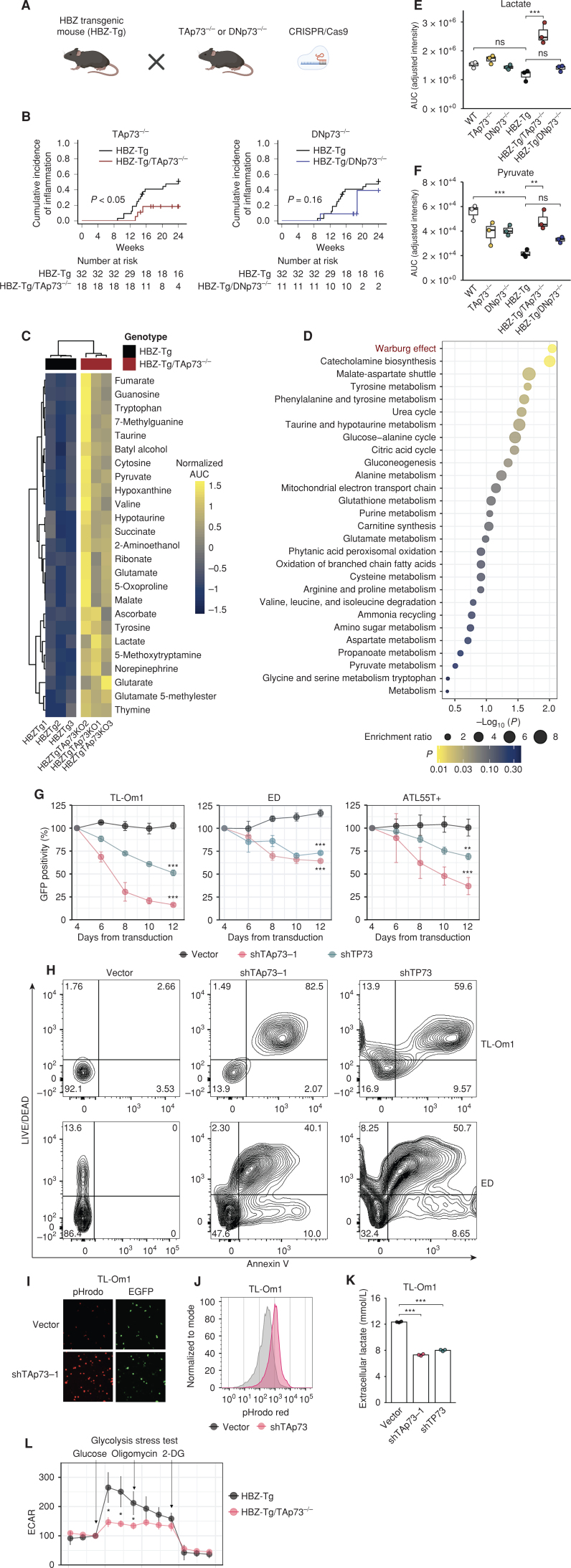
Figure 5. TAp73 inactivation causes ATL cell death and intracellular acidification due to lactate accumulation. A, Mating diagram of HBZ-Tg mice with TP73 knockout mice (TAp73−/− or DNp73−/−) created by CRISPR/Cas9. B, Cumulative incidence of skin inflammation in HBZ-Tg mice (n = 32) compared with HBZ-Tg/TAp73−/− mice (left; n = 18) or HBZ-Tg/DNp73−/− mice (right; n = 11). The P values determined by the Gray test are shown. C and D, Changes in metabolites between HBZ-Tg and HBZ-Tg/TAp73−/− mouse CD4+ T cells. Shown are the top 25 differentially altered metabolites with the normalized area under the curve (AUC; mean-centered and divided by the standard deviation of each variable; C) and enriched metabolite sets (D), both of which were analyzed by using the MetaboAnalyst (78). E and F, Intracellular lactate (E) and pyruvate (F) levels in the murine CD4+ T cells (n = 3). Calculated ion intensities (normalized AUC) are shown. G, GFP competition assay of ATL cell lines with TP73 knockdown (n = 3). Lentiviral vectors for knockdown encoded enhanced GFP (EGFP). The date of lentiviral transduction was counted as day 1. H, Cell viability and apoptosis assay with TP73 knockdown. On day 8 after transduction, ATL cells were analyzed by flow cytometry. Representative dot plots are shown. I and J, Intracellular pH was assessed by pHrodo Red AM in TL-Om1 cells on day 8 after transduction. Fluorescence microscopy photographs with EGFP (indicates lentivirus-transduced cells) and pHrodo Red AM (I) and flow cytometry results (J). K, Extracellular lactate in TL-Om1 cell cultures on day 8 after transduction (n = 3). L, Extracellular acidification rate (ECAR) assessed by metabolic flux assay of CD4+ T cells from HBZ-Tg or HBZ-Tg/TAp73−/− mice (n = 3). Glucose, oligomycin, and 2-deoxyglucose (2-DG) were injected at the indicated time points. Results are plotted as mean ± SD, using one-way ANOVA with post hoc Tukey (E and F), Dunnet test (G and K), or Student t test (L). *, P < 0.05; **, P < 0.01; ***, P < 0.001; ns, not significant. Created with BioRender.com.
Figure 5.
TAp73 inactivation causes ATL cell death and intracellular acidification due to lactate accumulation. A, Mating diagram of HBZ-Tg mice with TP73 knockout mice (TAp73−/− or DNp73−/−) created by CRISPR/Cas9. B, Cumulative incidence of skin inflammation in HBZ-Tg mice (n = 32) compared with HBZ-Tg/TAp73−/− mice (left; n = 18) or HBZ-Tg/DNp73−/− mice (right; n = 11). The P values determined by the Gray test are shown. C and D, Changes in metabolites between HBZ-Tg and HBZ-Tg/TAp73−/− mouse CD4+ T cells. Shown are the top 25 differentially altered metabolites with the normalized area under the curve (AUC; mean-centered and divided by the standard deviation of each variable; C) and enriched metabolite sets (D), both of which were analyzed by using the MetaboAnalyst (78). E and F, Intracellular lactate (E) and pyruvate (F) levels in the murine CD4+ T cells (n = 3). Calculated ion intensities (normalized AUC) are shown. G, GFP competition assay of ATL cell lines with TP73 knockdown (n = 3). Lentiviral vectors for knockdown encoded enhanced GFP (EGFP). The date of lentiviral transduction was counted as day 1. H, Cell viability and apoptosis assay with TP73 knockdown. On day 8 after transduction, ATL cells were analyzed by flow cytometry. Representative dot plots are shown. I and J, Intracellular pH was assessed by pHrodo Red AM in TL-Om1 cells on day 8 after transduction. Fluorescence microscopy photographs with EGFP (indicates lentivirus-transduced cells) and pHrodo Red AM (I) and flow cytometry results (J). K, Extracellular lactate in TL-Om1 cell cultures on day 8 after transduction (n = 3). L, Extracellular acidification rate (ECAR) assessed by metabolic flux assay of CD4+ T cells from HBZ-Tg or HBZ-Tg/TAp73−/− mice (n = 3). Glucose, oligomycin, and 2-deoxyglucose (2-DG) were injected at the indicated time points. Results are plotted as mean ± SD, using one-way ANOVA with post hoc Tukey (E and F), Dunnet test (G and K), or Student t test (L). *, P < 0.05; **, P < 0.01; ***, P < 0.001; ns, not significant. Created with BioRender.com.
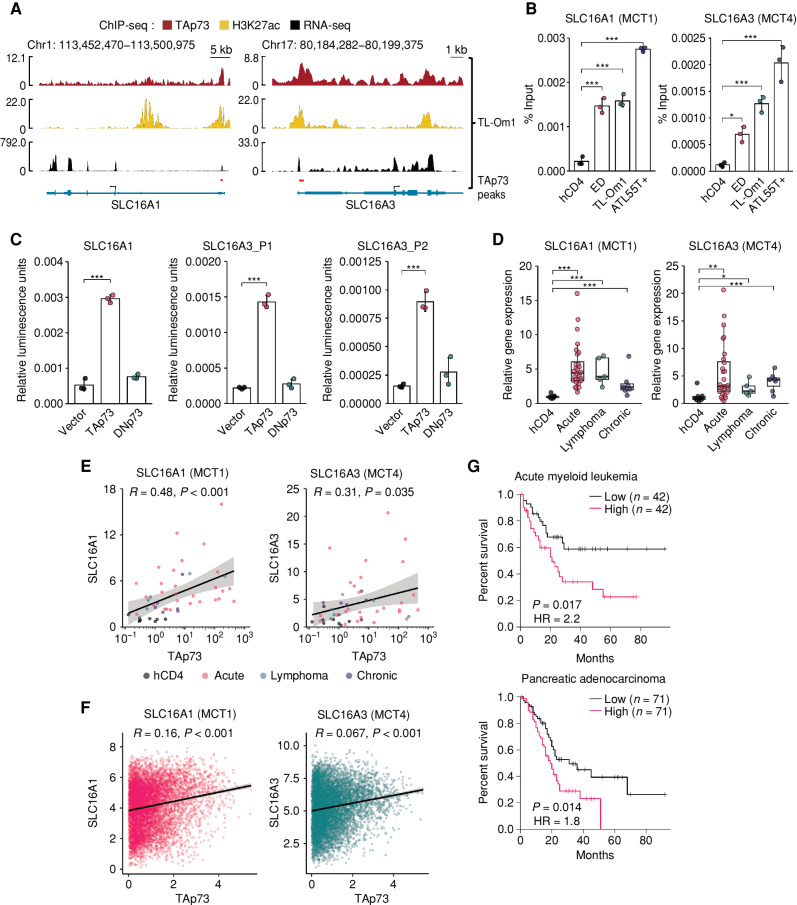
Figure 6. TAp73 upregulates both the SLC16A1 and SLC16A3 genes that encode lactate transporters. A, TAp73 and H3K27ac enrichments (ChIP-seq) and transcripts (RNA-seq) of the SLC16A1 (left) and SLC16A3 (right) genes in TL-Om1 cells. Peaks of TAp73 ChIP-seq are shown as red bars in both genes. B, ChIP-qPCR for TAp73 in the SLC16A1 (left) and SLC16A3 (right) promoter regions in ATL cell lines and healthy human donor CD4+ T cells (hCD4; n = 3). C, Promoter assays using the TP73 motif identified within the TAp73 peaks shown in A. Relative luciferase activities for the SLC16A1 promoter (left) and the SLC16A3 promoter (center and right) were examined with TP73 isoform expression in HEK293 cells. (n = 3). Schematics of the assay plasmids are shown in Supplementary Fig. S5A. D, mRNA expression of SLC16A1 (left) and SLC16A3 (right) measured by RT-qPCR in hCD4 cells (n = 8) and ATL patients (acute type, n = 28; lymphoma type, n = 5; chronic type, n = 7). E and F, Correlation between TAp73 expression and expression of SLC16A1 (left) or SLC16A3 (right) in hCD4 cells and ATL patients (E) and TCGA data (F). G, Overall survival of patients with TAp73, SLC16A1, and SLC16A3 high or low gene sets calculated by the GEPIA2 signature scoring (76) on TCGA data (RNA-seq). Group cutoff for splitting each cohort was set as 60% (high) and 40% (low). Statistical values of the log-rank test are shown with hazard ratio (HR). Results are plotted with mean ± SD, using one-way ANOVA with post hoc Dunnet (B and C) or Steel test (D). *, P < 0.05; **, P < 0.01; ***, P < 0.001; ns, not significant.
Figure 6.
TAp73 upregulates both the SLC16A1 and SLC16A3 genes that encode lactate transporters. A, TAp73 and H3K27ac enrichments (ChIP-seq) and transcripts (RNA-seq) of the SLC16A1 (left) and SLC16A3 (right) genes in TL-Om1 cells. Peaks of TAp73 ChIP-seq are shown as red bars in both genes. B, ChIP-qPCR for TAp73 in the SLC16A1 (left) and SLC16A3 (right) promoter regions in ATL cell lines and healthy human donor CD4+ T cells (hCD4; n = 3). C, Promoter assays using the TP73 motif identified within the TAp73 peaks shown in A. Relative luciferase activities for the SLC16A1 promoter (left) and the SLC16A3 promoter (center and right) were examined with TP73 isoform expression in HEK293 cells. (n = 3). Schematics of the assay plasmids are shown in Supplementary Fig. S5A. D, mRNA expression of SLC16A1 (left) and SLC16A3 (right) measured by RT-qPCR in hCD4 cells (n = 8) and ATL patients (acute type, n = 28; lymphoma type, n = 5; chronic type, n = 7). E and F, Correlation between TAp73 expression and expression of SLC16A1 (left) or SLC16A3 (right) in hCD4 cells and ATL patients (E) and TCGA data (F). G, Overall survival of patients with TAp73, SLC16A1, and SLC16A3 high or low gene sets calculated by the GEPIA2 signature scoring (76) on TCGA data (RNA-seq). Group cutoff for splitting each cohort was set as 60% (high) and 40% (low). Statistical values of the log-rank test are shown with hazard ratio (HR). Results are plotted with mean ± SD, using one-way ANOVA with post hoc Dunnet (B and C) or Steel test (D). *, P < 0.05; **, P < 0.01; ***, P < 0.001; ns, not significant.
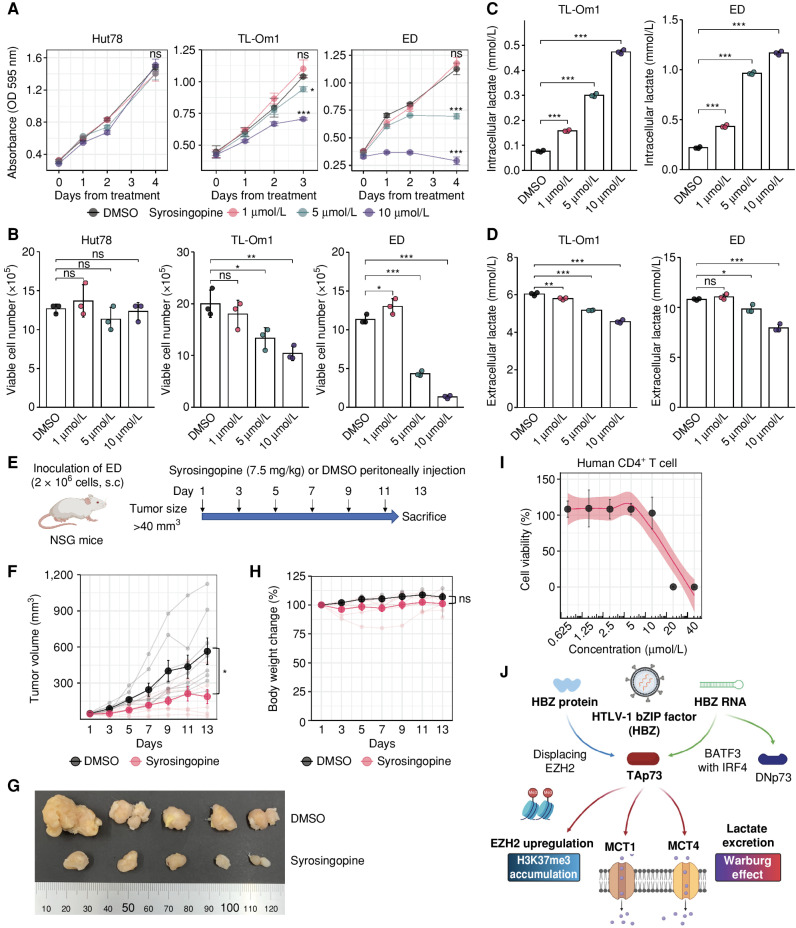
Figure 7. Efficacy of the MCT1/4 inhibitor syrosingopine on ATL cells. A and B, Cell proliferation assay (A) and viable cell numbers (B) for HTLV-1–unifected T cells (Hut78) or ATL cells (TL-Om1 and ED) treated with syrosingopine (1 μmol/L, 5 μmol/L and 10 μmol/L; n = 3). Values in comparison with the dimethyl sulfoxide (DMSO) group are shown. C and D, ATL cells expel less lactate when treated with syrosingopine. Lactate was examined intracellularly (C) or extracellularly (D) after 4 days of syrosingopine treatment. E–H, Therapeutic efficacy of syrosingopine in NOD/SCID/IL2Rgnull (NSG) mice after inoculation with ATL cells (ED). Experimental outline for the in vivo experiment to compare syrosingopine with DMSO (E). Tumor volumes were measured every 2 days in NSG mice treated with syrosingopine (n = 7) or DMSO (n = 8; F). Representative tumors resected from the mice are shown in G. Body weight changes of NSG mice treated with syrosingopine (n = 7) or DMSO (n = 4; H). I, Viability of human CD4+ T cells from healthy donors undergoing syrosingopine treatment (n = 3). J, Graphical summary of this study. HBZ protein and RNA both induce the Warburg effect and H3K27me3 accumulation by activating TAp73 expression. Results are plotted as mean ± SD, using one-way ANOVA with post hoc Dunnet test (A–D) or Student t test (F and H). *, P < 0.05; **, P < 0.01; ***, P < 0.001; ns, not significant. Created with BioRender.com.
Figure 7.
Efficacy of the MCT1/4 inhibitor syrosingopine on ATL cells. A and B, Cell proliferation assay (A) and viable cell numbers (B) for HTLV-1–unifected T cells (Hut78) or ATL cells (TL-Om1 and ED) treated with syrosingopine (1 μmol/L, 5 μmol/L and 10 μmol/L; n = 3). Values in comparison with the dimethyl sulfoxide (DMSO) group are shown. C and D, ATL cells expel less lactate when treated with syrosingopine. Lactate was examined intracellularly (C) or extracellularly (D) after 4 days of syrosingopine treatment. EH, Therapeutic efficacy of syrosingopine in NOD/SCID/IL2Rgnull (NSG) mice after inoculation with ATL cells (ED). Experimental outline for the in vivo experiment to compare syrosingopine with DMSO (E). Tumor volumes were measured every 2 days in NSG mice treated with syrosingopine (n = 7) or DMSO (n = 8; F). Representative tumors resected from the mice are shown in G. Body weight changes of NSG mice treated with syrosingopine (n = 7) or DMSO (n = 4; H). I, Viability of human CD4+ T cells from healthy donors undergoing syrosingopine treatment (n = 3). J, Graphical summary of this study. HBZ protein and RNA both induce the Warburg effect and H3K27me3 accumulation by activating TAp73 expression. Results are plotted as mean ± SD, using one-way ANOVA with post hoc Dunnet test (AD) or Student t test (F and H). *, P < 0.05; **, P < 0.01; ***, P < 0.001; ns, not significant. Created with BioRender.com.

References

    1. Hanahan D, Weinberg RA. Hallmarks of cancer: the next generation. Cell 2011;144:646–74. - PubMed
    1. Hanahan D. Hallmarks of cancer: new dimensions. Cancer Discov 2022;12:31–46. - PubMed
    1. Warburg O. On the origin of cancer cells. Science 1956;123:309–14. - PubMed
    1. Koppenol WH, Bounds PL, Dang CV. Otto Warburg's contributions to current concepts of cancer metabolism. Nat Rev Cancer 2011;11:325–37. - PubMed
    1. Satou Y, Yasunaga J, Yoshida M, Matsuoka M. HTLV-I basic leucine zipper factor gene mRNA supports proliferation of adult T cell leukemia cells. Proc Nat Acad Sci U S A 2006;103:720–5. - PMC - PubMed

Publication types

MeSH terms

Substances