


Incidence of Japanese Encephalitis and Acute Encephalitis Syndrome Hospitalizations in the Medium-Endemic Region in Central India
- PMID: 37162636
- PMCID: PMC10271976
- DOI: 10.1007/s44197-023-00110-7
Incidence of Japanese Encephalitis and Acute Encephalitis Syndrome Hospitalizations in the Medium-Endemic Region in Central India
Abstract
Background: We estimated the incidence of Japanese encephalitis (JE) and acute encephalitis syndrome (AES) following routine immunization with the live-attenuated SA 14-14-2 JE vaccine.
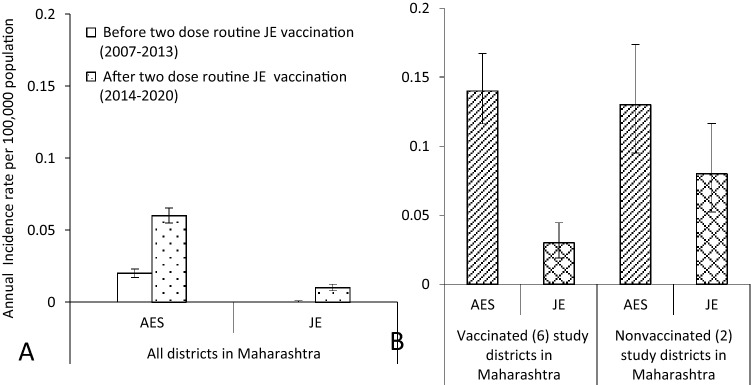
Methods: We implemented enhanced surveillance of AES and JE hospitalizations in endemic districts in Maharashtra and Telangana States during 2015-2016 and 2018-2020. We estimated incidence and compared differences in the incidence of JE and AES between two states, and vaccinated and unvaccinated districts during two study periods. We also considered secondary data from public health services to understand long-term trends from 2007 to 2020.
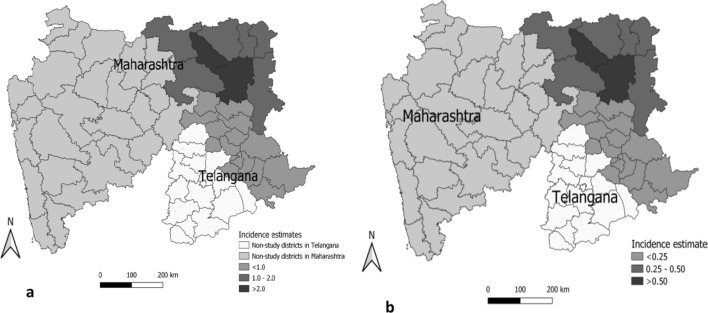
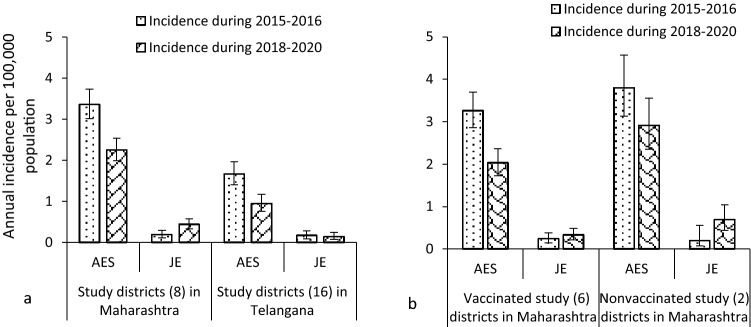
Results: The annual AES incidence rate of 2.25 cases per 100,000 children in Maharashtra during 2018-2020 was significantly lower than 3.36 cases per 100,000 children during 2015-2016. The six JE-vaccinated districts in Maharashtra had significantly lower incidence rates during 2018-2020 (2.03, 95% CI 1.73-2.37) than in 2015-16 (3.26, 2.86-3.70). In addition, the incidence of both JE and AES in two unvaccinated districts was higher than in the vaccinated districts in Maharashtra. Telangana had a lower incidence of both JE and AES than Maharashtra. The AES incidence rate of 0.95 (0.77-1.17) during 2018-2020 in Telangana was significantly lower than 1.67 (1.41-1.97) during 2015-2016.
Conclusions: The annual incidence rate of Japanese encephalitis was < 1 case per 100,000 children. It indicated accelerated control of Japanese encephalitis after routine immunization. However, the annual incidence of acute encephalitis syndrome was still > 1 case per 100,000 children. It highlights the need for improving surveillance and evaluating the impacts of vaccination.
Keywords: Central India; Hospitalization rates; Impact assessment; Incidence estimates; Infectious encephalitis; Japanese encephalitis.
© 2023. The Author(s).
Conflict of interest statement
None.
Figures

References
-
- European Centre for Disease Prevention and Control. Factsheet about Japanese encephalitis. https://www.ecdc.europa.eu/en/japanese-encephalitis/facts. Accessed 30 Sept 2022.
-
- National Vector Borne Diseases Control Programme. Directorate General of Health Services. Ministry of Health and Family Welfare, Government of India, New Delhi. https://nvbdcp.gov.in/index1.php?lang=1&level=1&sublinkid=5773&lid=3693. Accessed 30 Sept 2022.
-
- Vasanthapuram R, Shahul Hameed SK, Desai A, et al. Dengue virus is an under-recognised causative agent of acute encephalitis syndrome (AES): results from a four year AES surveillance study of Japanese encephalitis in selected states of India. Int J Infect Dis. 2019;84:S19–S24. doi: 10.1016/j.ijid.2019.01.008. - DOI - PubMed
Publication types
MeSH terms
Grants and funding
LinkOut - more resources
Full Text Sources
