[Preprint]. 2023 Apr 30:2023.04.30.538854.
doi: 10.1101/2023.04.30.538854.

Development of a nucleoside-modified mRNA vaccine against clade 2.3.4.4b H5 highly pathogenic avian influenza virus

Affiliations

Development of a nucleoside-modified mRNA vaccine against clade 2.3.4.4b H5 highly pathogenic avian influenza virus

Colleen Furey et al. bioRxiv. .

Update in

Abstract

Highly pathogenic avian influenza viruses from H5 clade 2.3.4.4b are circulating at unprecedently high levels in wild and domestic birds and have the potential to adapt to humans. We generated an mRNA lipid nanoparticle (LNP) vaccine encoding the hemagglutinin (HA) glycoprotein from a clade 2.3.4.4b H5 isolate. We show that the vaccine is immunogenic in mice and ferrets and prevents morbidity and mortality of ferrets following 2.3.4.4b H5N1 challenge.


Conflict of interest statement

Competing Interests S.E.H. and D.W. are co-inventors on patents that describe the use of nucleoside-modified mRNA as a platform to deliver therapeutic proteins and as a vaccine platform. S.H.Y.F. is an employee of Acuitas Therapeutics, a company focused on the development of lipid nanoparticulate nucleic acid delivery systems for therapeutic applications. The authors declare no other competing interests.

Figures
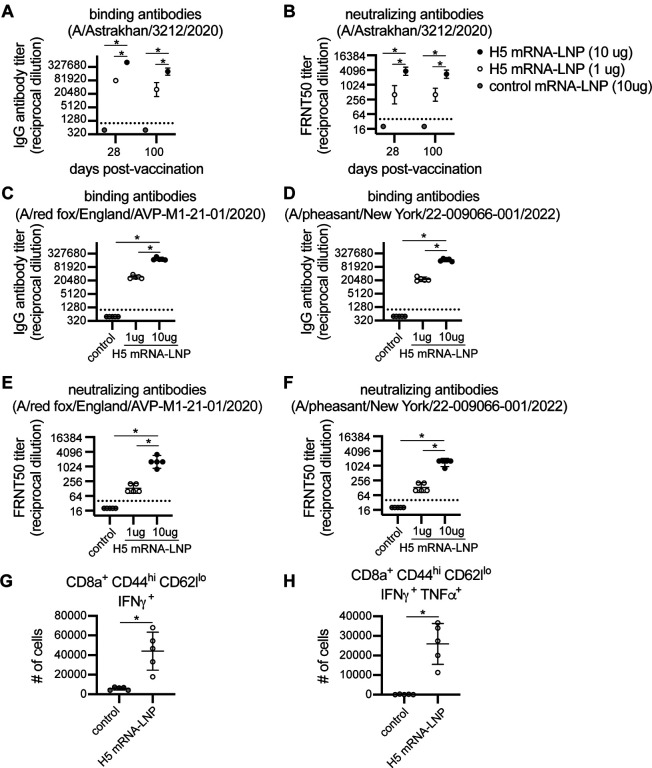
Figure 1.
Figure 1.. Clade 2.3.4.4b H5 HA mRNA-LNP vaccine induces humoral and cellular immune response in mice.
(A-F) Five mice were included per experimental group. Mice were vaccinated i.m. with 1 or 10 μg A/Astrakhan/3212/2020 HA mRNA-LNP or 10 μg Ovalbumin mRNA-LNP (control mRNA-LNP). (A-B) Serum samples were collected from mice at 28 and 100 days after vaccination. (A) Serum IgG titers reactive to A/Astrakhan/3212/2020 recombinant HA protein were quantified by ELISA. (B) A/Astrakhan/3212/2020 neutralizing antibodies were quantified; reciprocal dilutions of serum required to inhibit 50% virus infection are shown. (C-D) Serum samples collected 28 days after vaccination were tested by ELISA to quantify IgG reactive to A/red fox/England/AVP-M1–21-01/2020 or A/pheasant/New York/22–009066-001/2022 recombinant HA proteins. (E-F) A/red fox/England/AVPM1–21-01/2020 and A/pheasant/New York/22–009066-001/2022 neutralizing antibodies were quantified in serum samples collected 28 days after vaccination; reciprocal dilution of serum amounts required to inhibit 50% virus infection are shown. (G-H) Five mice per group were vaccinated i.m. with 1 μg A/Astrakhan/3212/2020 HA mRNA-LNP or 1 μg Ovalbumin mRNA-LNP (control mRNA-LNP). Spleens were harvested at 10 days after vaccination and splenocytes were incubated with H5 HA overlapping peptide pools before completing intracellular cytokine staining and flow cytometric analysis of CD8 T cells. Number of IFN-γ producing CD8+ T cells and IFN-γ and TFN-α producing CD8+ cells were quantified. All data are shown as geometric means ± 95% confidence intervals. Data in (A-F) were compared using one-way ANOVA with Tukey’s post hoc test. Values were log-transformed prior to statistical analysis. Data in (G-H) were compared using an unpaired two-tailed t test. Data are representative of 2 independent experiments. *P < 0.05
Figure 2.
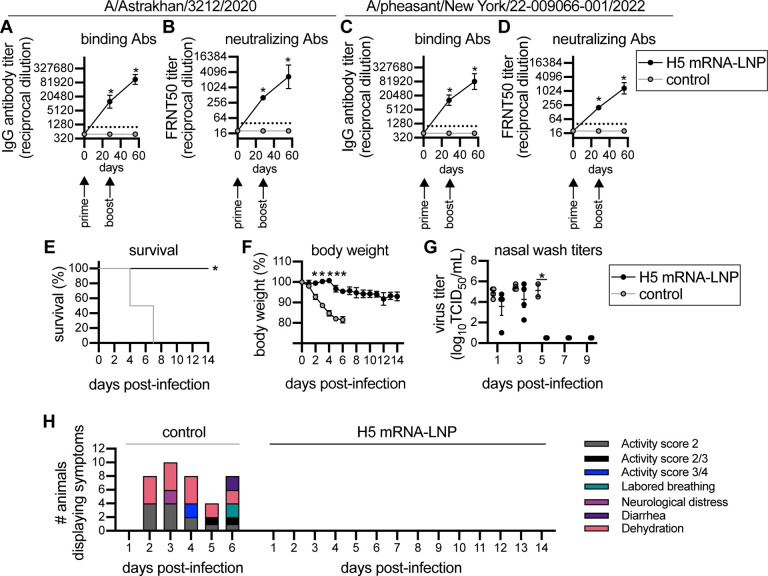
Figure 2.. H5 HA mRNA-LNP vaccine protects ferrets from clade 2.3.4.4b H5 virus infection.
Four ferrets per group were immunized with 60 μg A/Astrakhan/3212/2020 HA mRNA-LNP or Luciferase mRNA-LNP (control mRNA-LNP), followed by a 60 μg boost 28 days later. Ferrets were challenged with A/Bald eagle/North Carolina/ W22–140/2022 28 days after the second vaccination. Ferret serum samples were collected before vaccination and 28 days after each vaccination. (A-B) A/Astrakhan/3212/2020 and (C-D) A/pheasant/New York/22–009066-001/2022 serum IgG binding and neutralizing titers were quantified. Reciprocal dilutions of serum required to inhibit 50% virus infection are shown in panels (B) and (D). (E-F) Vaccinated ferrets were monitored for 14 days after i.n. infection with A/Bald eagle/North Carolina/ W22–140/2022. (E) Survival, (F) body weight, (G) virus titers in nasal wash samples, and (H) clinical scores are reported after infection. Data in (A-D) are shown as geometric means ± 95% confidence intervals and values were log-transformed prior to statistical analysis. Data in (F-G) are shown as means ± SEMs. Data in (A-D, F-G) were analyzed by mixed-model ANOVA with Greenhouse-Geisser correction and Sidak’s multiple comparisons test to compare differences with luciferase (control) mRNA immunization. For animals that died, their weight and viral titers on the day prior to death were carried forward for statistical analyses. Data in (E) were analyzed using a log rank test. *P<0.05.

References

    1. Group, W. O. F. H. N. E. W. Continued evolution of highly pathogenic avian influenza A (H5N1): updated nomenclature. Influenza and Other Respiratory Viruses 6, 1–5, (2012). - PMC - PubMed
    1. Lewis N. S. et al. Emergence and spread of novel H5N8, H5N5 and H5N1 clade 2.3.4.4 highly pathogenic avian influenza in 2020. Emerging Microbes & Infections 10, 148–151, (2021). - PMC - PubMed
    1. Verhagen J. H., Fouchier R. A. M. & Lewis N. Highly Pathogenic Avian Influenza Viruses at the Wild–Domestic Bird Interface in Europe: Future Directions for Research and Surveillance. Viruses 13, 212, (2021). - PMC - PubMed
    1. Global Consortium for H. N. & Related Influenza V. Role for migratory wild birds in the global spread of avian influenza H5N8. Science 354, 213–217, (2016). - PMC - PubMed
    1. Lycett S. J. et al. Genesis and spread of multiple reassortants during the 2016/2017 H5 avian influenza epidemic in Eurasia. Proc Natl Acad Sci U S A 117, 20814–20825, (2020). - PMC - PubMed

Publication types