This is a preprint.
Suboptimal Sleep Duration is Associated with Poorer Neuroimaging Brain Health Profiles
- PMID: 37162933
- PMCID: PMC10168497
- DOI: 10.1101/2023.04.20.23288891
Suboptimal Sleep Duration is Associated with Poorer Neuroimaging Brain Health Profiles
Update in
-
Suboptimal Sleep Duration Is Associated With Poorer Neuroimaging Brain Health Profiles in Middle-Aged Individuals Without Stroke or Dementia.J Am Heart Assoc. 2024 Jan 2;13(1):e031514. doi: 10.1161/JAHA.123.031514. Epub 2023 Dec 29. J Am Heart Assoc. 2024. PMID: 38156552 Free PMC article.
Abstract
Background: Cardiovascular health optimization during middle age benefits brain health. The American Heart Association's Life's Simple 7 recently added sleep duration as a key determinant of cardiovascular health becoming the Life's Essential 8. We tested the hypothesis that suboptimal sleep duration is associated with poorer neuroimaging brain health profiles in asymptomatic middle-aged adults.
Methods: We conducted a prospective MRI neuroimaging study in middle-aged persons without stroke, dementia, or multiple sclerosis enrolled in the UK Biobank. Self-reported sleep duration was categorized as short (<7 hours), optimal (7-<9 hours), or long (≥9 hours). Evaluated neuroimaging markers of brain health included white matter hyperintensities (presence and volume) and diffusion tensor imaging metrics (fractional anisotropy and mean diffusivity) evaluated in 48 distinct neuroanatomical regions. We used multivariable logistic and linear regression models, as appropriate, to test for association between sleep duration and neuroimaging markers of brain health.
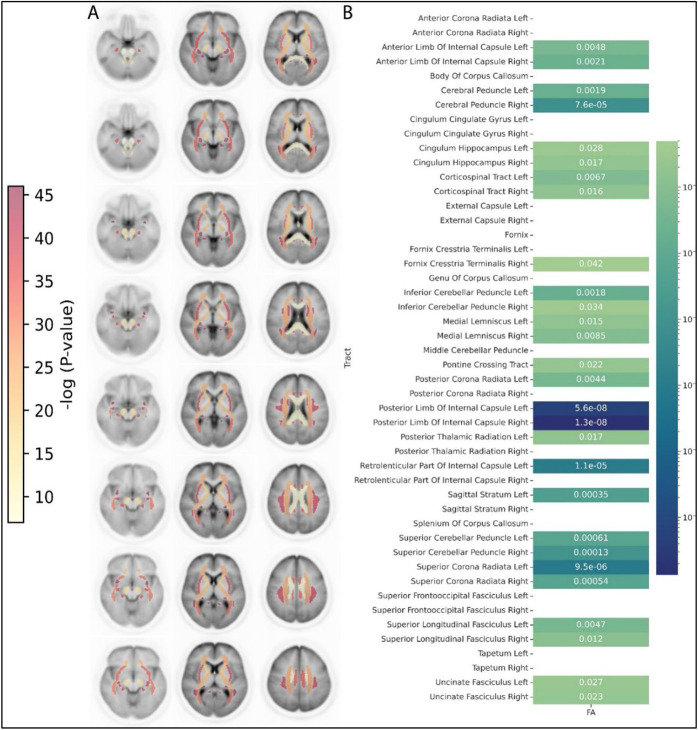
Results: We evaluated 39,502 middle-aged persons (mean age 55, 53% female). Of these, 28,712 (72.7%) had optimal, 8,422 (21.3%) short, and 2,368 (6%) long sleep. Compared to optimal sleep, short sleep was associated with higher risk (OR 1.11; 95% CI 1.05-1.17; P<0.001) and larger volume (beta=0.06, SE=0.01; P<0.001) of white matter hyperintensities, while long sleep was associated with higher volume (beta=0.04, SE=0.02; P=0.01) but not higher risk (P>0.05) of white matter hyperintensities. Short (beta=0.03, SE=0.01; P=0.004) and long sleep (beta=0.07, SE=0.02; P<0.001) were associated with worse fractional anisotropy, while only long sleep associated with worse mean diffusivity (beta=0.05, SE=0.02; P=0.005).
Conclusions: Among middle-aged adults without clinically observed neurological disease, suboptimal sleep duration is associated with poorer neuroimaging brain health profiles. Because the evaluated neuroimaging markers precede stroke and dementia by several years, our findings support early interventions aimed at correcting this modifiable risk factor.
Keywords: Brain health; Diffusion tensor imaging; Sleep; White matter hyperintensities.
Figures
References
-
- Lloyd-Jones DM, Allen NB, Anderson CAM, et al. Life’s Essential 8: Updating and Enhancing the American Heart Association’s Construct of Cardiovascular Health: A Presidential Advisory From the American Heart Association. Circulation. 2022;146(5):e18–e43. doi:10.1161/CIR.0000000000001078 - DOI - PMC - PubMed
-
- Defining Optimal Brain Health in Adults: A Presidential Advisory From the American Heart Association/American Stroke Association ∣ Stroke. Accessed December 20, 2022. https://www.ahajournals.org/doi/full/10.1161/STR.0000000000000148 - DOI - PMC - PubMed
Publication types
Grants and funding
LinkOut - more resources
Full Text Sources