Racial Inequality in Receipt of Medications for Opioid Use Disorder
- PMID: 37163624
- PMCID: PMC10243223
- DOI: 10.1056/NEJMsa2212412
Racial Inequality in Receipt of Medications for Opioid Use Disorder
Abstract
Background: Since 2010, Black persons in the United States have had a greater increase in opioid overdose-related mortality than other groups, but national-level evidence characterizing racial and ethnic disparities in the use of medications for opioid use disorder (OUD) is limited.
Methods: We used Medicare claims data from the 2016-2019 period for a random 40% sample of fee-for-service beneficiaries who were Black, Hispanic, or White; were eligible for Medicare owing to disability; and had an index event related to OUD (nonfatal overdose treated in an emergency department or inpatient setting, hospitalization with injection drug use-related infection, or inpatient or residential rehabilitation or detoxification care). We measured the receipt of medications to treat OUD (buprenorphine, naltrexone, and naloxone), the receipt of high-risk medications (opioid analgesics and benzodiazepines), and health care utilization, all in the 180 days after the index event. We estimated differences in outcomes according to race and ethnic group with adjustment for beneficiary age, sex, index event, count of chronic coexisting conditions, and state of residence.
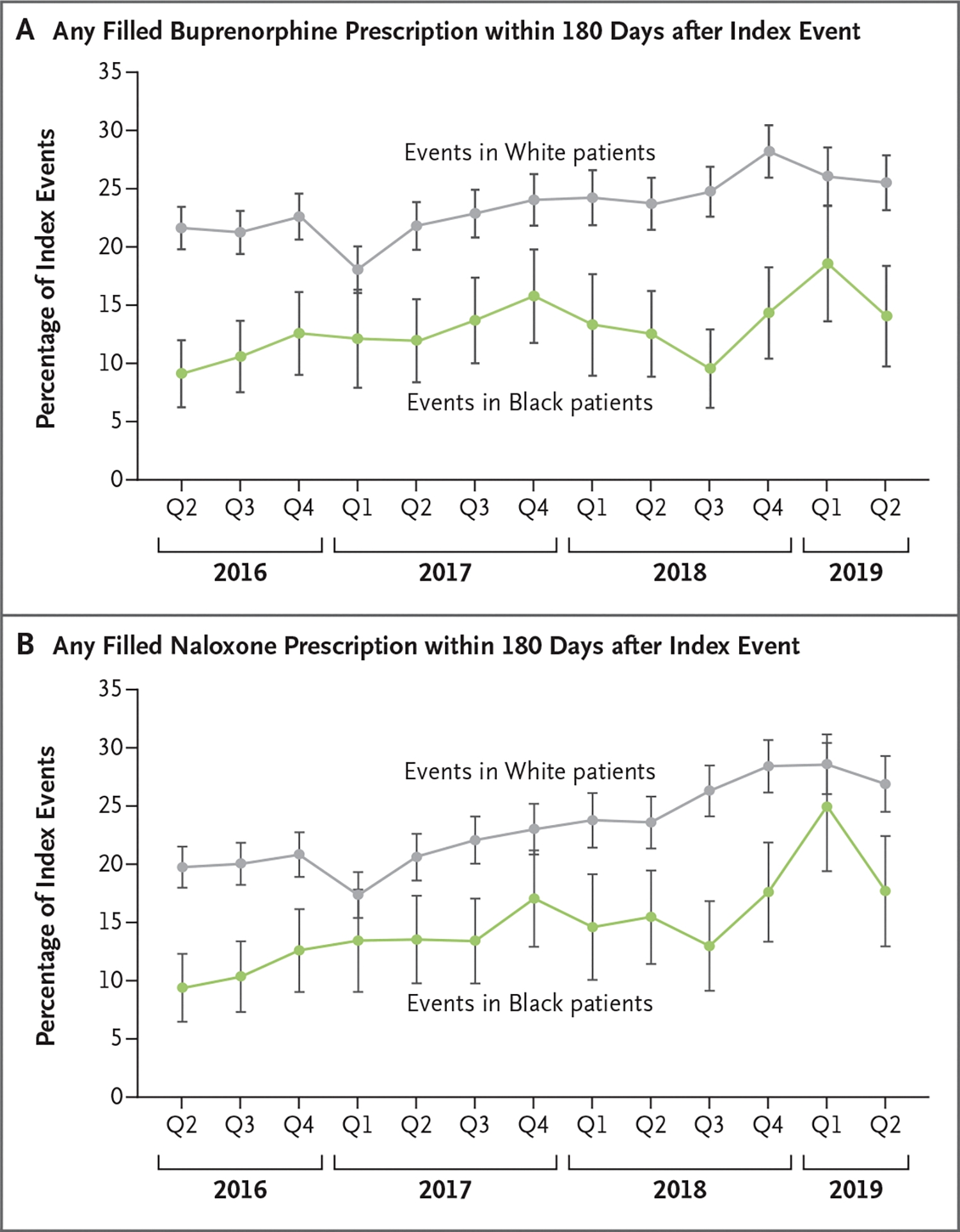
Results: We identified 25,904 OUD-related index events among 23,370 beneficiaries, with 3937 events (15.2%) occurring among Black patients, 2105 (8.1%) among Hispanic patients, and 19,862 (76.7%) among White patients. In the 180 days after the index event, patients received buprenorphine after 12.7% of events among Black patients, after 18.7% of those among Hispanic patients, and after 23.3% of those among White patients; patients received naloxone after 14.4%, 20.7%, and 22.9%, respectively; and patients received benzodiazepines after 23.4%, 29.6%, and 37.1%, respectively. Racial differences in the receipt of medications to treat OUD did not change appreciably from 2016 to 2019 (buprenorphine receipt: after 9.1% of index events among Black patients vs. 21.6% of those among White patients in 2016, and after 14.1% vs. 25.5% in 2019). In all study groups, patients had multiple ambulatory visits in the 180 days after the index event (mean number of visits, 6.6 after events among Black patients, 6.7 after events among Hispanic patients, and 7.6 after events among White patients).
Conclusions: Racial and ethnic differences in the receipt of medications to treat OUD after an index event related to this disorder among patients with disability were substantial and did not change over time. The high incidence of ambulatory visits in all groups showed that disparities persisted despite frequent health care contact. (Funded by the National Institute on Drug Abuse and the National Institute on Aging.).
Copyright © 2023 Massachusetts Medical Society.
Figures
References
-
- Centers for Disease Control and Prevention. U.S. overdose deaths in 2021 increased half as much as in 2020 — but are still up 15%. May 11, 2022. (https://www.cdc.gov/nchs/pressroom/nchs_press_releases/2022/202205.htm).
-
- KFF. Opioid overdose deaths by race/ethnicity. May 9, 2022. (https://www.kff.org/other/state-indicator/opioid-overdose-deaths-by-race...).
-
- Ma J, Bao Y-P, Wang R-J, et al. Effects of medication-assisted treatment on mortality among opioids users: a systematic review and meta-analysis. Mol Psychiatry 2019;24:1868–83. - PubMed
Publication types
MeSH terms
Substances
Grants and funding
LinkOut - more resources
Full Text Sources
Medical