


Rabies in Southeast Asia: a systematic review of its incidence, risk factors and mortality
- PMID: 37164462
- PMCID: PMC10173986
- DOI: 10.1136/bmjopen-2022-066587
Rabies in Southeast Asia: a systematic review of its incidence, risk factors and mortality
Abstract
Objective: Rabies is a neglected zoonotic disease that can infect all mammals, including humans. We aimed to summarise the current knowledge of the incidence, risk factors and mortality of rabies in Southeast Asia.
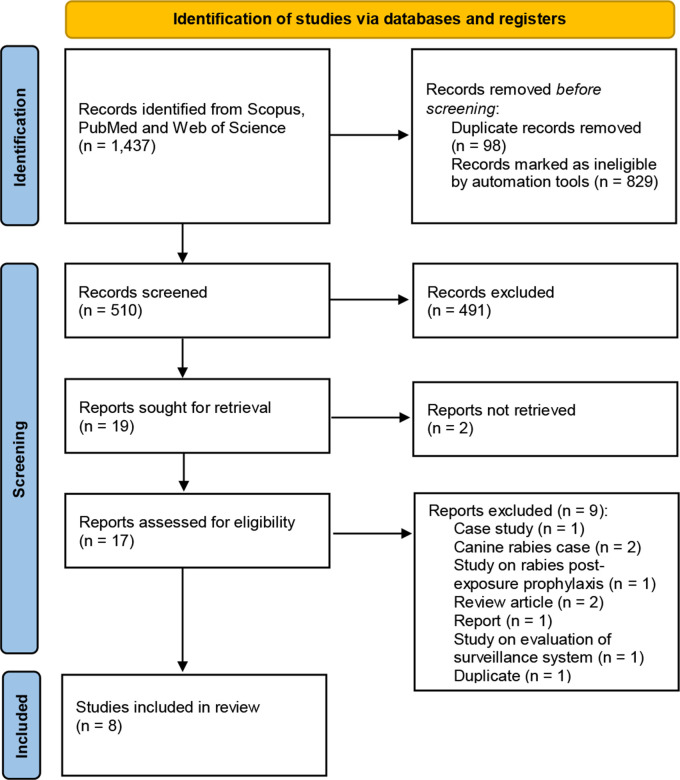
Design: Systematic review based on the Preferred Reporting Items for Systematic Reviews and Meta-Analyses 2020.
Data sources: Scopus, Web of Science and PubMed were searched from 1 January 2012 to 21 February 2023.
Eligibility criteria: Original English language articles published between 2012 and 2023 were included.
Data extraction and synthesis: Nine independent reviewers extracted data and assessed the risk of bias. The quality appraisal of included articles was carried out using the Mixed Methods Appraisal Tool.
Results: A total of eight articles were included in this analysis. In Vietnam, the incidence of rabies ranged from 1.7 to 117.2 per 100 000 population. The cumulative incidence in Sarawak was estimated at 1.7 per 100 000 population. In Indonesia, 104 human rabies cases were reported from 2008 to 2010, while in Thailand, a total of 46 rabies cases were reported in Thailand from 2010 to 2015. In the Philippines, the incidence of rabies ranged from 0.1 to 0.3 per 100 000 population. An increased risk of rabies virus infection was associated with a high population density, illiteracy, seasonal patterns and dog butchers. The case fatality rate was 100%.
Conclusion: This study included research from Southeast Asia, which may not represent rabies infection in other regions or continents. In addition, the role of publication bias should be acknowledged as grey literature was not included. The occurrence of rabies in Southeast Asia is due to the high number of unvaccinated stray and pet dogs, working hazards (dog butchers in Vietnam), the unavailability of the rabies vaccine in rural regions and misinformation about the significance of seeking treatment after dog bites.
Prospero registration number: CRD42022311654.
Keywords: epidemiology; public health; systematic review.
© Author(s) (or their employer(s)) 2023. Re-use permitted under CC BY-NC. No commercial re-use. See rights and permissions. Published by BMJ.
Conflict of interest statement
Competing interests: None declared.
Figures
References
-
- World Health Organization . WHO fact sheets: Rabies [Internet]. 2021. Available: https://www.who.int/news-room/fact-sheets/detail/rabies
-
- World Health Organization . WHO expert consultation on rabies second report. World Health Organ Tech Rep Ser 2013:1–139. - PubMed
-
- World Health Organization . WHO expert consultation on rabies: third report. 2018.
Publication types
MeSH terms
Substances
LinkOut - more resources
Full Text Sources
Medical
