Review
. 2023 May 10;13(1):81.
doi: 10.1186/s13578-023-01031-5.

NAD+ metabolism-based immunoregulation and therapeutic potential

Affiliations
Review

NAD+ metabolism-based immunoregulation and therapeutic potential

Jiankai Fang et al. Cell Biosci. .

Abstract

Nicotinamide adenine dinucleotide (NAD+) is a critical metabolite that acts as a cofactor in energy metabolism, and serves as a cosubstrate for non-redox NAD+-dependent enzymes, including sirtuins, CD38 and poly(ADP-ribose) polymerases. NAD+ metabolism can regulate functionality attributes of innate and adaptive immune cells and contribute to inflammatory responses. Thus, the manipulation of NAD+ bioavailability can reshape the courses of immunological diseases. Here, we review the basics of NAD+ biochemistry and its roles in the immune response, and discuss current challenges and the future translational potential of NAD+ research in the development of therapeutics for inflammatory diseases, such as COVID-19.

Keywords: Disease therapy; Immunoregulation; Metabolic homeostasis; Nicotinamide adenine dinucleotide (NAD+); Plasticity.


Conflict of interest statement

The authors declare no competing interests.

Figures
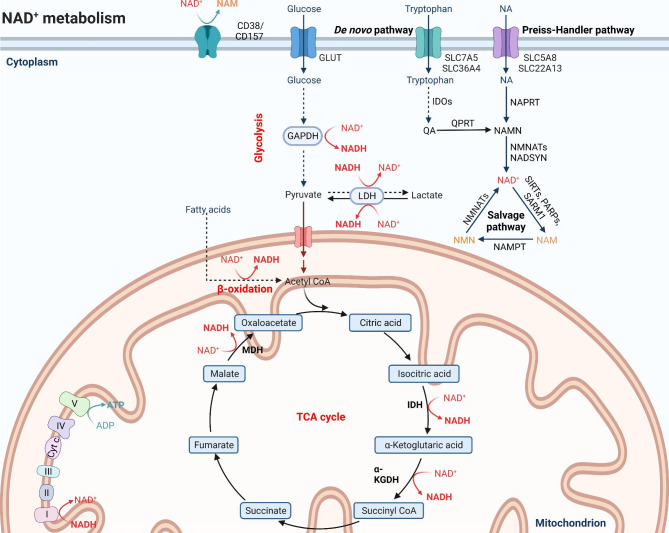
Fig. 1
Fig. 1
NAD+ metabolism. NAD+ levels are maintained by three independent biosynthetic pathways. The de novo synthesis pathway converts tryptophan to quinolinic acid (QA) via a series of enzymatic steps, in which indoleamine-2,3-dioxygenase (IDO) is a rate-limiting enzyme that catalyzes the first step and the conversion of QA to nicotinate mononucleotide (NAMN) is the ultimate bottleneck step catalyzed by quinolinate phosphoribosyltransferase (QPRT). The Preiss-Handler pathway uses dietary nicotinic acid (NA) to generate NAMN through nicotinate phosphoribosyltransferase (NAPRT). NAMN is converted to NAD+ by the sequential actions of nicotinamide mononucleotide adenylyl transferases (NMNATs) and NAD+ synthetase (NADSYN). The NAD+ salvage pathway recycles nicotinamide (NAM) generated as a by-product of the enzymatic activities of NAD+-consuming proteins (sirtuins, poly(ADP-ribose) polymerases (PARPs) and the NAD+ glycohydrolases CD38, CD157 and SARM1), into nicotinamide mononucleotide (NMN) via the rate-limiting enzyme NAM phosphoribosyltransferase (NAMPT). NMN is then converted into NAD+ via the different NMNATs. These renascent NAD+ receives a hydride to yield the reduced form NADH, thereby driving various metabolic processes including glycolysis, the tricarboxylic acid (TCA) cycle and β-oxidation of fatty acids. On the contrary, NADH provides an electron pair to drive oxidative phosphorylation (OXPHOS) for the generation of ATP in the mitochondria and the conversion of lactate to pyruvate in the cytoplasm, which are accompanied by intracellular NAD+ regeneration.
Fig. 2
Fig. 2
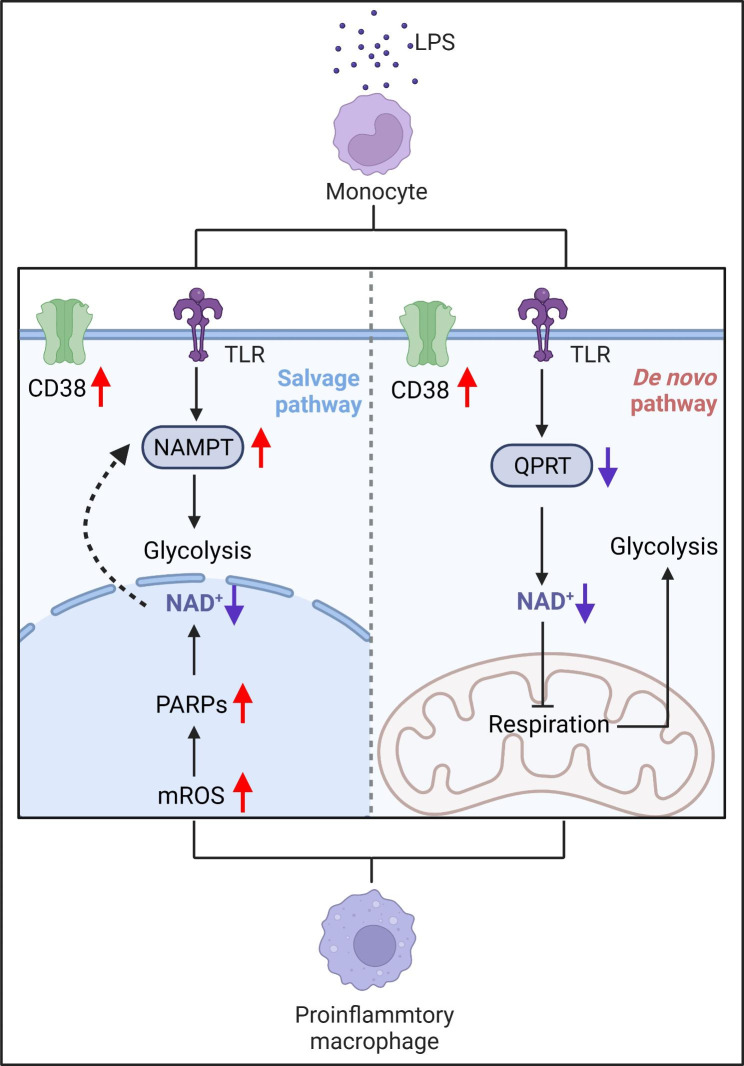
NAD+ regulates macrophage polarization. LPS challenge induces the generation of mitochondrial reactive oxygen species (mROS). This increase in ROS results in DNA damage and subsequent PARP activation, which consume NAD+ to repair damaged DNA and maintain genomic integrity. The NAD+ salvage pathway replenishes the NAD+ pools through increased NAMPT expression, thus initiating glycolytic reaction and programming pro-inflammatory macrophage polarization. In another context, diminished NAD+ levels are attributed to decreased QPRT expression in the de novo synthesis pathway. Low NAD+ concentration impairs mitochondrial respiration, thus inversely increasing glycolysis and facilitating inflammatory responses of macrophages. In addition, CD38 acts as another important NAD+-consuming enzyme during pro-inflammatory macrophage polarization.
Fig. 3
Fig. 3
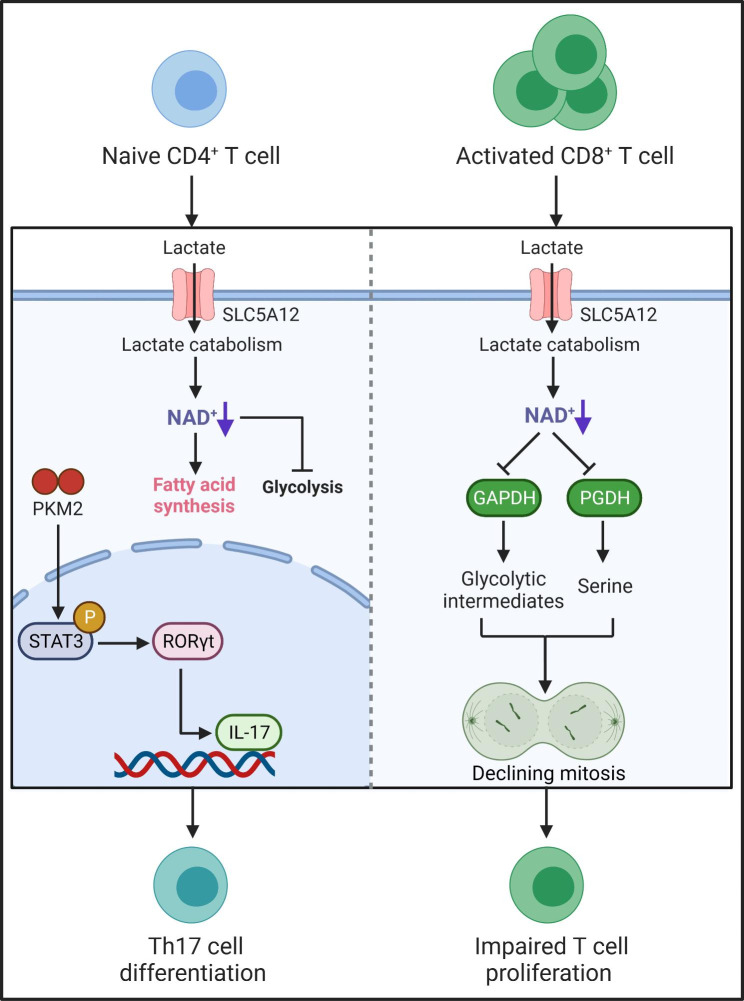
NAD+ regulates T cell fates through environmental lactate. SLC5A12-mediated lactate uptake into CD4+ T cells in the inflamed tissue reshapes their effector phenotypes, resulting in RORγt activation and subsequent IL-17 transcription via nuclear PKM2/STAT3 and enhanced fatty acid synthesis. It also leads to these renascent Th17 cell retention in the inflamed tissue as a result of reduced glycolysis and enhanced fatty acid synthesis. On the other hand, the continuous lactate catabolism through lactate dehydrogenase consumes amounts of NAD+ contents. The insufficient NAD+ pools cannot sustain NAD+-dependent enzymatic reactions involving glyceraldehyde 3-phosphate dehydrogenase (GAPDH) and 3-phosphoglycerate dehydrogenase (PGDH). The dysfunction of GAPDH and PGDH leads to the depletion of post-GAPDH glycolytic intermediates and the 3-phosphoglycerate derivative serine that are important fuels for T cell proliferation. The environmental lactate eventually suppresses effector T cell proliferation.

References

    1. Rajman L, Chwalek K, Sinclair DA. Therapeutic potential of NAD-Boosting molecules: the in vivo evidence. Cell Metab. 2018;27:529–47. doi: 10.1016/j.cmet.2018.02.011. - DOI - PMC - PubMed
    1. Garten A, Schuster S, Penke M, Gorski T, de Giorgis T, Kiess W. Physiological and pathophysiological roles of NAMPT and NAD metabolism. Nat Rev Endocrinol. 2015;11:535–46. doi: 10.1038/nrendo.2015.117. - DOI - PubMed
    1. Zapata-Perez R, Wanders RJA, van Karnebeek CDM, Houtkooper RH. NAD(+) homeostasis in human health and disease. EMBO Mol Med. 2021;13:e13943. doi: 10.15252/emmm.202113943. - DOI - PMC - PubMed
    1. Meyerhof O. Further studies on the Harden-Young effect in alcoholic fermentation of yeast preparations. J Biol Chem. 1949;180:575–86. doi: 10.1016/S0021-9258(18)56676-X. - DOI - PubMed
    1. Imai S, Armstrong CM, Kaeberlein M, Guarente L. Transcriptional silencing and longevity protein Sir2 is an NAD-dependent histone deacetylase. Nature. 2000;403:795–800. doi: 10.1038/35001622. - DOI - PubMed