


Neuroinflammation in Alzheimer's disease: microglial signature and their relevance to disease
- PMID: 37165437
- PMCID: PMC10170691
- DOI: 10.1186/s41232-023-00277-3
Neuroinflammation in Alzheimer's disease: microglial signature and their relevance to disease
Abstract
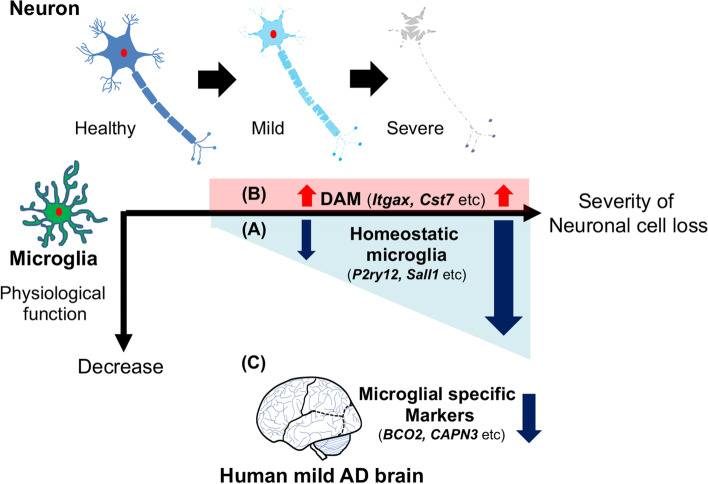
Alzheimer's disease (AD) is the most common form of dementia, pathologically characterized by senile plaques and neurofibrillary tangles (NFTs), resulting in neurodegeneration. Neuroinflammation, defined as the activation of glial cells such as microglia and astrocytes, is observed surrounding senile plaques and affected neurons in AD. Recently conducted genome-wide association studies (GWAS) indicate that a large section of identified AD risk genes are involved in immune responses and are enriched in microglia. Microglia are innate immune cells in the central nervous system (CNS), which are involved in immune surveillance and maintenance of homeostasis in the CNS. Recently, a novel subpopulation of activated microglia named as disease-associated microglia (DAM), also known as activated response microglia (ARM) or microglial neurodegenerative phenotype (MGnD), was identified in AD model mice. These microglia closely associate with β-amyloid (Aβ) plaques and exhibit characteristic gene expression profiles accompanied with reduced expressions of homeostatic microglial genes. However, it remains unclear whether decreased homeostatic microglia functions or increased DAM/ARM/MGnD functions correlate with the degree of neuronal loss in AD. To translate the results of rodent studies to human AD, precuneus, the brain region vulnerable to β-amyloid accumulation in preclinical AD, is of high interest, as it can provide novel insights into the mechanisms of microglia response to Aβ in early AD. In this study, we performed comparative analyses of gene expression profiles of microglia among three representative neurodegenerative mouse models and the human precunei with early AD pathology. We proceeded to evaluate the identified genes as potential therapeutic targets for AD. We believe that our findings will provide important resources to better understand the role of glial dysfunction in AD.
Keywords: Alzheimer's disease; Disease-associated microglia; Homeostatic microglia; Neuroinflammation; Precuneus.
© 2023. The Author(s).
Conflict of interest statement
The authors declare that they have no competing interests.
Figures
References
-
- Bis JC, Jian X, Kunkle BW, Chen Y, Hamilton-Nelson KL, Bush WS, Salerno WJ, Lancour D, Ma Y, Renton AE, et al. Whole exome sequencing study identifies novel rare and common Alzheimer’s-associated variants involved in immune response and transcriptional regulation. Mol Psychiatry. 2020;25(8):1859–1875. doi: 10.1038/s41380-018-0112-7. - DOI - PMC - PubMed
Publication types
Grants and funding
LinkOut - more resources
Full Text Sources
