Review
. 2023 Oct 25;14(10):762-775.
doi: 10.1093/procel/pwad026.

The microbiota-gut-brain axis and neurodevelopmental disorders

Affiliations
Review

The microbiota-gut-brain axis and neurodevelopmental disorders

Qinwen Wang et al. Protein Cell. .

Abstract

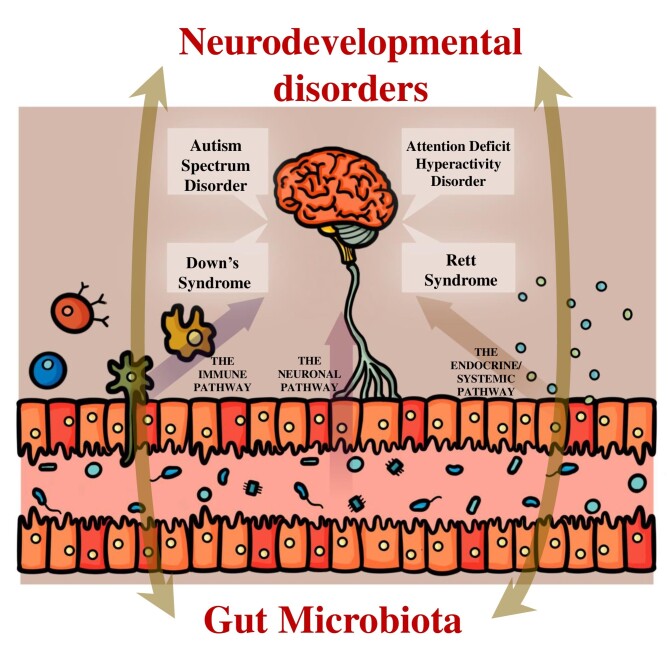
The gut microbiota has been found to interact with the brain through the microbiota-gut-brain axis, regulating various physiological processes. In recent years, the impacts of the gut microbiota on neurodevelopment through this axis have been increasingly appreciated. The gut microbiota is commonly considered to regulate neurodevelopment through three pathways, the immune pathway, the neuronal pathway, and the endocrine/systemic pathway, with overlaps and crosstalks in between. Accumulating studies have identified the role of the microbiota-gut-brain axis in neurodevelopmental disorders including autism spectrum disorder, attention deficit hyperactivity disorder, and Rett Syndrome. Numerous researchers have examined the physiological and pathophysiological mechanisms influenced by the gut microbiota in neurodevelopmental disorders (NDDs). This review aims to provide a comprehensive overview of advancements in research pertaining to the microbiota-gut-brain axis in NDDs. Furthermore, we analyzed both the current state of research progress and discuss future perspectives in this field.

Keywords: brain axis; gut; gut microbiome; microbiota; neurodevelopmental disorders.


Conflict of interest statement

The authors declare no conflicts of interest.

Figures
Graphical Abstract
Graphical Abstract
Figure 1.
Figure 1.
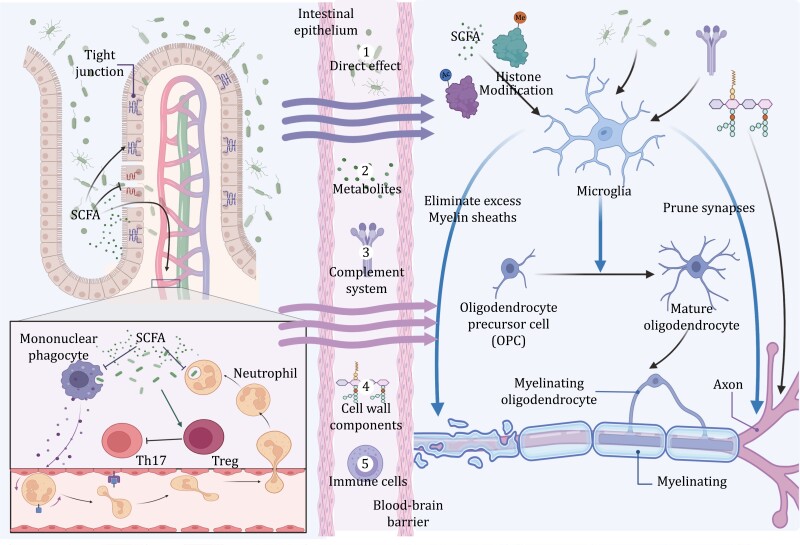
The immune pathway. Along the immune pathway, the gut microbiota regulates the brain by the bacteria themselves, microbial-derived metabolites (e.g., SCFAs, secondary bile acids, and amino acid metabolites), bacterial cell wall components (e.g., peptidoglycan, LPS), as well as microbial-intrigued immune cells and their secretory factors. The gut microbiota modulates enteric immunity in terms of the intestinal barrier, peripheral immune cells, and cytokines. For example, SCFAs derived by the gut microbiota seem to maintain a symbiotic relationship with the host by suppressing immune responses and protecting commensal bacteria from elimination, while also enhancing enteric barriers and reduce gut permeability to prevent invasion by harmful microorganisms. Proofs are that SCFAs have restrictive effects on neutrophil chemotaxis and mononuclear phagocyte system, promoting effect on regulatory T cells (Treg cells) and SCFAs can alleviate gut epithelium injury and regulate tight junctions. Meanwhile, in the CNS, microglia act as an important agent in neurodevelopment through their functions of synaptic pruning, neural progenitor cells (NPCs) pool supervision, neurogenesis regulation, etc. The gut microbiota affects microglia from different ways, exerting considerable effects on the neurodevelopmental process.
Figure 2.
Figure 2.
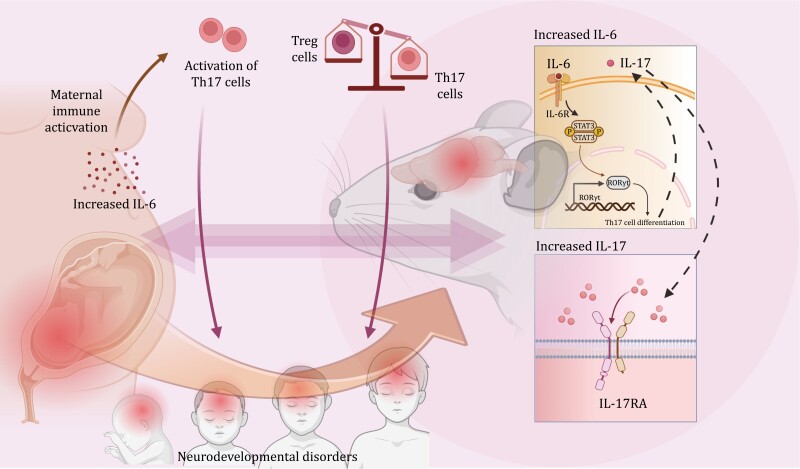
Maternal immune activation. MIA is associated with an increased risk of NDDs in the fetuses. One of the important cytokines for MIA is IL-17, which is produced mainly by Th17 cells. The gut microbiota is able to affect IL-17a levels and mucosal immunity as a whole by regulating the balance between Th17 cells and Treg cells. Besides, the production of IL-17 is also stimulated by elevated IL-6 levels during inflammation in pregnant females. Based on evidence from animal models, inside the CNS, IL17RA is located predominantly in the cortical neurons of S1DZ and elevated IL-17a levels lead to overactivation in these neurons, which then induces abnormalities in terms of social behaviors in MIA offsprings. Another important cytokine is IL-6. IL-6 not only affects the activation of Th17 cells, as is discussed above, but also affects neurons themselves by inducing transcriptional synaptogenesis through STAT3-dependent production of RGS4, which increase glutamatergic synapse density and disrupt hippocampal connectivity.
Figure 3.
Figure 3.
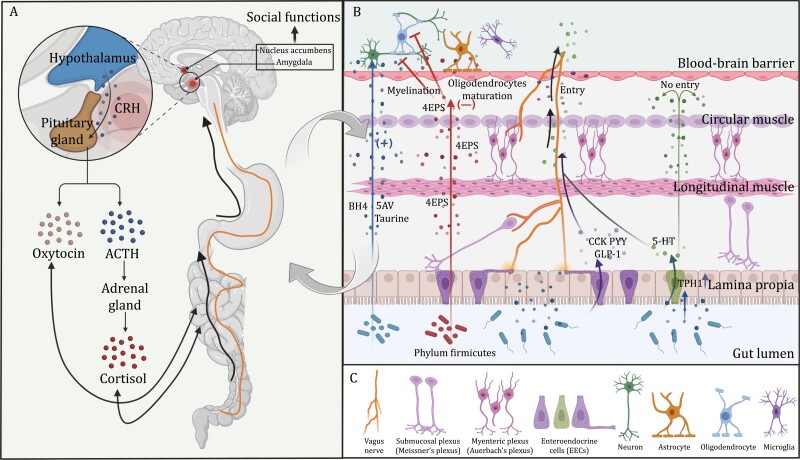
The endocrine (systemic) pathway and the neuronal pathway. (A) The HN axis and the HPA axis play an important role in the endocrine (systemic) pathway. The neuropeptide oxytocin acts as an important component of the HN axis, modulates the interplay within the serotonergic system in the nucleus accumbens and the marginal activity in the amygdala, thus regulating social functions. Along the HPA axis, peripheral cortisol levels have been found to be significantly higher in patients with ASD and bacterial species, such as Enterococcus faecalis, inhibit the elevated glucocorticoid levels after social stress and promote social behaviors in mice, indicating that the gut microbiota is capable of influencing HPA axis. (B) The gut microbiota can produce neuroactive molecules (e.g., 5AV, taurine, and 4EPS) directly and these molecules have diverse effects on neurodevelopment processes (i.e., myelination, oligodendrocytes maturation). The gut microbiota also regulates the production of 5-HT in ECCs. However, metabolites like 5-HT cannot across the blood–brain barrier without the vagus nerve. Microbial-derived metabolites and other substances not only interact with the vagus nerve but also impact the ENS and the intestinal mechanosensory. The vagus nerve is an important agent between the endocrine (systemic) pathway and the neuronal pathway.

References

    1. Aarts E, Ederveen THA, Naaijen Jet al. Gut microbiome in ADHD and its relation to neural reward anticipation. PLoS One 2017a;12:e0183509. - PMC - PubMed
    1. Aarts E, Ederveen THA, Naaijen Jet al. Gut microbiome in ADHD and its relation to neural reward anticipation. PLoS One 2017b;12:e0183509. - PMC - PubMed
    1. Agirman G, Hsiao EY.. SnapShot: the microbiota-gut-brain axis. Cell 2021;184:2524–2524.e1. - PubMed

    1. Agustí A, García-Pardo MP, López-Almela Iet al. Interplay between the gut-brain axis, obesity and cognitive function. Front Neurosci 2018;12:155. - PMC - PubMed
    1. Alemi F, Poole DP, Chiu Jet al. The receptor TGR5 mediates the prokinetic actions of intestinal bile acids and is required for normal defecation in mice. Gastroenterology 2013;144:145–154. - PMC - PubMed

Publication types