


SELENOP modifies sporadic colorectal carcinogenesis and WNT signaling activity through LRP5/6 interactions
- PMID: 37166989
- PMCID: PMC10313376
- DOI: 10.1172/JCI165988
SELENOP modifies sporadic colorectal carcinogenesis and WNT signaling activity through LRP5/6 interactions
Abstract
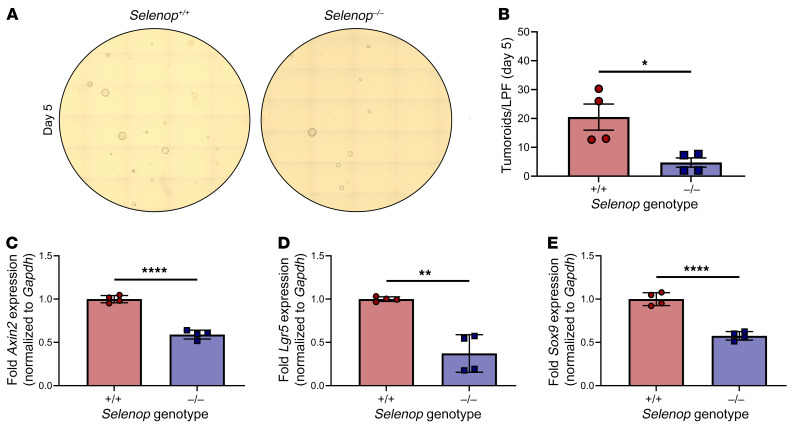
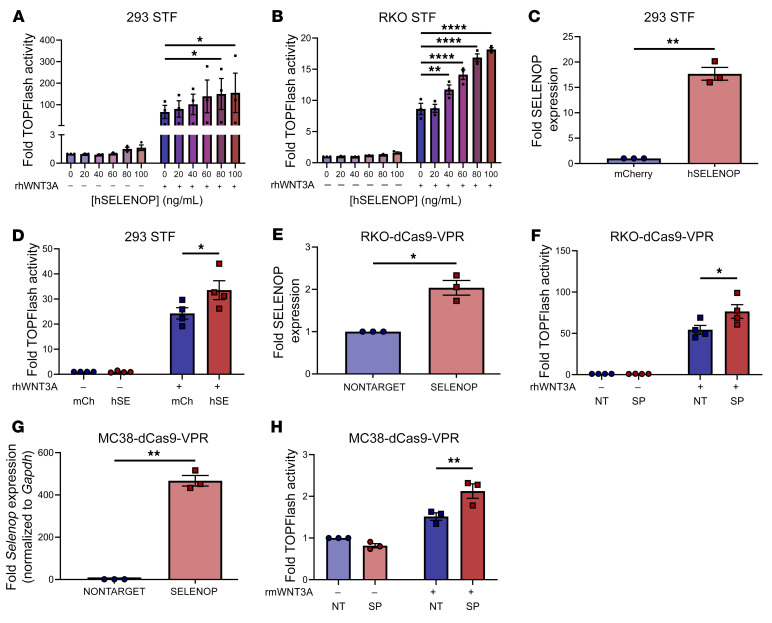
Although selenium deficiency correlates with colorectal cancer (CRC) risk, the roles of the selenium-rich antioxidant selenoprotein P (SELENOP) in CRC remain unclear. In this study, we defined SELENOP's contributions to sporadic CRC. In human single-cell cRNA-Seq (scRNA-Seq) data sets, we discovered that SELENOP expression rose as normal colon stem cells transformed into adenomas that progressed into carcinomas. We next examined the effects of Selenop KO in a mouse adenoma model that involved conditional, intestinal epithelium-specific deletion of the tumor suppressor adenomatous polyposis coli (Apc) and found that Selenop KO decreased colon tumor incidence and size. We mechanistically interrogated SELENOP-driven phenotypes in tumor organoids as well as in CRC and noncancer cell lines. Selenop-KO tumor organoids demonstrated defects in organoid formation and decreases in WNT target gene expression, which could be reversed by SELENOP restoration. Moreover, SELENOP increased canonical WNT signaling activity in noncancer and CRC cell lines. In defining the mechanism of action of SELENOP, we mapped protein-protein interactions between SELENOP and the WNT coreceptors low-density lipoprotein receptor-related proteins 5 and 6 (LRP5/6). Last, we confirmed that SELENOP-LRP5/6 interactions contributed to the effects of SELENOP on WNT activity. Overall, our results position SELENOP as a modulator of the WNT signaling pathway in sporadic CRC.
Keywords: Colorectal cancer; Gastroenterology.
Conflict of interest statement
Figures





Comment in
-
The selenoprotein P-LRP5/6-WNT3A complex promotes tumorigenesis in sporadic colorectal cancer.J Clin Invest. 2023 Jul 3;133(13):e171885. doi: 10.1172/JCI171885. J Clin Invest. 2023. PMID: 37395277 Free PMC article.
References
-
- Duffield-Lillico AJ, et al. Baseline characteristics and the effect of selenium supplementation on cancer incidence in a randomized clinical trial: a summary report of the Nutritional Prevention of Cancer Trial. Cancer Epidemiol Biomarkers Prev. 2002;11(7):630–639. - PubMed
Publication types
MeSH terms
Substances
Grants and funding
- IK2 BX004648/BX/BLRD VA/United States
- U54 CA274367/CA/NCI NIH HHS/United States
- K01 DK123495/DK/NIDDK NIH HHS/United States
- R01 DK099204/DK/NIDDK NIH HHS/United States
- P30 DK058404/DK/NIDDK NIH HHS/United States
- F31 CA232272/CA/NCI NIH HHS/United States
- F30 DK111107/DK/NIDDK NIH HHS/United States
- R03 DK123489/DK/NIDDK NIH HHS/United States
- R01 DK103831/DK/NIDDK NIH HHS/United States
- R01 CA244188/CA/NCI NIH HHS/United States
- U24 DK059637/DK/NIDDK NIH HHS/United States
- R35 GM122516/GM/NIGMS NIH HHS/United States
- R25 GM134979/GM/NIGMS NIH HHS/United States
- P30 CA068485/CA/NCI NIH HHS/United States
- I01 BX001426/BX/BLRD VA/United States
- F30 DK120149/DK/NIDDK NIH HHS/United States
- P50 CA236733/CA/NCI NIH HHS/United States
LinkOut - more resources
Full Text Sources
Medical
Molecular Biology Databases
Research Materials
Miscellaneous
