


Sex and Gender Differences in Psychosocial Risk Profiles Among Patients with Coronary Heart Disease - the THORESCI-Gender Study
- PMID: 37170007
- PMCID: PMC10803502
- DOI: 10.1007/s12529-023-10170-5
Sex and Gender Differences in Psychosocial Risk Profiles Among Patients with Coronary Heart Disease - the THORESCI-Gender Study
Abstract
Background: Psychosocial factors tend to cluster and exhibit differences associated with sex assigned at birth. Gender disparities, though, remain uncharted so far. The current study aimed to first explore the clustering of eight established psychosocial risk factors among patients with coronary heart disease (CHD), followed by examining how sex and gender differences characterize these psychosocial risk profiles, while adjusting for the effect of age.
Method: In total, 532 patients with CHD (Mage = 68.2 ± 8.9; 84% male) completed the comprehensive psychosocial screener and questionnaires to gauge gender identity, traits, and sociocultural norm scores. A three-step latent profile analysis (LPA) was performed to identify latent profiles and their correlates.
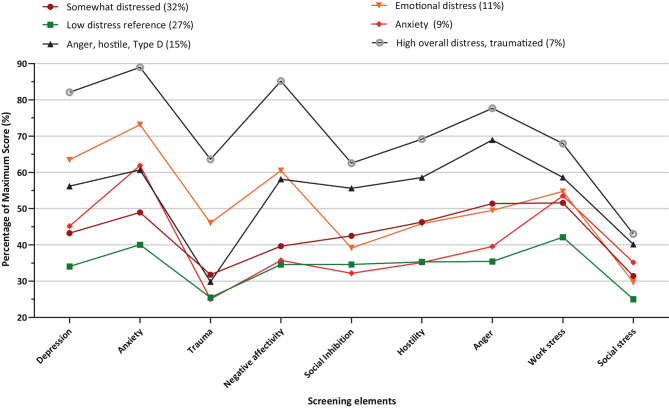
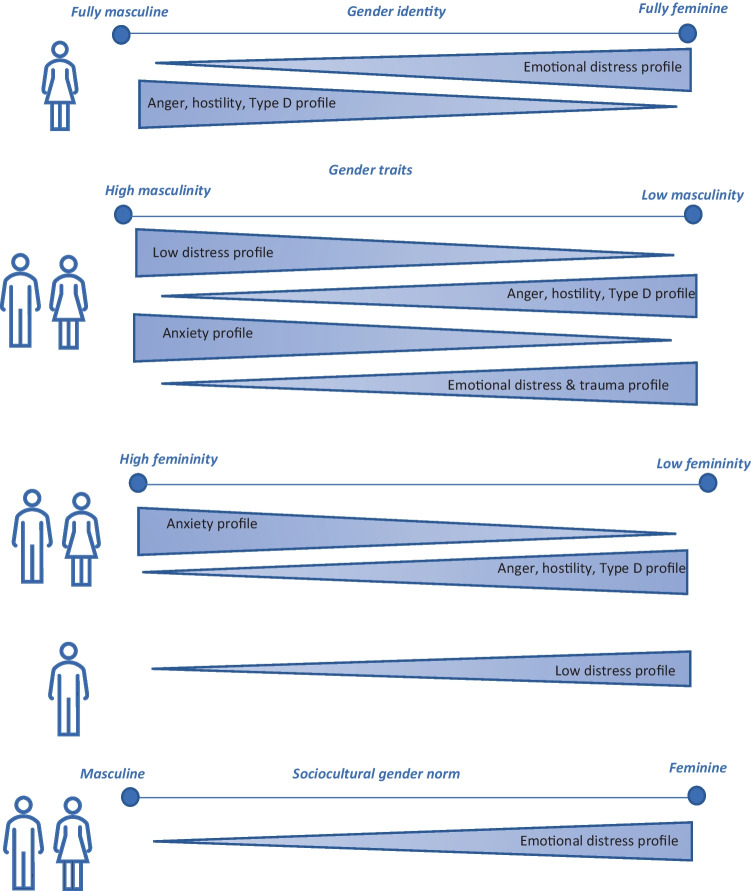
Results: LPA revealed six psychosocial risk profiles: (1) somewhat distressed overall (32%); (2) low distress (27%); (3) anger, hostility, and Type D (15%); (4) emotional distress and trauma (11%); (5) anxiety (9%); and (6) high overall distress (7%). Masculine traits and older age increased the odds to belong to the low distress profile (#2), while feminine traits and a feminine gender norm score increased the chance to belong to profiles with moderate to high distress. The effects of gender identity and feminine traits were sex dependent.
Conclusion: The current study's findings explain heterogeneity among patients with CHD by considering the joint occurrence of psychosocial risk factors, and the role of sex, age, and gender within those profiles. Being more sensitive to the roles that sex, gender, and an integrated set of risk factors play may ultimately improve treatment and adherence.
Keywords: Acute coronary syndrome; Latent profile analysis; Gender; Psychosocial risk factors; Sex.
© 2023. The Author(s).
Conflict of interest statement
The authors declare no competing interests.
Figures

References
-
- Piepoli M, Hoes A, Agewall A, Albus C, Brotons C, Catapano A. 2016 European Guidelines on cardiovascular disease prevention in clinical practice: the Sixth Joint Task Force of the European Society of Cardiology and Other Societies on Cardiovascular Disease Prevention in Clinical Practice (constituted by representatives of 10 societies and by invited experts)Developed with the special contribution of the European Association for Cardiovascular Prevention & Rehabilitation (EACPR) Eur Heart J. 2016;37(29):2315–2381. doi: 10.1093/eurheartj/ehw106. - DOI - PMC - PubMed
-
- Steptoe A, Kivimäki M. Stress and cardiovascular disease: an update on current knowledge. Annual Review of Public Health. 2013;34:337–54. 10.1146/annurev-publhealth-031912-114452 - PubMed
MeSH terms
Grants and funding
LinkOut - more resources
Full Text Sources
Miscellaneous
