


Research evidence and implementation gaps in the engagement of people with lived experience in mental health and substance use research: a scoping review
- PMID: 37170357
- PMCID: PMC10176886
- DOI: 10.1186/s40900-023-00442-5
Research evidence and implementation gaps in the engagement of people with lived experience in mental health and substance use research: a scoping review
Abstract
Background: There is growing recognition that engaging people with lived experience (PWLE) in mental health and substance use research improves the quality of the research in terms of relevance to the population and the feasibility of the work. Engagement also provides positive opportunities for research teams and the PWLE engaged. However, there are many gaps in the research on PWLE engagement. This scoping review synthesizes the gaps in the implementation of PWLE engagement and in the research on engagement as presented by research teams engaging PWLE in their work.
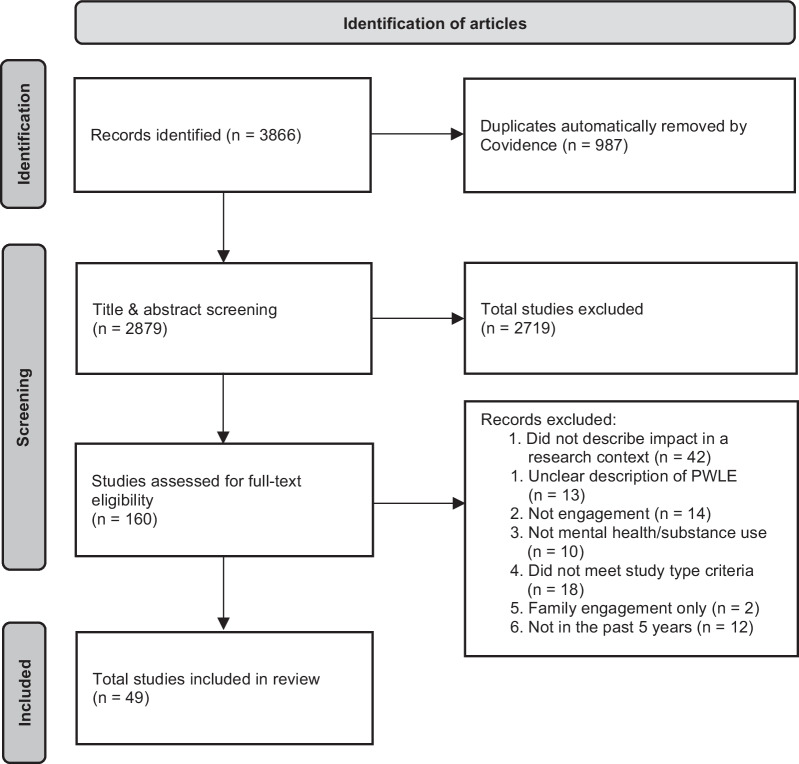
Method: A systematic electronic database search was conducted in 2022 for published articles on PWLE engagement in mental health and substance use research. Potential articles were screened for relevance. The search led to 49 final articles included in the review. The 49 articles were then coded using codebook thematic analysis to answer two research questions: (1) What are the research evidence gaps regarding the engagement of PWLE in mental health and substance use research?; and (2) What are the gaps in implementing PWLE engagement in mental health and substance use research? PWLE were engaged in the conduct of this review.
Results: Results showed that research evidence gaps include further work on conceptualizing engagement; developing resources, tools, and practice recommendations to support research teams; increasing diversity in evaluations of engagement; and evaluating engagement, including its impact on the research, on PWLE, and on researchers. Implementation gaps included several broader institutional gaps and gaps in the day-to-day practice of engagement.
Conclusions: Despite progress in PWLE engagement in mental health and substance use research in recent years, research evidence and implementation gaps remain. Research teams are encouraged to consider these gaps and conduct research and implementation activities to address them in a rigorous manner.
Keywords: Evidence gaps; Lived experience; Patient and public involvement; Patient engagement; Patient-oriented research; Research gaps.
Plain language summary
There is growing recognition that engaging people with lived experience (PWLE) in mental health and substance use research improves the quality of the research by making it more relevant to the population and more feasible. Engagement also provides positive opportunities for those working in this way. However, many questions remain unanswered in terms of PWLE engagement. We reviewed the published literature to identify gaps in the research on PWLE engagement and on the ways PWLE engagement is practiced in mental health and substance use research. We identified 49 articles addressing these issues. We examined each article to identify (1) research evidence gaps regarding the engagement of PWLE in mental health and substance use research; and (2) gaps in the way PWLE engagement is put into place in mental health and substance use research. We found that research evidence gaps include the need for further research work to understand what engagement and lived experience are; the need to develop resources, tools, and practice recommendations to support PWLE engagement; the need to increase the diversity of the PWLE engaged; and the need to evaluate the impact of engagement on the research, on PWLE, and on researchers. Gaps in the practice of PWLE engagement included several broader institutional gaps and gaps in the day-to-day practice. Despite progress in PWLE engagement in research in recent years, many gaps remain. Research teams are encouraged to conduct research to clarify these aspects of engagement and to implement engagement in ways that address these gaps.
© 2023. The Author(s).
Conflict of interest statement
The authors declare that they have no competing interests.
Figures
References
-
- Pittaway E, Bartolomei L, Hugman R. Stop stealing our stories’: the ethics of research with vulnerable groups. J Hum Rights Pract. 2010;2(2):229–51. doi: 10.1093/jhuman/huq004. - DOI
Publication types
LinkOut - more resources
Full Text Sources
