


Energy Partitioning in Multicomponent Nanoscintillators for Enhanced Localized Radiotherapy
- PMID: 37172016
- PMCID: PMC10214376
- DOI: 10.1021/acsami.3c00853
Energy Partitioning in Multicomponent Nanoscintillators for Enhanced Localized Radiotherapy
Abstract
Multicomponent nanomaterials consisting of dense scintillating particles functionalized by or embedding optically active conjugated photosensitizers (PSs) for cytotoxic reactive oxygen species (ROS) have been proposed in the last decade as coadjuvant agents for radiotherapy of cancer. They have been designed to make scintillation-activated sensitizers for ROS production in an aqueous environment under exposure to ionizing radiations. However, a detailed understanding of the global energy partitioning process occurring during the scintillation is still missing, in particular regarding the role of the non-radiative energy transfer between the nanoscintillator and the conjugated moieties which is usually considered crucial for the activation of PSs and therefore pivotal to enhance the therapeutic effect. We investigate this mechanism in a series of PS-functionalized scintillating nanotubes where the non-radiative energy transfer yield has been tuned by control of the intermolecular distance between the nanotube and the conjugated system. The obtained results indicate that non-radiative energy transfer has a negligible effect on the ROS sensitization efficiency, thus opening the way to the development of different architectures for breakthrough radiotherapy coadjutants to be tested in clinics.
Keywords: energy transfer; nanomaterials; radiotherapy; scintillators; singlet oxygen.
Conflict of interest statement
The authors declare no competing financial interest.
Figures

 ) PS. (b) Photophysics of the sensitization
of SO production under exposure to ionizing radiation. The free electrons
and holes generated by interaction between the ionizing radiation
and the NT recombine directly on the NT and on the PS. The latter
is promoted to its excited-state singlet (Sn*) or triplet (Tn*) with a ratio
of 1:3. The energy stored in the NT can be therefore transferred by
non-radiative energy transfer (ETnr) producing additional
PS molecules in the S1* state. The PS molecules in the
S1* state can subsequently experience intersystem crossing
(ISC) that further populates the T1* state. From PS in
the triplet state, the energy is transferred by a second non-radiative
energy transfer step to molecular oxygen, which is promoted to its
excited singlet state
) PS. (b) Photophysics of the sensitization
of SO production under exposure to ionizing radiation. The free electrons
and holes generated by interaction between the ionizing radiation
and the NT recombine directly on the NT and on the PS. The latter
is promoted to its excited-state singlet (Sn*) or triplet (Tn*) with a ratio
of 1:3. The energy stored in the NT can be therefore transferred by
non-radiative energy transfer (ETnr) producing additional
PS molecules in the S1* state. The PS molecules in the
S1* state can subsequently experience intersystem crossing
(ISC) that further populates the T1* state. From PS in
the triplet state, the energy is transferred by a second non-radiative
energy transfer step to molecular oxygen, which is promoted to its
excited singlet state  . (c) Sketch of ETnr active and
ETnr inactive multicomponent scintillating NTs realized
by incrementing the intermolecular distance between the NT and the
PS molecules.
. (c) Sketch of ETnr active and
ETnr inactive multicomponent scintillating NTs realized
by incrementing the intermolecular distance between the NT and the
PS molecules.
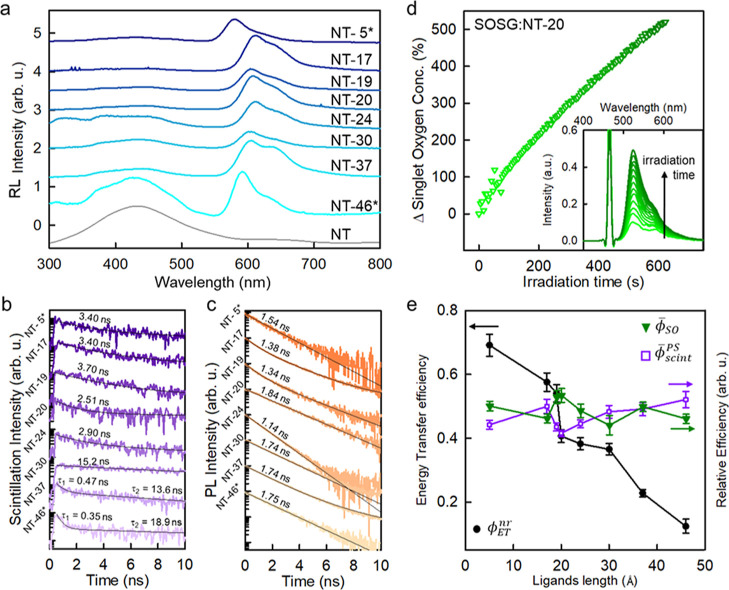
 ) of the PS, and SO relative sensitization
ability
) of the PS, and SO relative sensitization
ability  after 600 s of exposure to soft X-rays
for the multicomponent nanoscintillator series, as a function of the
NT-to-PS intermolecular distance. Error bars are put as the mean standard
deviation calculated on a N = 3 measurement replica.
after 600 s of exposure to soft X-rays
for the multicomponent nanoscintillator series, as a function of the
NT-to-PS intermolecular distance. Error bars are put as the mean standard
deviation calculated on a N = 3 measurement replica.References
MeSH terms
Substances
LinkOut - more resources
Full Text Sources
