Combined COVID-19 vaccination and hepatitis C virus screening intervention in marginalised populations in Spain
- PMID: 37173456
- PMCID: PMC10180614
- DOI: 10.1038/s43856-023-00292-y
Combined COVID-19 vaccination and hepatitis C virus screening intervention in marginalised populations in Spain
Abstract
Background: COVID-19 has hindered hepatitis C virus (HCV) and HIV screening, particularly in marginalised groups, who have some of the highest rates of these conditions and lowest rates of COVID-19 vaccination. We assessed the acceptability of combining HCV testing with COVID-19 vaccination in a centre for addiction services (CAS) in Barcelona and a mobile testing unit (MTU) in Madrid, Spain.
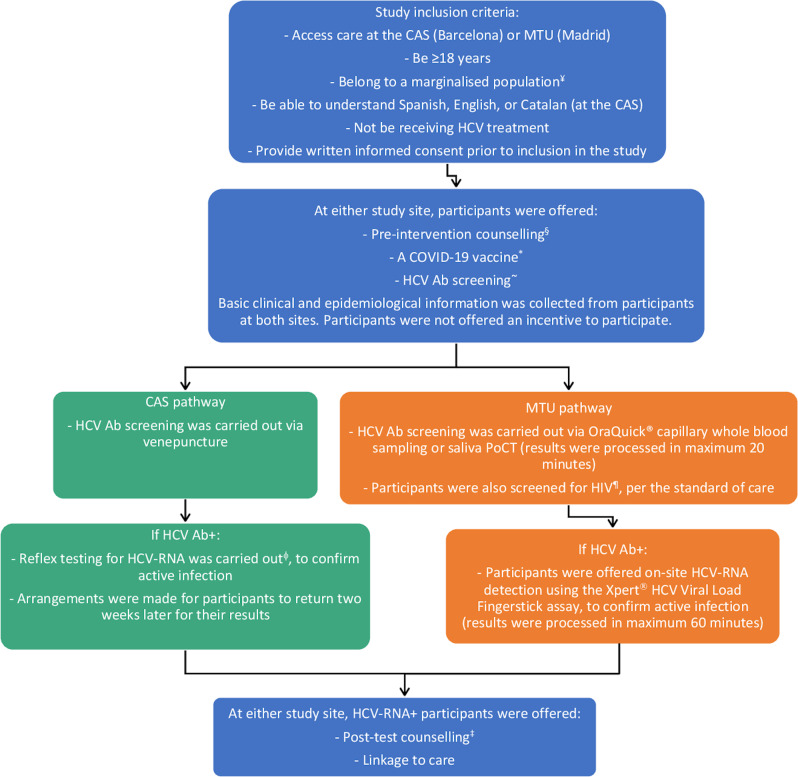
Methods: From 28/09/2021 to 30/06/2022, 187 adults from marginalised populations were offered HCV antibody (Ab) testing along with COVID-19 vaccination. If HCV Ab+, they were tested for HCV-RNA. MTU participants were also screened for HIV. HCV-RNA+ and HIV+ participants were offered treatment. Data were analysed descriptively.
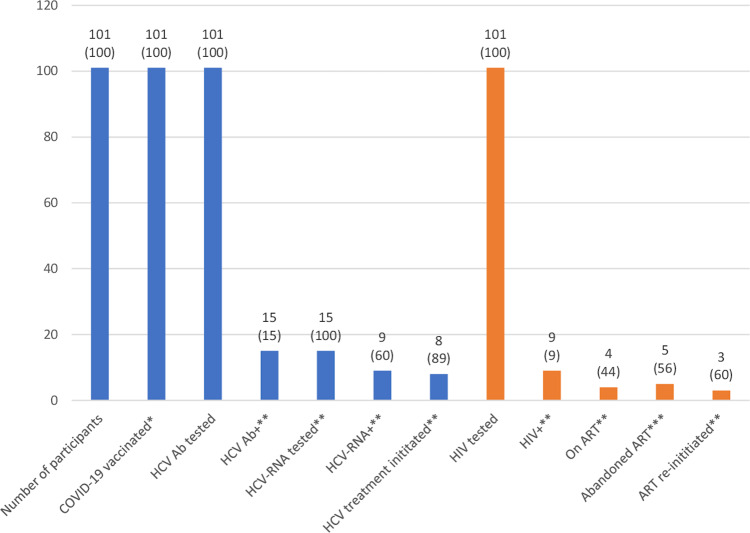
Results: Findings show how of the 86 CAS participants: 80 (93%) had been previously vaccinated for COVID-19, of whom 72 (90%) had the full first round schedule; none had a COVID-19 vaccine booster and all received a COVID-19 vaccine; 54 (62.8%) were tested for HCV Ab, of whom 17 (31.5%) were positive, of whom all were tested for HCV-RNA and none were positive. Of the 101 MTU participants: none had been vaccinated for COVID-19 and all received a COVID-19 vaccine; all were tested for HCV Ab and HIV and 15 (14.9%) and 9 (8.9%) were positive, respectively; of those HCV Ab+, 9 (60%) were HCV-RNA+, of whom 8 (88.9%) have started treatment; 5 (55.6%) of those HIV+ had abandoned antiretroviral therapy, of whom 3 (60%) have re-started it.
Conclusions: The intervention was accepted by 54 (62.8%) CAS participants and all MTU participants and can be used in marginalised communities.
Plain language summary
The COVID-19 pandemic has reduced the numbers of people being screened to determine whether they are infected with the hepatitis C virus (HCV) or HIV. This is particularly the case for marginalised populations, which include people with substance use disorders (e.g., injecting drug use), those who are experiencing homelessness, and those with mental health disorders. This study explored whether these populations were willing to be tested for HCV after receiving a COVID-19 vaccination in a centre for addiction services in Barcelona and a mobile testing unit (MTU) in Madrid, Spain. Those attending the MTU were also screened for HIV. Most participants were both vaccinated and tested for HCV and HIV, as applicable, when offered. Applying this approach more widely could improve healthcare reach among marginalised populations.
© 2023. The Author(s).
Conflict of interest statement
J.V.L. acknowledges a grant from AbbVie to ISGlobal to partially fund this study and grants and speaker fees from AbbVie, Gilead Sciences, and MSD and speaker fees from Genfit, Intercept, Janssen, and ViiV, outside of the submitted work. J.V.L. and M.V.-R. acknowledge institutional support to ISGlobal from the Spanish Ministry of Science and Innovation and the State Research Agency through the “Centro de Excelencia Severo Ochoa 2019–2023” Programme (CEX2018-000806-S) and from the “Generalitat de Catalunya” through the CERCA Programme, outside of the submitted work. P.R. acknowledges grants, personal fees, and non-financial support from Gilead Sciences and Merck, personal fees from ViiV, and personal fees and non-financial support from AbbVie, outside of the submitted work. M.B. reports advisory fees from Gilead Sciences, AbbVie, GlaxoSmithKline, and Assembly Biosciences and speaker fees from Gilead Sciences and AbbVie, outside of the submitted work. L.G.-L. reports speaker fees from Lundbeck and Esteve, outside of the submitted work. R.F.P.-Á. reports speaker honorariums from Angelini, Casen Recordati, Exeltis, Lundbeck, MSD, Mundipharma, Servier, and Takeda, outside of the submitted work. J.J.F. has received consulting fees and research support from Gilead Sciences and AbbVie, outside of the submitted work. J.V. acknowledges speaker fees from Gilead Sciences, AbbVie, and ViiV, outside of the submitted work. G.C., J.L.E., and W.M. declare no conflicts of interest.
Figures

References
-
- World Health Organization. Global Progress Report on HIV, Viral Hepatitis and Sexually Transmitted Infections, 2021. https://www.who.int/publications/i/item/9789240027077 (2021).
-
- World Health Organization. Hepatitis C. https://www.who.int/news-room/fact-sheets/detail/hepatitis-c (2022).
-
- Ministerio de Sanidad. Guía de cribado de la infección por el VHC. https://www.sanidad.gob.es/ciudadanos/enfLesiones/enfTransmisibles/sida/... (2020).
-
- Ministerio de Ciencia e Innovación. Vigilancia Epidemiológica de Hepatitis C en España, 2020. https://www.isciii.es/QueHacemos/Servicios/VigilanciaSaludPublicaRENAVE/... (2020).
-
- Ministerio de Ciencia e Innovación. Vigilancia Epidemiológica de Hepatitis C en España, 2019. https://www.isciii.es/QueHacemos/Servicios/VigilanciaSaludPublicaRENAVE/... (2019).