


The effect of catheter-based sham renal denervation in hypertension: systematic review and meta-analysis
- PMID: 37173636
- PMCID: PMC10182607
- DOI: 10.1186/s12872-023-03269-w
The effect of catheter-based sham renal denervation in hypertension: systematic review and meta-analysis
Abstract
Background: Renal denervation (RDN) has emerged in recent years as a possible treatment for hypertension. The first sham-controlled trial showed a small magnitude and non-significant in the blood pressure (BP) lowering effect, also due to a substantial decrease of BP in sham arm. Considering this, we aimed to quantify the magnitude of BP decrease within the sham arm of Randomized Controlled Trials (RCT) with RDN in patients with hypertension.
Methods: Electronic databases were searched since inception until January 2022 for randomized sham-controlled trials which assessed the efficacy in lowering BP of the sham intervention for catheter-based RDN in adult patients with hypertension. The outcomes were change in ambulatory/office systolic and diastolic BP.
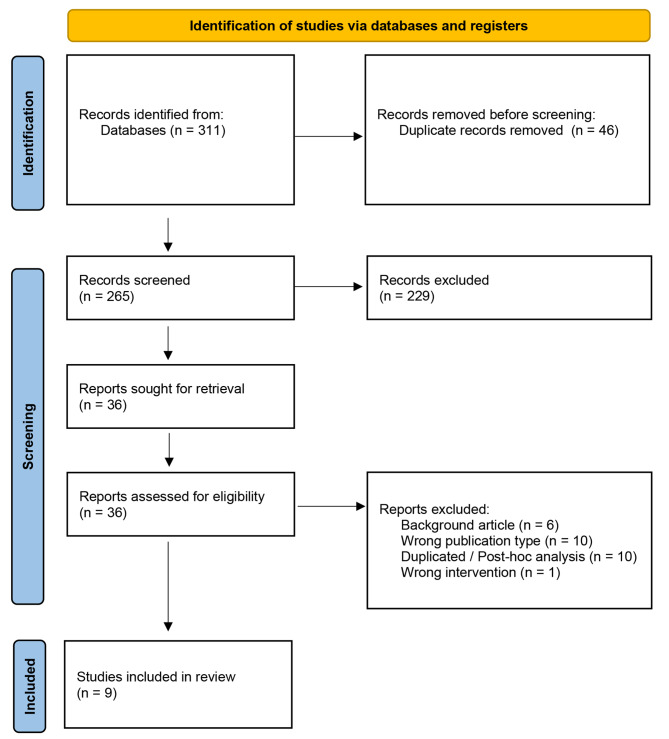
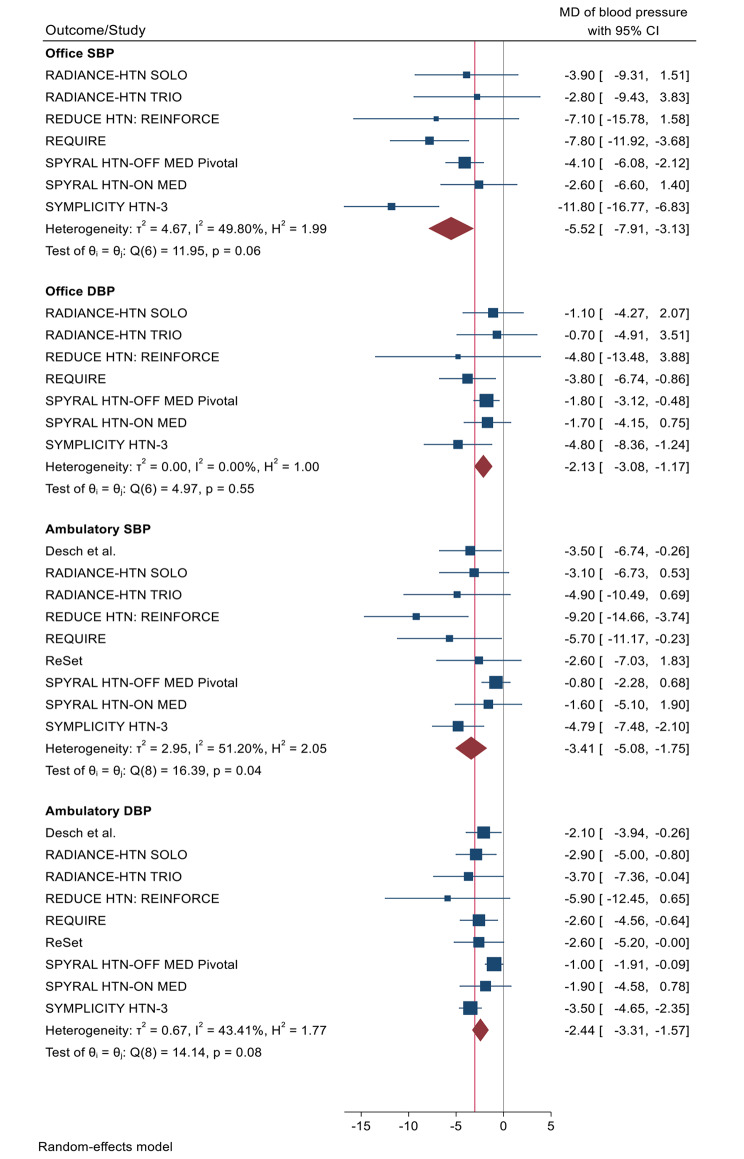
Results: A total of 9 RCT were included in the analysis enrolling a total of 674 patients. Sham intervention showed a decrease in all evaluated outcomes. Office systolic BP had a reduction of -5.52 mmHg [95%CI -7.91, -3.13] and office diastolic BP of -2.13 mmHg [95%CI -3.08, -1.17]. Sham procedure for RDN also showed a reduction of -3.41 mmHg [95%CI -5.08, -1.75] in ambulatory systolic BP and - 2.44 mmHg [95%CI -3.31, -1.57] in ambulatory diastolic BP.
Conclusion: Despite recent data indicating that RDN might be an effective treatment for patients with resistant hypertension when compared to a sham intervention, our results indicate that the sham intervention for RDN also has a significant effect on lowering Office and Ambulatory (24-h) Blood Pressure in adult patients with hypertension. This highlights that BP itself might be sensitive to placebo-like effect and also brings further difficulties in establishing the BP lowering efficacy of invasive interventions due to the magnitude of the sham effect.
Keywords: Hypertension; Placebo; Renal denervation; Renal sympathetic denervation; Sham.
© 2023. The Author(s).
Conflict of interest statement
DC has participated in educational meetings and/or attended conferences or symposia (including travel, accommodation, and/or hospitality) with Bristol-Myers Squibb, Bayer, Boehringer Ingelheim, Daiichi Sankyo, Merck Serono, Ferrer, Pfizer, Novartis, and Roche >3 years; no conflicts of interest <3 years. JJF had speaker and consultant fees with Grünenthal, Fundação MSD (Portugal), TEVA, MSD, Allergan, Medtronic, GlaxoSmithKline, Novartis, Lundbeck, Solvay, BIAL, Merck Serono, Merz, Ipsen, Biogen, Acadia, Allergan, Abbvie, Sunovion-Pharmaceuticals. FJP had consultant and speaker fees with Astra Zeneca, Bayer, BMS, Boehringer Ingelheim and Daiichi Sankyo. There is no any other conflict of interest by the rest of the authors.
Figures
References
-
- Mancia G, De Backer G, Dominiczak A et al. 2018 ESC/ESH Guidelines for themanagement of arterial hypertension. 2007.
Publication types
MeSH terms
Substances
LinkOut - more resources
Full Text Sources
Medical
