


Effect of pharmacogenomics testing guiding on clinical outcomes in major depressive disorder: a systematic review and meta-analysis of RCT
- PMID: 37173736
- PMCID: PMC10176803
- DOI: 10.1186/s12888-023-04756-2
Effect of pharmacogenomics testing guiding on clinical outcomes in major depressive disorder: a systematic review and meta-analysis of RCT
Abstract
Background: Pharmacogenomic testing guided treatment have been developed to guide drug selection or conversion in major depressive disorder patients. Whether patients benefit from pharmacogenetic testing remains unclear. We aim to evaluates the effect of pharmacogenomic testing guiding on clinical outcomes of major depressive disorder.
Methods: Pubmed, Embase, and Cochrane Library of Clinical Trials were searched from inception until August 2022. Key terms included pharmacogenomic and antidepressive. Odds ratios (RR) with 95% confidence intervals (95%CIs) were calculated using fixed-effects model for low or moderate heterogeneity or random-effects model for high heterogeneity.
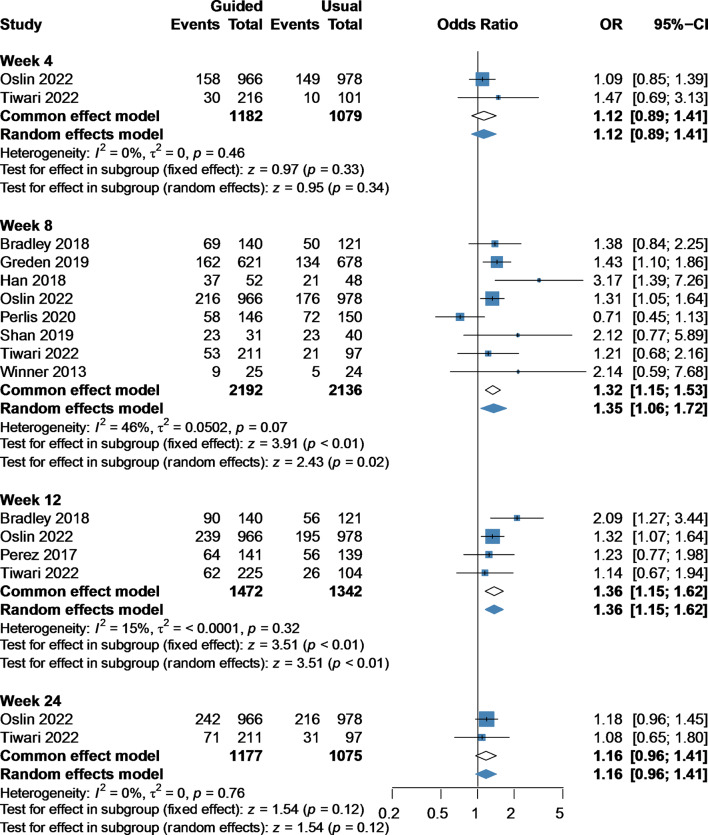
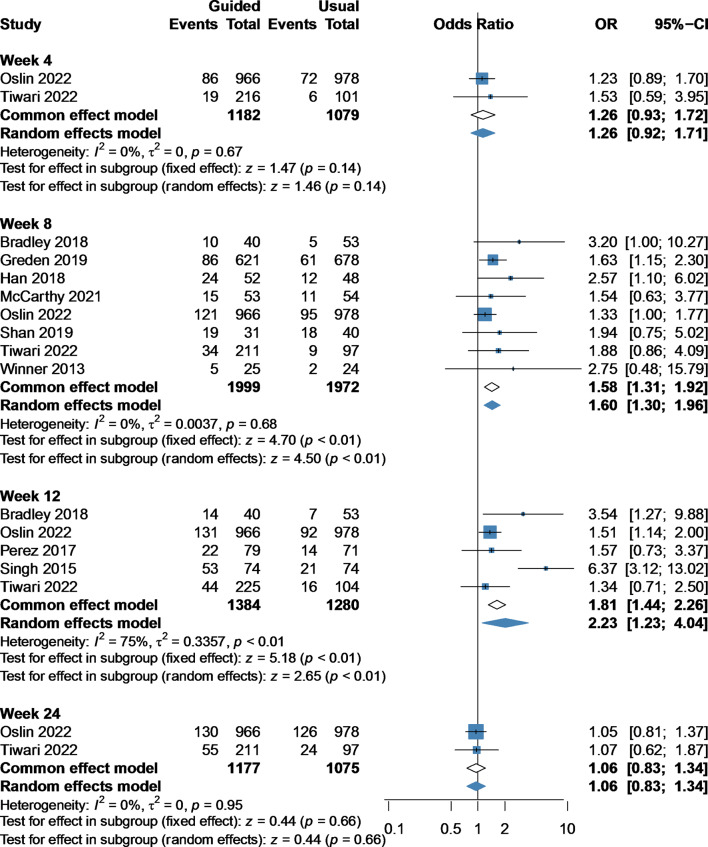
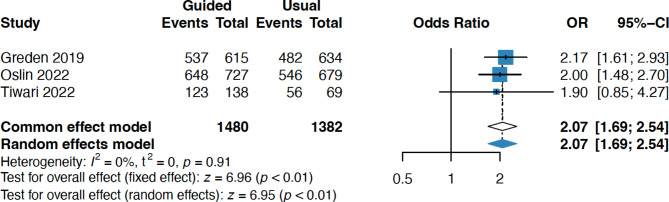
Results: Eleven studies (5347 patients) were included. Compared with usual group, pharmacogenomic testing guided group was associated with an increased response rate at week 8 (OR 1.32, 95%CI 1.15-1.53, 8 studies, 4328 participants) and week 12 (OR 1.36, 95%CI 1.15-1.62, 4 studies, 2814 participants). Similarly, guided group was associated with an increased rate of remission at week 8 (OR 1.58, 95%CI 1.31-1.92, 8 studies, 3971 participants) and week 12 (OR 2.23, 95%CI 1.23-4.04, 5 studies, 2664 participants). However, no significant differences were found between the two groups in response rate at week 4 (OR 1.12, 95%CI 0.89-1.41, 2 studies, 2261 participants) and week 24 (OR 1.16, 95%CI 0.96-1.41, 2 studies, 2252 participants), and remission rate at week 4 (OR 1.26, 95%CI 0.93-1.72, 2 studies, 2261 participants) and week 24 (OR 1.06, 95%CI 0.83-1.34, 2 studies, 2252 participants). Medication congruence in 30 days was significantly reduced in the pharmacogenomic guided group compared with the usual care group (OR 2.07, 95%CI 1.69-2.54, 3 studies, 2862 participants). We found significant differences between subgroups of target population in response and remission rate.
Conclusion: Patients with major depressive disorder may benefit from pharmacogenomic testing guided treatment by achieving target response and remission rates more quickly.
Keywords: Guided; Major depressive disorder; Pharmacogenomic.
© 2023. The Author(s).
Conflict of interest statement
The authors declare no competing interests.
Figures
References
Publication types
MeSH terms
Substances
LinkOut - more resources
Full Text Sources
