Review
. 2023 Apr 25;15(9):2446.
doi: 10.3390/cancers15092446.

Diagnostic Bioliquid Markers for Pancreatic Cancer: What We Have vs. What We Need

Affiliations
Review

Diagnostic Bioliquid Markers for Pancreatic Cancer: What We Have vs. What We Need

Geou-Yarh Liou et al. Cancers (Basel). .

Abstract

Pancreatic ductal adenocarcinoma (PDAC), the most common type of pancreatic cancer, currently has a dismal five-year survival rate of approximately 10% due to late diagnosis and a lack of efficient treatment options such as surgery. Furthermore, the majority of PDAC patients have surgically unresectable cancer, meaning cancer cells have either reached the surrounding blood vessels or metastasized to other organs distant from the pancreas area, resulting in low survival rates as compared to other types of cancers. In contrast, the five-year survival rate of surgically resectable PDAC patients is currently 44%. The late diagnosis of PDAC is a result of little or no symptoms in its early stage of development and a lack of specific biomarkers that may be utilized in routine examinations in the clinic. Although healthcare professionals understand the importance of early detection of PDAC, the research on the subject has lagged and no significant changes in the death toll of PDAC patients has been observed. This review is focused on understanding potential biomarkers that may increase the early diagnosis of PDAC patients at its surgically resectable stage. Here, we summarize the currently available biomarkers used in the clinic as well as those being developed with the hope of providing insight into the future of liquid biomarkers to be used in routine examinations for the early diagnosis of PDAC.

Keywords: biomarker; early detection; early diagnosis; exosomes; liquid biopsy; pancreatic ductal adenocarcinoma; resectable pancreatic cancer; secreted factors.


Conflict of interest statement

No disclosure was reported by all authors and no competing interest declared by the authors regarding the publication of this article.

Figures
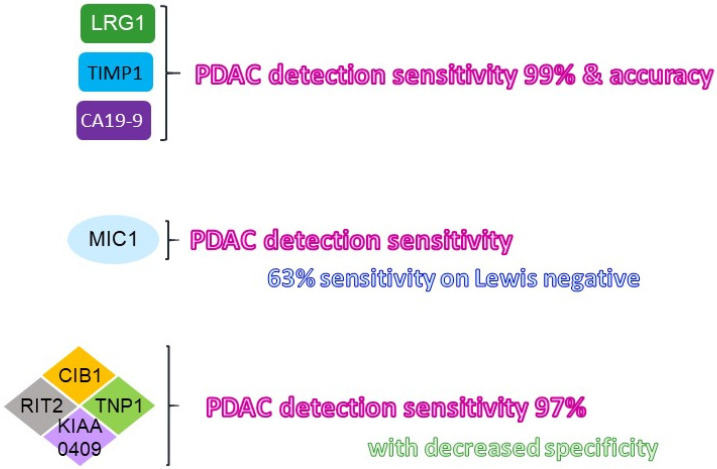
Figure 1
Figure 1
Summary of the newly identified diagnostic liquid biomarkers for PDAC. The newly identified liquid biomarkers for improving the sensitivity as well as the specificity of PDAC at its early stage were illustrated. The improved detection sensitivity indicated was in comparison with that using CA19-9 alone. LRG: leucine-richalpha-2 glycoprotein; TIMP: tissue inhibitor matrix metalloproteinase; MIC: macrophage inhibitory cytokine; CIB: calcium and integrin binding; TNP: transition protein; RIT2: RaslikewithoutCAAX2.
Figure 2
Figure 2
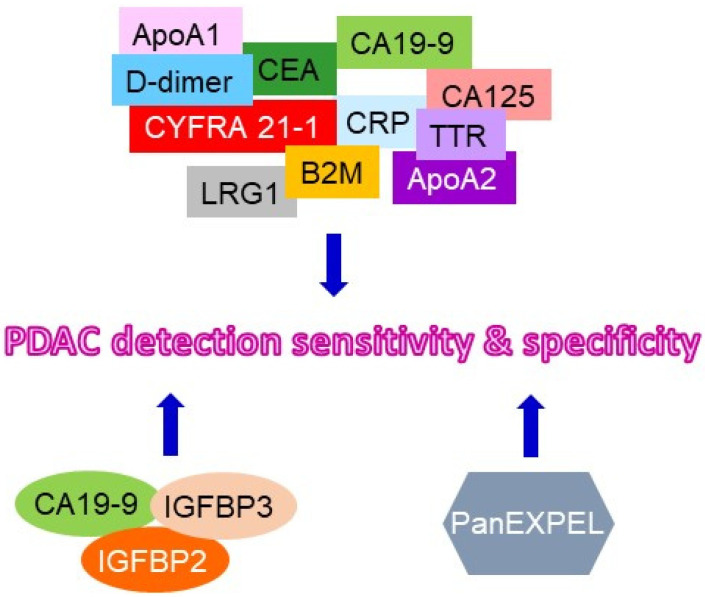
Summary of the suggested combination of clinical liquid biomarkers for PDAC detection. The recommended combination of clinical liquid biomarkers for improving the sensitivity and specificity of PDAC at its early stage were illustrated. ApoA1: apolipoproteinA1; CRP:C-reactive protein; CYFRA21-1: cytokeratin 19 fragment 21-1; TTR: transthyretin; LRG: leucin-richalpha-2 glycoprotein; B2M: beta-2 macroglobulin; PanEXPEL: new biomarkers in pancreatic cancer using EXPEL methodology.
Figure 3
Figure 3
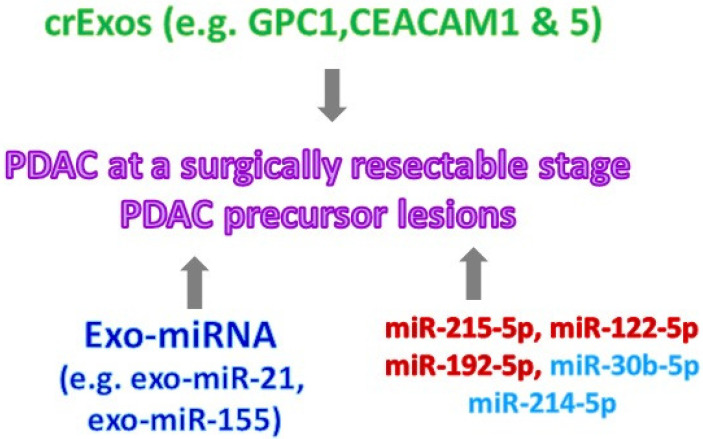
Summary of the potential liquid biomarkers for detection of PDAC and its precursor lesions. The reported secreted factors from PDAC and its precursor lesions which can be used as potential liquid biomarkers in the clinic were illustrated. crExos: circulating exosomes; GPC: glypican; CEACAM: carcinoembryonic antigen-related cell adhesion; exo-miRNA: exosomal microRNA; miRNA: serum microRNA.

References

    1. Bengtsson A., Andersson R., Ansari D. The actual 5-year survivors of pancreatic ductal adenocarcinoma based on real-world data. Sci. Rep. 2020;10:16425. doi: 10.1038/s41598-020-73525-y. - DOI - PMC - PubMed
    1. Wood H.E., Gupta S., Kang J.Y., Quinn M.J., Maxwell J.D., Mudan S., Majeed A. Pancreatic cancer in England and Wales 1975-2000: Patterns and trends in incidence, survival and mortality. Aliment. Pharmacol. Ther. 2006;23:1205–1214. doi: 10.1111/j.1365-2036.2006.02860.x. - DOI - PubMed
    1. Siegel R.L., Miller K.D., Wagle N.S., Jemal A. Cancer statistics, 2023. CA Cancer J. Clin. 2023;73:17–48. doi: 10.3322/caac.21763. - DOI - PubMed
    1. Silverberg E., Grant R.N. Cancer statistics, 1970. CA Cancer J. Clin. 1970;20:11–23. doi: 10.3322/canjclin.20.1.10. - DOI - PubMed
    1. Rochefort P., Lardy-Cleaud A., Sarabi M., Desseigne F., Cattey-Javouhey A., de la Fouchardiere C. Long-Term Survivors in Metastatic Pancreatic Ductal Adenocarcinoma: A Retrospective and Matched Pair Analysis. Oncologist. 2019;24:1543–1548. doi: 10.1634/theoncologist.2018-0786. - DOI - PMC - PubMed

LinkOut - more resources