


Low-Dose Bevacizumab for the Treatment of Focal Radiation Necrosis of the Brain (fRNB): A Single-Center Case Series
- PMID: 37174026
- PMCID: PMC10177060
- DOI: 10.3390/cancers15092560
Low-Dose Bevacizumab for the Treatment of Focal Radiation Necrosis of the Brain (fRNB): A Single-Center Case Series
Abstract
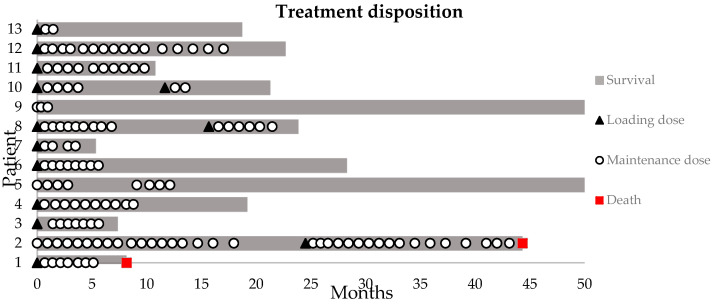
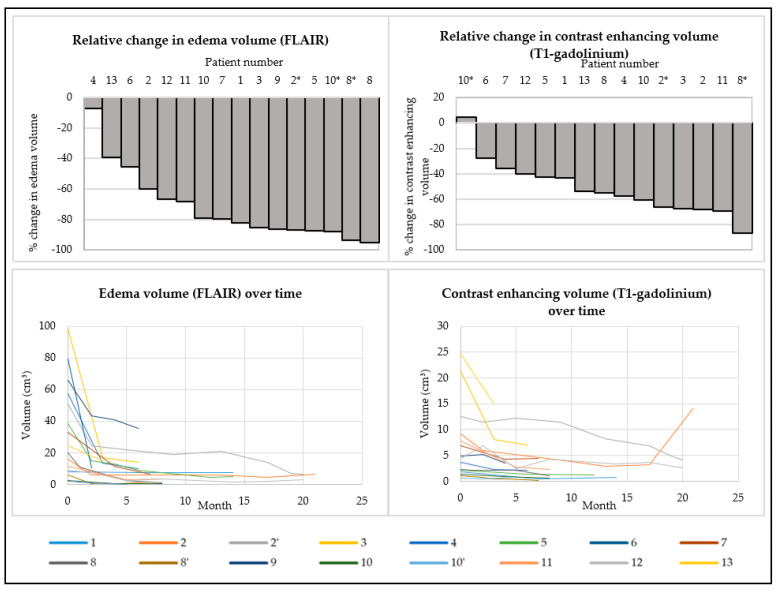
Focal radiation necrosis of the brain (fRNB) is a late adverse event that can occur following the treatment of benign or malignant brain lesions with stereotactic radiation therapy (SRT) or stereotactic radiosurgery (SRS). Recent studies have shown that the incidence of fRNB is higher in cancer patients who received immune checkpoint inhibitors. The use of bevacizumab (BEV), a monoclonal antibody that targets the vascular endothelial growth factor (VEGF), is an effective treatment for fRNB when given at a dose of 5-7.5 mg/kg every two weeks. In this single-center retrospective case series, we investigated the effectiveness of a low-dose regimen of BEV (400 mg loading dose followed by 100 mg every 4 weeks) in patients diagnosed with fRNB. A total of 13 patients were included in the study; twelve of them experienced improvement in their existing clinical symptoms, and all patients had a decrease in the volume of edema on MRI scans. No clinically significant treatment-related adverse effects were observed. Our preliminary findings suggest that this fixed low-dose regimen of BEV can be a well-tolerated and cost-effective alternative treatment option for patients diagnosed with fRNB, and it is deserving of further investigation.
Keywords: VEGF inhibitor; bevacizumab; case series; low-dose regimen; radiation necrosis of the brain; radiotherapy; stereotactic radiation therapy.
Conflict of interest statement
The authors declare no conflict of interest.
Figures
References
-
- Kohutek Z.A., Yamada Y., Chan T.A., Brennan C.W., Tabar V., Gutin P.H., Jonathan Yang T., Rosenblum M.K., Ballangrud Å., Young R.J., et al. Long-term risk of radionecrosis and imaging changes after stereotactic radiosurgery for brain metastases. J. Neuro-Oncol. 2015;125:149–156. doi: 10.1007/s11060-015-1881-3. - DOI - PMC - PubMed
-
- Varlotto J.M., Flickinger J.C., Niranjan A., Bhatnagar A.K., Kondziolka D., Lunsford L.D. Analysis of tumor control and toxicity in patients who have survived at least one year after radiosurgery for brain metastases. Int. J. Radiat. Oncol. Biol. Phys. 2003;57:452–464. doi: 10.1016/S0360-3016(03)00568-6. - DOI - PubMed
LinkOut - more resources
Full Text Sources
