Review
. 2023 Apr 24;12(9):1233.
doi: 10.3390/cells12091233.

Animal Models of Drug-Resistant Epilepsy as Tools for Deciphering the Cellular and Molecular Mechanisms of Pharmacoresistance and Discovering More Effective Treatments

Affiliations
Review

Animal Models of Drug-Resistant Epilepsy as Tools for Deciphering the Cellular and Molecular Mechanisms of Pharmacoresistance and Discovering More Effective Treatments

Wolfgang Löscher et al. Cells. .

Abstract

In the last 30 years, over 20 new anti-seizure medicines (ASMs) have been introduced into the market for the treatment of epilepsy using well-established preclinical seizure and epilepsy models. Despite this success, approximately 20-30% of patients with epilepsy have drug-resistant epilepsy (DRE). The current approach to ASM discovery for DRE relies largely on drug testing in various preclinical model systems that display varying degrees of ASM drug resistance. In recent years, attempts have been made to include more etiologically relevant models in the preclinical evaluation of a new investigational drug. Such models have played an important role in advancing a greater understanding of DRE at a mechanistic level and for hypothesis testing as new experimental evidence becomes available. This review provides a critical discussion of the pharmacology of models of adult focal epilepsy that allow for the selection of ASM responders and nonresponders and those models that display a pharmacoresistance per se to two or more ASMs. In addition, the pharmacology of animal models of major genetic epilepsies is discussed. Importantly, in addition to testing chemical compounds, several of the models discussed here can be used to evaluate other potential therapies for epilepsy such as neurostimulation, dietary treatments, gene therapy, or cell transplantation. This review also discusses the challenges associated with identifying novel therapies in the absence of a greater understanding of the mechanisms that contribute to DRE. Finally, this review discusses the lessons learned from the profile of the recently approved highly efficacious and broad-spectrum ASM cenobamate.

Keywords: Dravet syndrome; anti-seizure drugs; drug resistant epilepsy; kainate; kindling; pilocarpine; seizures; temporal lobe epilepsy.


Conflict of interest statement

W. Löscher was involved in the development of levetiracetam (UCB Pharma; Brussels, Belgium) and imepitoin (Elbion/Boehringer Ingelheim, Germany), has received consultancy fees from Lundbeck, Angelini, AC Immune, Clexio Biosciences, UCB Pharma, Pragma Therapeutics, Boehringer Ingelheim, Pfizer, and Johnson & Johnson, and has served on the advisory boards of Grünenthal, UCB Pharma, and Angelini Pharma. He is a member of the external consultant board (ECB) of the Epilepsy Therapy Screening Program (ETSP) of the National Institute of Neurological Disorders and Stroke, National Institutes of Health, Rockville, MD, USA. He is also co-founder of PrevEp Inc., Bethesda, MD. H.S. White has received grant funding from UCB Pharma and Eisai Pharmaceuticals; consultant fees from Biogen, GW, Neurelis, Inc. Takeda, Inc. and JAZZ Pharmaceuticals; and speaker honoraria from SK Pharmaceuticals and UCB Pharma. H.S. White is also co-founder of NeuroAdjuvants, Inc., Salt Lake City, UT, USA.

Figures
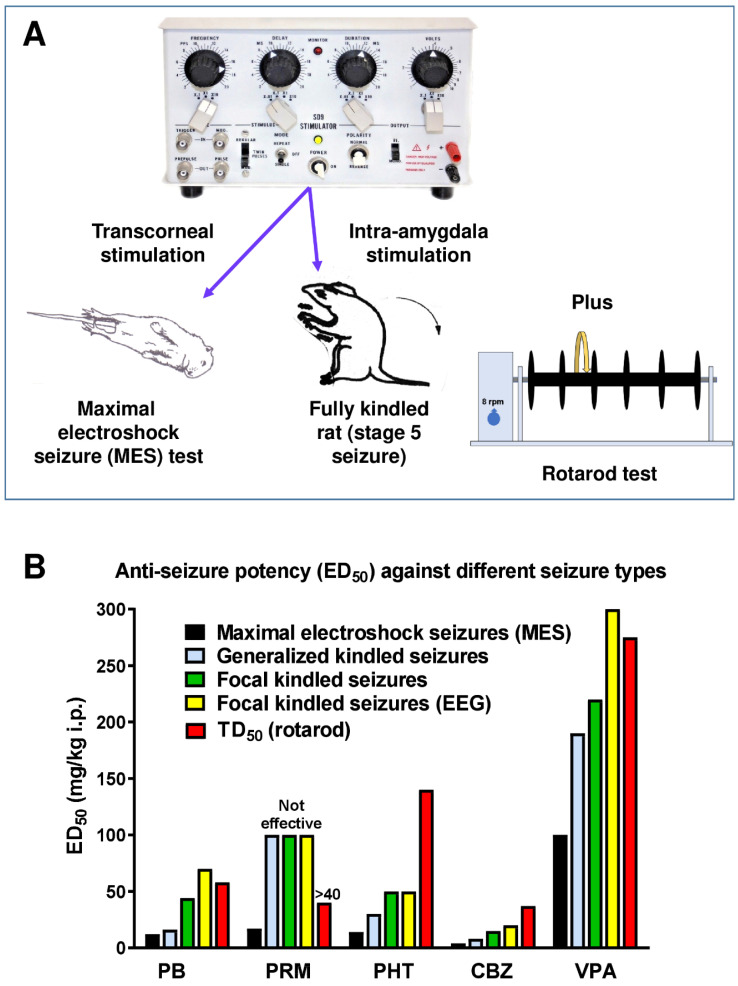
Figure 2
Figure 2
A comparison of the pharmacology of maximal electroshock seizures (MES) and different types of amygdala-kindled seizures in age-matched female Wistar rats. For comparison, also the TD50 determined in the rotarod test in nonkindled female Wistar rats is shown. However, note that the TD50 of ASMs may be significantly lower in kindled rats [41]. (A) Schematic illustration of the three models used for this comparison. (B) Anti-seizure potencies, expressed as i.p. ED50s and i.p. TD50s for “minimal neurotoxicity”. As illustrated, all kindled seizure types were more difficult to suppress than MES in naive (non-kindled) rats. Furthermore, in kindled rats, focal kindled seizures (stages 1–3) were less sensitive to ASMs than secondarily generalized kindled (stage 4–5) seizures. Similar results were found with benzodiazepines (diazepam, clonazepam; see Table S1) and some investigational drugs, which are not illustrated in the figure. “Not effective” indicates that an ED50 could not be determined up to the indicated dose. Data are from Löscher et al. [40] and Löscher and Nolting [43]. Abbreviations: CBZ, carbamazepine; PB, phenobarbital; PHT, phenytoin; PRM, primidone; and VPA, valproate.
Figure 1
Figure 1
Different categories of mouse and rat models of drug-resistant seizures. See text for details. Abbreviations: ASM, anti-seizure medication; BDZ, benzodiazepine; BRV, brivaracetam; CBM, cenobamate; CBZ, carbamazepine; CLZ, clonazepam; DZP, diazepam; FBM, felbamate; GBP, gabapentin; LCM, lacosamide; LEV, levetiracetam; LTG, lamotrigine; PB, phenobarbital; PER, perampanel; PGB, pregabalin; PHT, phenytoin; RTG, retigabine; SE, status epilepticus; TGB, tiagabine; TLE, temporal lobe epilepsy; TPM, topiramate; VGB, vigabatrin; and VPA, valproate.
Figure 3
Figure 3
The phenytoin-resistant amygdala-kindled rat model. (A) Schematic illustration of selection of drug-refractory (nonresponders) and drug-responsive (responders) rats from the kindling model by repeated testing of female Wistar rats with maximum tolerated doses of phenytoin (75 mg/kg i.p.) or its prodrug fosphenytoin (83.5 mg/kg i.p.). (B) Example of a selection of drug-refractory (nonresponders) and drug-responsive (responders) rats from the kindling model by repeated testing with the phenytoin prodrug fosphenytoin. A total of 52 fully-kindled, female Wistar rats were used in this experiment. The anti-seizure effect of a maximum tolerated dose of fosphenytoin (83.5 mg/kg i.p.) was tested by single-dose administration once per week by determining the focal seizure threshold (ADT) in each rat 1 h after drug injection. Control thresholds were determined in each rat 2–3 days before each drug trial, using i.p. injection of saline. All data are shown as means ± S.E.M. Significant differences to control threshold are indicated by asterisks (p < 0.001). After each drug injection, blood was sampled for drug analysis in plasma. Only drug trials in which phenytoin plasma levels were within or above the “therapeutic range” in patients with epilepsy (about 10–20 µg/mL) were used for the final evaluation of data. Of the 52 fully kindled rats used in the experiment, 16 rats always responded with a significant ADT increase (responders), whereas 10 rats never showed such an anti-seizure effect (nonresponders). The remaining 26 rats exhibited variable responses to phenytoin (not illustrated). Plasma levels of phenytoin were not different between responders or nonresponders (the shaded area indicates the therapeutic plasma concentration range of phenytoin). Data are from Löscher et al. [17].
Figure 4
Figure 4
Extension of drug resistance to several anti-seizure medications (ASMs) in the phenytoin-resistant amygdala-kindled rat model and potential mechanisms involved in drug resistance. (A) Per definition, the loss of anti-seizure efficacy of phenytoin in phenytoin nonresponders was 100% when compared with the anti-seizure effect of this drug in responders. After kindled rats had been selected into responders and nonresponders by repeated testing with phenytoin or fosphenytoin as shown in Figure 3, each of the other ASMs shown in the figure was tested in at least two different doses in phenytoin responders and nonresponders. The anti-seizure effect was determined by the increase in the focal seizure threshold (ADT) compared with the control ADT in the same rats. Groups of 8–10 fully kindled rats were used for each drug trial. All drugs shown in the figure significantly increased ADT in phenytoin responders. Loss of efficacy in nonresponders is indicated by comparing the drug-induced ADT increase in phenytoin nonresponders with that obtained in responders. Except for levetiracetam, all drugs were less efficacious (by at least 50%) in phenytoin nonresponders compared with responders. Data are from Löscher [31]. (B) Various variables were tested for their role in drug resistance in amygdala-kindled phenytoin nonresponders. See text for discussion. Symbols: ∅, no effect; +, effect. Abbreviations: BBB, blood–brain barrier; CBZ, carbamazepine; FBM, felbamate; GBP, gabapentin; LEV, levetiracetam; LTG, lamotrigine; PB, phenobarbital; PHT, phenytoin; TPM, topiramate; VGB, vigabatrin; and VPA, valproate.
Figure 5
Figure 5
Differences between ASM responders and nonresponders in two animal models of drug-resistant epilepsy. For comparison, alterations associated with ASM resistance in patients are shown. Those alterations that occur both in the models and in patients are highlighted by the colored boxes. For details see Löscher [3], Löscher et al. [15], and Löscher [17].
Figure 6
Figure 6
The phenobarbital-resistant epileptic rat. (A) Illustrates the procedure to select phenobarbital-responders and nonresponders from large groups of epileptic female Sprague–Dawley rats. Rats were made epileptic in response to SE induced by sustained (~25 min) electrical stimulation of the basolateral amygdala (BLA). The dosing protocol for phenobarbital (PB) consisted of an i.p. bolus dose of 25 mg/kg PB in the morning of the first treatment day, followed 10 h later by an administration of 15 mg/kg i.p., and then twice daily 15 mg/kg i.p. for the 13 subsequent days. This dosing protocol was shown to lead to the maintenance of plasma levels of PB within the therapeutic range (10–40 µg/m). Furthermore, these doses reflected the maximum tolerated doses of PB in rats. (B) Illustrates the effect of PB on spontaneous recurrent seizures (SRSs) in 33 epileptic rats from 3 prospective studies (data were combined in this figure). As shown in (A), SRSs were recorded over two weeks before the onset of PB treatment (predrug control), followed by drug treatment for two weeks, and then a two-week postdrug control period. SRSs were continuously (24/7) recorded by video EEG in the 33 rats over the 6 weeks of this experiment. A response to PB was defined by complete seizure suppression during treatment or a seizure suppression of >50–75% compared with seizure frequency in the predrug and postdrug control periods. The first graph in (B) illustrates individual seizure frequencies (SRSs in 2 weeks) of all 33 rats in these experiments, while the second graph shows respective data from the 20 responders, and the third graph shows data from the 13 nonresponders selected in these experiments from the 33 rats. Only the PB responders exhibited a significant difference in seizure frequency to control recordings (indicated by asterisks; p < 0.001), so the response to this ASM was an all-or-none phenomenon. The fourth graph in (B) illustrates the average plasma concentration (mean ± SEM) of PB from the blood samples taken during the treatment period. Statistical analysis did not indicate a significant difference in PB plasma levels between groups. The shaded area indicates the therapeutic plasma concentration range of PB in patients with epilepsy, demonstrating that all rats exhibited PB plasma concentrations within this range. Data are from Löscher [17].
Figure 7
Figure 7
Current testing scheme for the NINDS Epilepsy Therapy Screening Program (ETSP) for pharmacoresistant epilepsy. Models included are those used for the identification and differentiation of potential therapies. Note that for the 6 Hz test, stimulus intensities of 2×C97 are used in mice (44 mA) and rats (80 V). Modified from NINDS PANAChE webpage (https://panache.ninds.nih.gov/Home/CurrentModels; assessed on 20 January 2023). See text for details.
Figure 8
Figure 8
Comparison of anti-seizure potencies of various anti-seizure medications (ASMs) in the maximal electroshock seizure (MES) vs. 6 Hz focal seizure tests in mice. Anti-seizure potencies are illustrated as i.p. ED50s. When available, 6 Hz data are shown for 2 corneal stimulation currents, 32 mA and 44 mA. Most data are from male CF-1 mice. For comparison, also i.p. TD50s in the rotarod test in mice are shown. “NE” (not effective) indicates that an ED50 or TD50 could not be determined up to the indicated dose. Note that most ASMs are less effective in the 6 Hz model than in the MES model. Exceptions are clonazepam, tiagabine, valproate, and levetiracetam. Furthermore, most ASMs lose efficacy in the 6 Hz model when increasing the current from 32 to 44 mA. Data are from Barton et al. [113] and Guignet et al. [116]. See also Table S1 for an illustration of these data.
Figure 9
Figure 9
Comparison of anti-seizure potencies of various anti-seizure medications (ASMs) in the maximal electroshock seizure (MES) test vs. the intrahippocampal kainate model in mice. In the intrahippocampal kainate model, ED50s (i.p.) were calculated from the number of hippocampal paroxysmal discharges (HPDs) recorded in the EEG for 40 min before and after acute (single drug) drug treatment [165] or 20 min before and 60 min after acute drug treatment [167]. Before treatment, average HPD frequencies ranged between 32 and 46/h [167]. For comparison, TD50s determined in the rotarod test in mice are shown [43,116]. “NE” (not effective) indicates that an ED50 or TD50 could not be determined up to the indicated dose. Note that the 4/10 ASMs tested (phenytoin, carbamazepine, lamotrigine, valproate, and levetiracetam) were either ineffective (NE) or only reduced the frequency of HPDs at doses in the range of the TD50, whereas the other 6 drugs (diazepam, phenobarbital, tiagabine, vigabatrin, levetiracetam, and pregabalin) were effective in this model at doses below their TD50. Moreover, note that the definition of HPD used by Duveau et al. [167] differs from that used by Riban et al. [165]; see also Twele et al. [165] for defining the different types of electrographic seizures recorded in this model. MES and rotarod data are from Löscher and Nolting [43], Barton et al. [113], and Guignet et al. [116]. See also Table S1 for an illustration of these data.
Figure 10
Figure 10
Drug potency vs. efficacy. (A) Dose–effect curves of two drugs that illustrate the difference between drug potency and drug efficacy. Drug A has a moderately lower potency (i.e., the dose inducing a defined drug response) but a much lower efficacy (i.e., maximum drug response) than drug B. (B) Anti-seizure potency vs. efficacy in the 6 Hz focal seizure mouse model. Anti-seizure potencies are shown as i.p. ED50s determined at 3 transcorneal stimulation currents, 22 mA (the CC97 for induction of seizures), 32 mA (1.5-times the CC97), and 44 mA (twice the CC97), respectively. “NE” (not effective) indicates that an ED50 could not be determined up to the indicated dose. Note the logarithmic scale used for illustration of ED50s. Except for cenobamate, all ASMs shown lose potency with increasing currents, indicating that the anti-seizure efficacy of cenobamate in this model is higher than that of the other ASMs. Data are from Barton et al. [113] and Guignet et al. [116].

References

    1. Devinsky O., Vezzani A., O’Brien T.J., Jette N., Scheffer I.E., De Curtis M., Perucca P. Epilepsy. Nat. Rev. Dis. Prim. 2018;4:18024. doi: 10.1038/nrdp.2018.24. - DOI - PubMed
    1. Löscher W., Potschka H., Sisodiya S.M., Vezzani A. Drug Resistance in Epilepsy: Clinical Impact, Potential Mechanisms, and New Innovative Treatment Options. Pharmacol. Rev. 2020;72:606–638. doi: 10.1124/pr.120.019539. - DOI - PMC - PubMed
    1. Löscher W. Critical review of current animal models of seizures and epilepsy used in the discovery and development of new antiepileptic drugs. Seizure. 2011;20:359–368. doi: 10.1016/j.seizure.2011.01.003. - DOI - PubMed
    1. Galanopoulou A.S., Buckmaster P.S., Staley K.J., Moshé S.L., Perucca E., Engel J., Jr., Löscher W., Noebels J.L., Pitkänen A., Stables J., et al. The American Epilepsy Society Basic Science Committee and The International League Against Epilepsy Working Group on Recommendations for Preclinical Epilepsy Drug Discovery. Identification of new epilepsy treatments: Issues in preclinical methodology. Epilepsia. 2012;53:571–582. - PMC - PubMed
    1. Potschka H. Animal models of drug-resistant epilepsy. Epileptic Disord. 2012;14:226–234. doi: 10.1684/epd.2012.0532. - DOI - PubMed

Publication types

Substances
