


Radiation Dose Reduction for Coronary Artery Calcium Scoring Using a Virtual Noniodine Algorithm on Photon-Counting Detector Computed-Tomography Phantom Data
- PMID: 37174932
- PMCID: PMC10177425
- DOI: 10.3390/diagnostics13091540
Radiation Dose Reduction for Coronary Artery Calcium Scoring Using a Virtual Noniodine Algorithm on Photon-Counting Detector Computed-Tomography Phantom Data
Abstract
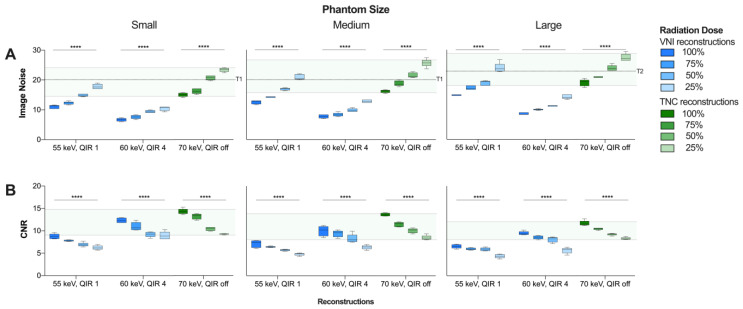
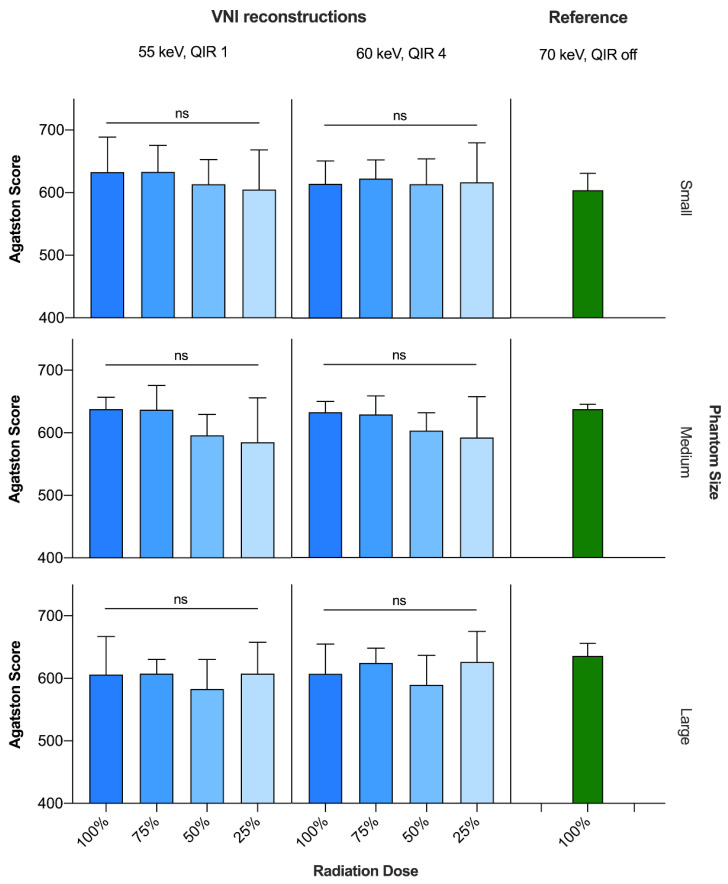
Background: On the basis of the hypothesis that virtual noniodine (VNI)-based coronary artery calcium scoring (CACS) is feasible at reduced radiation doses, this study assesses the impact of radiation dose reduction on the accuracy of this VNI algorithm on a photon-counting detector (PCD)-CT. Methods: In a systematic in vitro setting, a phantom for CACS simulating three chest sizes was scanned on a clinical PCD-CT. The standard radiation dose was chosen at volumetric CT dose indices (CTDIVol) of 1.5, 3.3, 7.0 mGy for small, medium-sized, and large phantoms, and was gradually reduced by adjusting the tube current resulting in 100, 75, 50, and 25%, respectively. VNI images were reconstructed at 55 keV, quantum iterative reconstruction (QIR)1, and at 60 keV/QIR4, and evaluated regarding image quality (image noise (IN), contrast-to-noise ratio (CNR)), and CACS. All VNI results were compared to true noncontrast (TNC)-based CACS at 70 keV and standard radiation dose (reference). Results: INTNC was significantly higher than INVNI, and INVNI at 55 keV/QIR1 higher than at 60 keV/QIR4 (100% dose: 16.7 ± 1.9 vs. 12.8 ± 1.7 vs. 7.7 ± 0.9; p < 0.001 for every radiation dose). CNRTNC was higher than CNRVNI, but it was better to use 60 keV/QIR4 (p < 0.001). CACSVNI showed strong correlation and agreement at every radiation dose (p < 0.001, r > 0.9, intraclass correlation coefficient > 0.9). The coefficients of the variation in root-mean squared error were less than 10% and thus clinically nonrelevant for the CACSVNI of every radiation dose. Conclusion: This phantom study suggests that CACSVNI is feasible on PCD-CT, even at reduced radiation dose while maintaining image quality and CACS accuracy.
Keywords: calcium scoring; computed tomography; coronary artery disease; photon-counting detector; radiation dose; virtual noniodine.
Conflict of interest statement
U.J.S. receives institutional research support and/or personal fees from Bayer, Bracco, Elucid Bioimaging, Guerbet, HeartFlow, Inc., Keya Medical, and Siemens. A.V.-S. receives institutional research support and/or personal fees from Bayer, Elucid Bioimaging and Siemens. T.E. received a speaker fee and travel support from Siemens Medical Solutions USA Inc. J.O. is an employee of Siemens Medical Solutions USA Inc. C.T. has received speaker’s fees from Siemens Healthineers, Heartflow Inc., and AstraZeneca.
Figures
References
-
- Grandhi G.R., Mirbolouk M., Dardari Z.A., Al-Mallah M.H., Rumberger J.A., Shaw L.J., Blankstein R., Miedema M.D., Berman D.S., Budoff M.J., et al. Interplay of Coronary Artery Calcium and Risk Factors for Predicting CVD/CHD Mortality: The CAC Consortium. JACC Cardiovasc. Imaging. 2020;13:1175–1186. doi: 10.1016/j.jcmg.2019.08.024. - DOI - PubMed
-
- Vakil P., Wen Z., Lima A.S., Weber E.J., Kallianos K.G., Elicker B.M., Naeger D.M., Henry T.S., Ordovas K.G. Predictive Value of Coronary Artery Calcium in Patients Receiving Computed Tomography Pulmonary Angiography for Suspected Pulmonary Embolism in the Emergency Department. J. Thorac. Imaging. 2022;37:279–284. doi: 10.1097/RTI.0000000000000654. - DOI - PubMed
LinkOut - more resources
Full Text Sources
Miscellaneous
