. 2023 May 3;24(9):8179.
doi: 10.3390/ijms24098179.

ABCA3 Deficiency-Variant-Specific Response to Hydroxychloroquine

Affiliations

ABCA3 Deficiency-Variant-Specific Response to Hydroxychloroquine

Xiaohua Yang et al. Int J Mol Sci. .

Abstract

Biallelic variants in ABCA3, the gene encoding the lipid transporter ATP-binding cassette subfamily A member 3 (ABCA3) that is predominantly expressed in alveolar type II cells, may cause interstitial lung diseases in children (chILD) and adults. Currently, there is no proven therapy, but, frequently, hydroxychloroquine (HCQ) is used empirically. We hypothesized that the in vitro responsiveness to HCQ might correlate to patients' clinical outcomes from receiving HCQ therapy. The clinical data of the subjects with chILD due to ABCA3 deficiency and treated with HCQ were retrieved from the literature and the Kids Lung Register data base. The in vitro experiments were conducted on wild type (WT) and 16 mutant ABCA3-HA-transfected A549 cells. The responses of the functional read out were assessed as the extent of deviation from the untreated WT. With HCQ treatment, 19 patients had improved or unchanged respiratory conditions, and 20 had respiratory deteriorations, 5 of whom transiently improved then deteriorated. The in vitro ABCA3 functional assays identified two variants with complete response, five with partial response, and nine with no response to HCQ. The variant-specific HCQ effects in vivo closely correlated to the in vitro data. An ABCA3+ vesicle volume above 60% of the WT volume was linked to responsiveness to HCQ; the HCQ treatment response was concentration dependent and differed for variants in vitro. We generated evidence for an ABCA3 variant-dependent impact of the HCQ in vitro. This may also apply for HCQ treatment in vivo, as supported by the retrospective and uncontrolled data from the treatment of chILD due to ABCA3 deficiency.

Keywords: ABCA3; ATP-binding cassette subfamily A member 3; HCQ; ILD; chILD; childhood interstitial lung disease; diffuse parenchymal lung disease; hydroxychloroquine; interstitial lung disease.


Conflict of interest statement

The authors declare no conflict of interest.

Figures
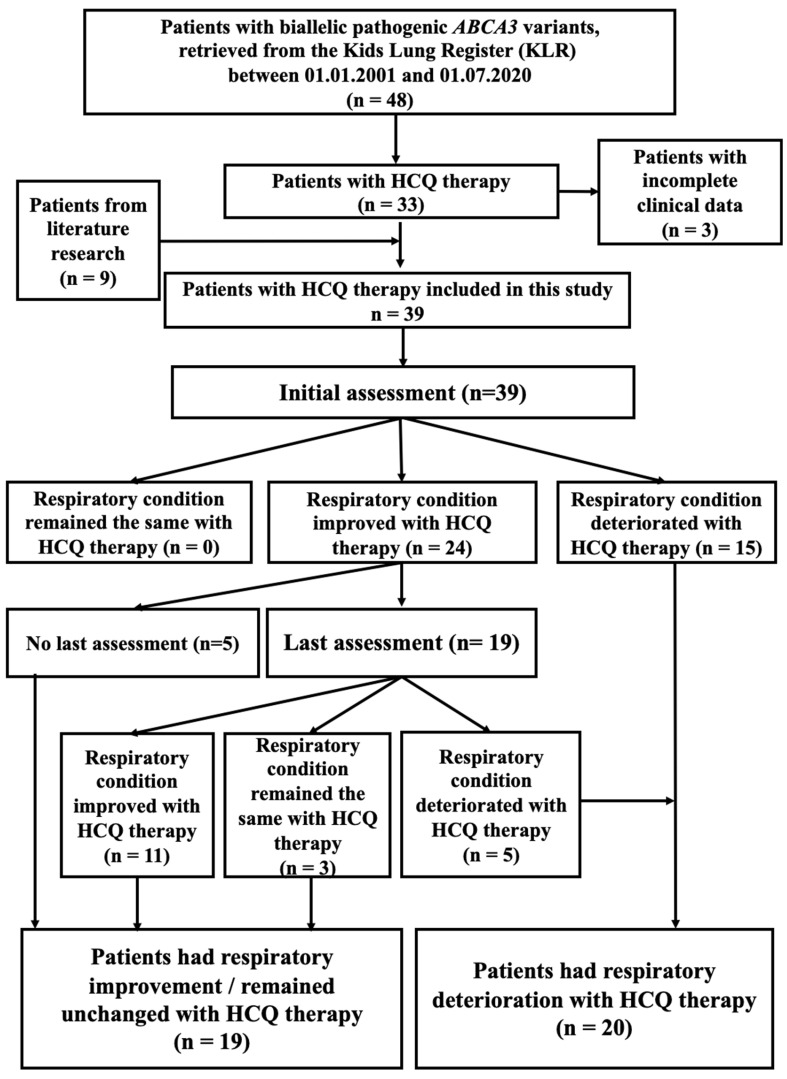
Figure 1
Figure 1
Flow chart of the cohort included in this study.
Figure 2
Figure 2
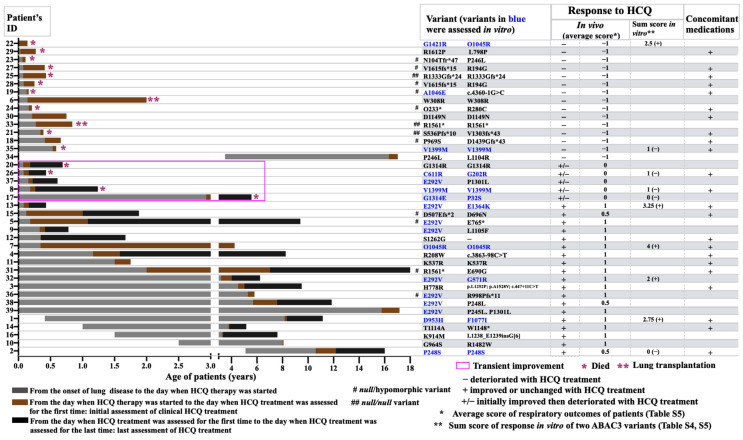
Cohort of 39 patients with pathogenic ABCA3 variants and treated with HCQ, sorted by age of lung disease onset and clinical severity. Data of patients 3, 14, 15, 16, 27, 28, 29, 30, and 31 were retrieved from the literature, and the other cases were from the Kids Lung Register (see Table S5). Start and duration of HCQ treatment varied largely. In most of the patients who survived a clinical response (in vivo, columns 3 and 4 from right) to HCQ treatment was noted, whereas, in those who dead, only transient or no responses were noted. The in vitro responses to HCQ (column 2 from right) where available were correlated to the in vivo responses.
Figure 3
Figure 3
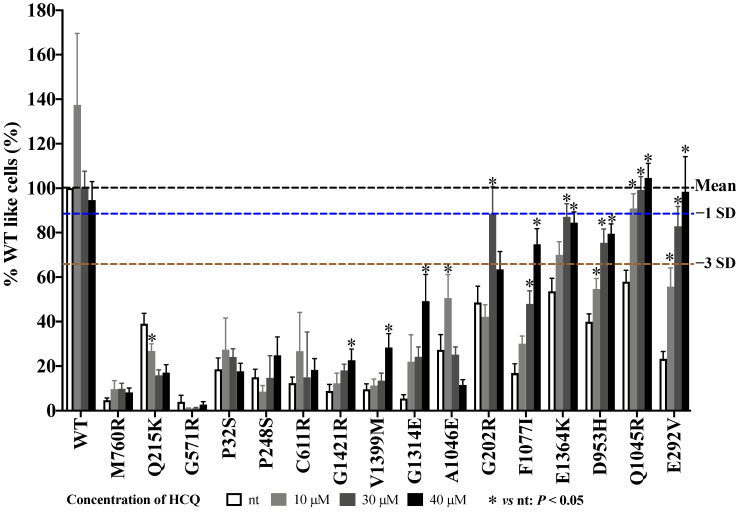
Response of 16 ABCA3 variants to HCQ in vitro assessed using high-content screening method. Results (% WT nt) were shown as means + S.E.M (Individual values were listed in Figure S5). Black dotted line indicated mean value. Blue dotted line indicated mean −1 nSD. Brown dotted line indicated mean −3 nSD. * indicates p value < 0.05.
Figure 4
Figure 4
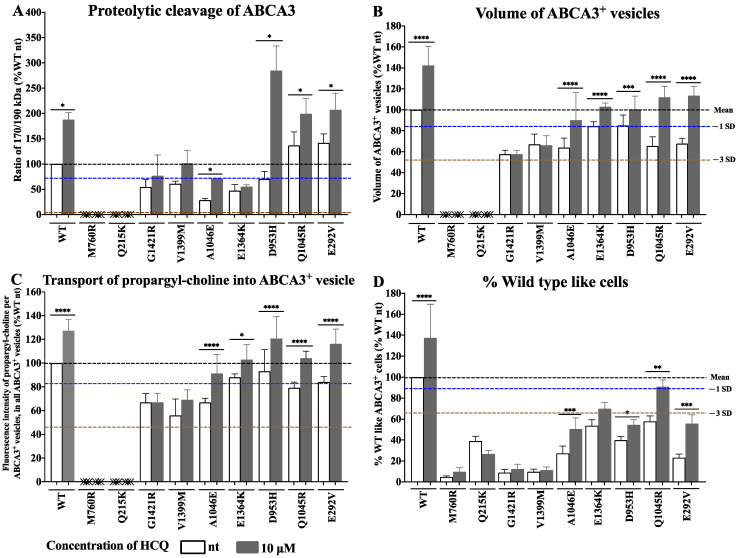
Nine ABCA3 variants assessed using three small-format assays for response to HCQ in vitro. Proteolytic cleavage of ABCA3 (A). Volume of ABCA3+ vesicles (B). Transport of propargyl-choline into ABCA3+ vesicles (C). Results from HCS with HCQ 10 μM treatment were shown as: % WT-like cells (D). Results (% WT nt) were shown as means + S.E.M of three independent experiments. * indicates p value 0.0332, ** indicates p value 0.0021, *** indicates p value 0.0002, and **** indicates p value < 0.0001. Black dotted line indicated mean value. Blue dotted line indicated mean −1 nSD. Brown dotted line indicated mean −3 nSD.
Figure 5
Figure 5
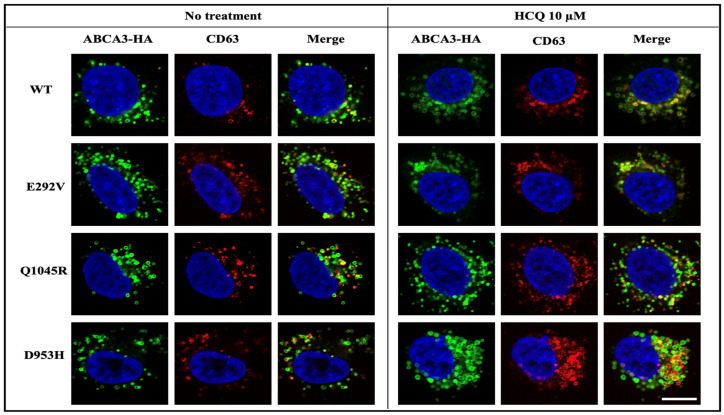
A549 cells stably expressing WT or mutated ABCA3-HA were treated with RPMI-1640 + 10% FBS (no treatment) or RPMI-1640 + 10% FBS-added HCQ 10 µM (HCQ 10 µM) for 24 h, and then stained for ABCA3-HA and lysosomal marker CD63. ABCA3-HA in green, CD63 in red, and DAPI in blue. Scale bar represents 20 μm.
Figure 6
Figure 6
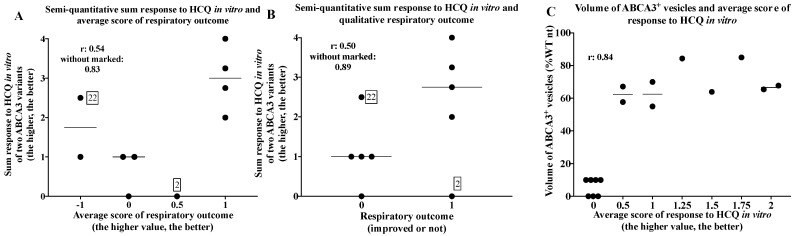
Correlation of semi-quantitative sum response to HCQ in vitro of two ABCA3 variants and average score of respiratory outcomes of patients (A), semi-quantitative sum responses to HCQ in vitro of two ABCA3 variants and qualitative respiratory outcomes of patients (B), and volume of ABCA3+ vesicles and average score of responses to HCQ in vitro by number of assays (C). Line indicates median value of individual values given in each column. Outlier were marked with patients’ ID in box (Table S5).
Figure 7
Figure 7
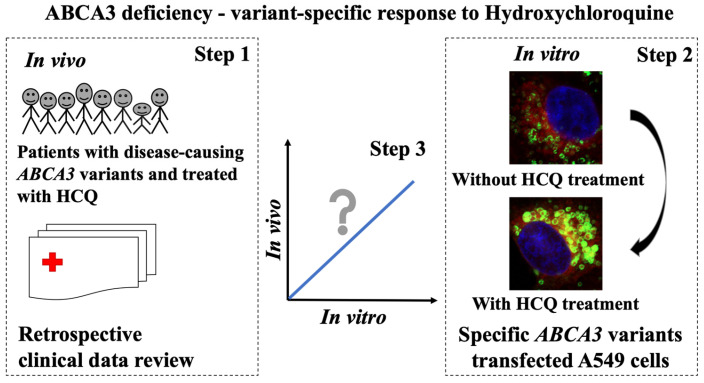
Summary of this study in pictogram: ABCA3 deficiency—variant-specific response to hydroxychloroquine. Step 1: systematically analyzed the clinical outcomes of patients with disease-causing ABCA3 variants treated with HCQ. Step 2: explored the effect of HCQ on 16 ABCA3 variants on the cellular level. Confocal images show E292V-variant-transfected A549 cells without and with exposure to HCQ (10 μM). Step 3: evaluated the relation of the HCQ response in vivo and in vitro.

References

    1. Ban N., Matsumura Y., Sakai H., Takanezawa Y., Sasaki M., Arai H., Inagaki N. ABCA3 as a lipid transporter in pulmonary surfactant biogenesis. J. Biol. Chem. 2007;282:9628–9634. doi: 10.1074/jbc.M611767200. - DOI - PubMed
    1. Griese M. Pulmonary surfactant in health and human lung diseases: State of the art. Eur. Respir. J. 1999;13:1455–1476. doi: 10.1183/09031936.99.13614779. - DOI - PubMed
    1. Hartl D., Griese M. Interstitial lung disease in children—Genetic background and associated phenotypes. Respir. Res. 2005;6:32. doi: 10.1186/1465-9921-6-32. - DOI - PMC - PubMed
    1. Schindlbeck U., Wittmann T., Höppner S., Kinting S., Liebisch G., Hegermann J., Griese M. ABCA3 missense mutations causing surfactant dysfunction disorders have distinct cellular phenotypes. Hum. Mutat. 2018;39:841–850. doi: 10.1002/humu.23416. - DOI - PubMed
    1. Wambach J.A., Casey A.M., Fishman M.P., Wegner D.J., Wert S.E., Cole F.S., Hamvas A., Nogee L.M. Genotype–Phenotype Correlations for Infants and Children with ABCA3 Deficiency. Am. J. Respir. Crit. Care Med. 2014;189:1538–1543. doi: 10.1164/rccm.201402-0342OC. - DOI - PMC - PubMed

Substances