Review
. 2023 May 5;24(9):8329.
doi: 10.3390/ijms24098329.

Tissue Sodium Accumulation Induces Organ Inflammation and Injury in Chronic Kidney Disease

Affiliations
Review

Tissue Sodium Accumulation Induces Organ Inflammation and Injury in Chronic Kidney Disease

Yasuhiko Ito et al. Int J Mol Sci. .

Abstract

High salt intake is a primary cause of over-hydration in chronic kidney disease (CKD) patients. Inflammatory markers are predictors of CKD mortality; however, the pathogenesis of inflammation remains unclear. Sodium storage in tissues has recently emerged as an issue of concern. The binding of sodium to tissue glycosaminoglycans and its subsequent release regulates local tonicity. Many cell types express tonicity-responsive enhancer-binding protein (TonEBP), which is activated in a tonicity-dependent or tonicity-independent manner. Macrophage infiltration was observed in the heart, peritoneal wall, and para-aortic tissues in salt-loading subtotal nephrectomized mice, whereas macrophages were not prominent in tap water-loaded subtotal nephrectomized mice. TonEBP was increased in the heart and peritoneal wall, leading to the upregulation of inflammatory mediators associated with cardiac fibrosis and peritoneal membrane dysfunction, respectively. Reducing salt loading by a diuretic treatment or changing to tap water attenuated macrophage infiltration, TonEBP expression, and inflammatory marker expression. The role of TonEBP may be crucial during the cardiac fibrosis and peritoneal deterioration processes induced by sodium overload. Anti-interleukin-6 therapy improved cardiac inflammation and fibrosis and peritoneal membrane dysfunction. Further studies are necessary to establish a strategy to regulate organ dysfunction induced by TonEBP activation in CKD patients.

Keywords: IL-6; TonEBP; inflammation; organ dysfunction; sodium storage.


Conflict of interest statement

The authors declare no conflict of interest.

Figures
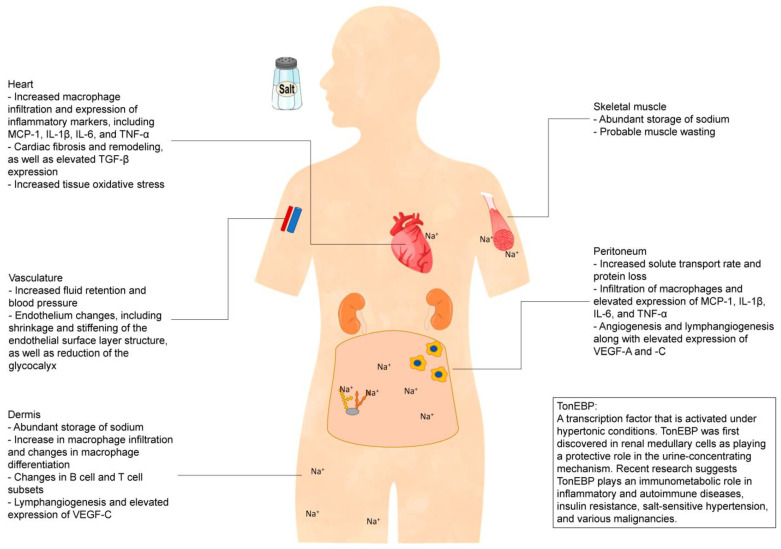
Figure 1
Figure 1
Excessive salt intake induces inflammation via local tonicity-responsive enhancer-binding protein (TonEBP) in the heart, vasculature, dermis, skeletal muscle, and peritoneum of patients with chronic renal failure.
Figure 2
Figure 2
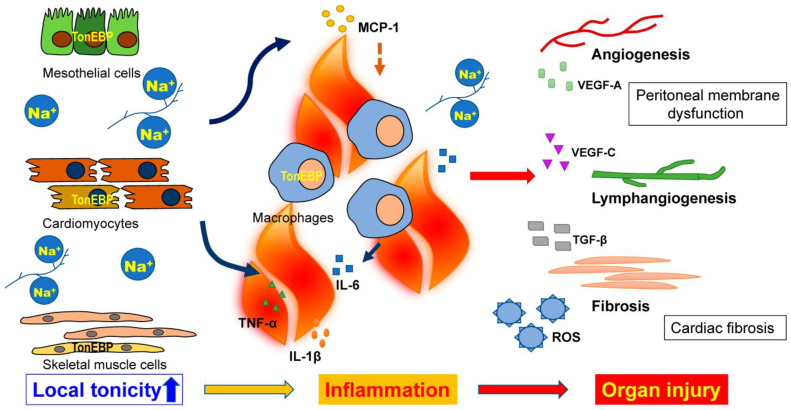
Under renal failure conditions with high salt intake, TonEBP plays a crucial role in the development of inflammation and tissue damage in the heart and peritoneal membrane. In 5/6Nx/NaCl mice with renal failure, high salt intake upregulates TonEBP in mesothelial cells and cardiomyocytes via increased local tonicity due to accumulation of sodium. Activation of TonEBP induces MCP-1 expression, leading to macrophage infiltration and upregulation of inflammatory cytokines, at least partly via the TonEBP–MCP-1 pathway. Inflammation causes tissue damage in the heart and peritoneal membrane, leading to cardiac fibrosis and high peritoneal transport rate with neoangiogenesis and lymphangiogenesis in PD.
Figure 3
Figure 3
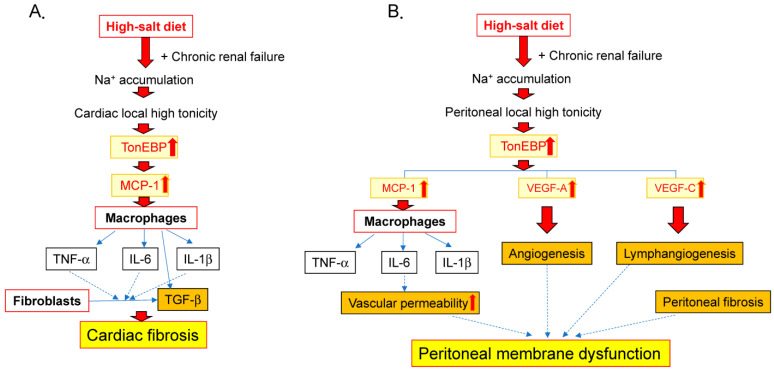
Mechanisms of tissue-sodium-accumulation-induced cardiac fibrosis and peritoneal membrane dysfunction via TonEBP activation. (A) Heart; (B) peritoneal membrane. (A) High salt intake induces activation of TonEBP, which upregulates MCP-1 expression by cardiomyocytes, leading to macrophage infiltration via the TonEBP–MCP-1 pathway in CKD [50]. Macrophages express inflammatory mediators such as TNF-α, IL-6, and IL-1, leading to induction of TGF-β in inflammation during the fibrosis process [78]. TonEBP plays an important role in cardiac inflammation and cardiac fibrosis in patients with renal failure and high salt intake. (B) Excessive dietary salt intake under renal dysfunction enhances accumulation of sodium, leading to activation of TonEBP [50]. TonEBP upregulates MCP-1, inflammatory cytokines, VEGF-A, and VEGF-C in vivo. IL-6 enhances MCP-1 and VEGF-A expression [74], leading to further macrophage infiltration and angiogenesis. High-tonicity conditions upregulate expression of MCP-1, IL-6, VEGF-A, and VEGF-C by mesothelial cells and macrophages via TonEBP activation [74]. TonEBP regulates inflammatory and angiogenetic changes in the peritoneum of CKD patients. These structural changes result in peritoneal membrane dysfunction.

References

    1. Borrelli S., De Nicola L., De Gregorio I., Polese L., Pennino L., Elefante C., Carbone A., Rappa T., Minutolo R., Garofalo C. Volume-Independent Sodium Toxicity in Peritoneal Dialysis: New Insights from Bench to Bed. Int. J. Mol. Sci. 2021;22:12804. doi: 10.3390/ijms222312804. - DOI - PMC - PubMed
    1. Titze J., Luft F.C. Speculations on salt and the genesis of arterial hypertension. Kidney Int. 2017;91:1324–1335. doi: 10.1016/j.kint.2017.02.034. - DOI - PubMed
    1. Nakayama M., Kawaguchi Y. Multicenter survey on hydration status and control of blood pressure in Japanese CAPD patients. Perit. Dial. Int. 2002;22:411–414. - PubMed
    1. Valtuille R. Potential Novel Benefits of Sodium Restriction in Chronic Kidney Disease. Curr. Hypertens. Rev. 2021;17:59–66. doi: 10.2174/1573402116666200615152139. - DOI - PubMed
    1. Minegishi S., Luft F.C., Titze J., Kitada K. Sodium Handling and Interaction in Numerous Organs. Am. J. Hypertens. 2020;33:687–694. doi: 10.1093/ajh/hpaa049. - DOI - PMC - PubMed