


Alternative Arterial Access Routes for Endovascular Thrombectomy in Patients with Acute Ischemic Stroke: A Study from the MR CLEAN Registry
- PMID: 37176697
- PMCID: PMC10179212
- DOI: 10.3390/jcm12093257
Alternative Arterial Access Routes for Endovascular Thrombectomy in Patients with Acute Ischemic Stroke: A Study from the MR CLEAN Registry
Abstract
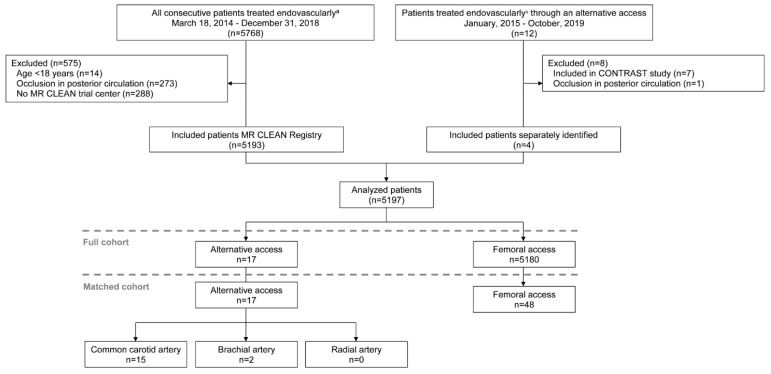
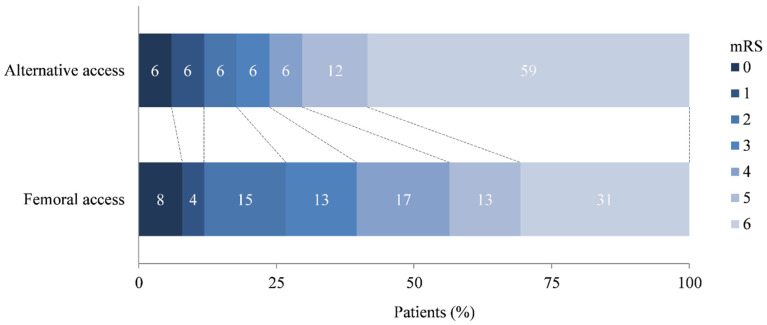
Background: Endovascular thrombectomy (EVT) through femoral access is difficult to perform in some patients with acute ischemic stroke due to challenging vasculature. We compared outcomes of EVT through femoral versus alternative arterial access. Methods: In this observational study, we included patients from the MR CLEAN Registry who underwent EVT for acute ischemic stroke in the anterior circulation between 2014 and 2019 in the Netherlands. Patients who underwent EVT through alternative and femoral access were matched on propensity scores in a 1:3 ratio. The primary endpoint was favorable functional outcome (modified Rankin Scale score ≤ 2) at 90 days. Secondary endpoints were early neurologic recovery, mortality, successful intracranial reperfusion and puncture related complications. Results: Of the 5197 included patients, 17 patients underwent EVT through alternative access and were matched to 48 patients who underwent EVT through femoral access. Alternative access was obtained through the common carotid artery (n = 15/17) and brachial artery (n = 2/17). Favorable functional outcome was less often observed after EVT through alternative than femoral access (18% versus 27%; aOR, 0.36; 95% CI, 0.05-2.74). The rate of successful intracranial reperfusion was higher for alternative than femoral access (88% versus 58%), although mortality (59% versus 31%) and puncture related complications (29% versus 0%) were more common after alternative access. Conclusions: EVT through alternative arterial access is rarely performed in the Netherlands and seems to be associated with worse outcomes than standard femoral access. A next step would be to compare the additional value of EVT through alternative arterial access after failure of femoral access.
Keywords: alternative access; brachial artery; carotid artery; endovascular thrombectomy; femoral artery; outcome; radial artery; stroke.
Conflict of interest statement
Amsterdam University Medical Center received funds from Stryker® for consultations by prof. dr. Majoie, prof. dr. Roos, and drs. Berkhemer. Maastricht University Medical Center received funds from Stryker® and Codman® for consultations by prof. dr. Van Zwam. Prof. dr. van Zwam: consultation fees from Stryker, Nico Lab, and Cerenovus, paid to the institution. Prof. dr. Majoie: Related: Grants TWIN Foundation; Unrelated: Grants from CVON/Dutch Heart Foundation, Stryker, European Commission, TWIN Foundation, Healthcare Evaluation Netherlands (all paid to institution); shareholder of Nico-lab, a company that focuses on the use of artificial intelligence for medical image analysis (modest). Prof. dr. Dippel: unrestricted grants from Dutch Heart Foundation, Dutch Brain Foundation, The Netherlands Organisation for Health Research and Development, Health Holland Top Sector Life Science, AngioCare BV, Covidien/EV3, MEDAC GmbH/LAMEPRO, Top Medical/Concentric, Thrombolytic Science LLC, Stryker, Medtronic and Penumbra Inc. for the conduct of trials of acute treatment for stroke. The other authors report no conflict.
Figures
References
Grants and funding
LinkOut - more resources
Full Text Sources
Medical
