


Association between the triglyceride-glucose index and the presence and prognosis of coronary microvascular dysfunction in patients with chronic coronary syndrome
- PMID: 37179333
- PMCID: PMC10183136
- DOI: 10.1186/s12933-023-01846-z
Association between the triglyceride-glucose index and the presence and prognosis of coronary microvascular dysfunction in patients with chronic coronary syndrome
Abstract
Background: Coronary microvascular dysfunction (CMD) is a strong determinant of prognosis in patients with chronic coronary syndrome (CCS). The triglyceride-glucose index (TyG index), an alternative method to evaluate insulin resistance, is positively correlated with the incidence and adverse outcomes of cardiovascular diseases. However, the relationship between the TyG index and the presence and prognosis of CMD in CCS patients has not been investigated. Therefore, we aimed to evaluate the association between the TyG index and the presence and clinical outcomes of CMD among CCS patients.
Methods: CCS patients who underwent coronary angiography between June 2015 to June 2019 were included. The TyG index was calculated as Ln[fasting triglycerides (mg/dL) × fasting blood glucose (mg/dL)/2]. Coronary angiography‑derived index of microvascular resistance (caIMR) was used to measure microvascular function, and CMD was defined as caIMR ≥ 25U. Patients with CMD were divided into three groups (T1, T2, and T3 groups) according to TyG tertiles. The primary endpoint was major adverse cardiac event (MACE).
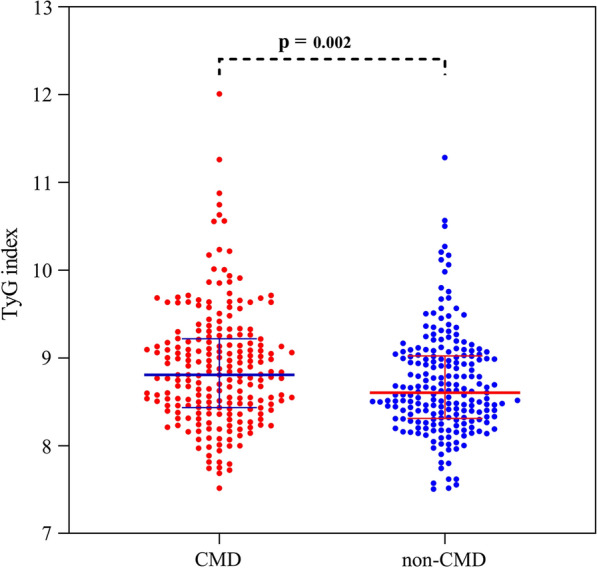
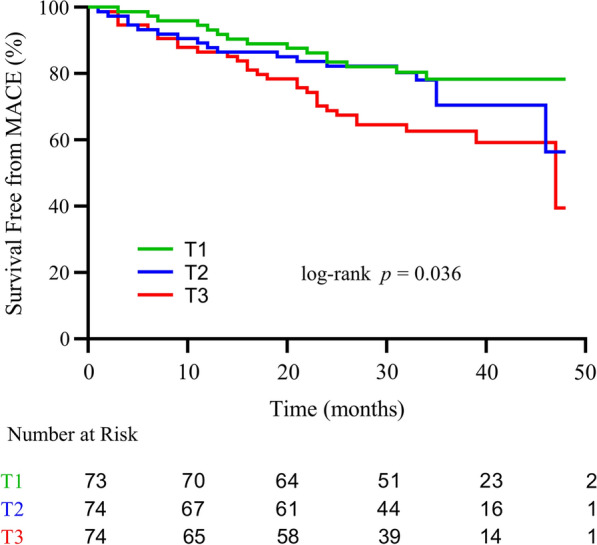
Results: Of 430 CCS patients, 221 patients had CMD. CMD patients had significantly higher TyG index than those without CMD. Sixty-three MACE was recorded during the follow-up duration among CMD patients, and the incidence rate of MACE was higher in the T3 group compared to T1/T2 groups (39.2% vs. 20.5% vs. 25.7%; P = 0.035). Multivariable logistic regression analysis showed that the TyG index was an independent predictor of CMD (OR, 1.436; 95% CI, 1.014-2.034; P = 0.042). Compared to the T1 group, the T3 group strongly correlated with the risk of MACE in CMD patients even after adjusting for additional confounding risk factors (HR, 2.132; 95%CI, 1.066-4.261; P = 0.032).
Conclusion: TyG index is significantly associated with the risk of CMD, and it is an independent predictor of MACE among CMD patients with CCS. This study suggests that the TyG index has important clinical significance for the early prevention and risk stratification of CMD.
Keywords: Chronic coronary syndrome; Clinical outcomes; Coronary angiography‑derived index of microvascular resistance; Coronary microvascular dysfunction; Triglyceride-glucose index.
© 2023. The Author(s).
Conflict of interest statement
The authors declare no conflict of interest.
Figures


References
-
- Padro T, Manfrini O, Bugiardini R, Canty J, Cenko E, De Luca G, et al. ESC Working Group on Coronary Pathophysiology and Microcirculation position paper on 'coronary microvascular dysfunction in cardiovascular disease'. Cardiovasc Res. 2020;116(4):741–755. doi: 10.1093/cvr/cvaa003. - DOI - PMC - PubMed
Publication types
MeSH terms
Substances
LinkOut - more resources
Full Text Sources
