. 2023 Apr 26;8(18):16471-16478.
doi: 10.1021/acsomega.3c01647. eCollection 2023 May 9.

Adsorption and Dissociation of R-Methyl p-Tolyl Sulfoxide on Au(111)

Affiliations

Adsorption and Dissociation of R-Methyl p-Tolyl Sulfoxide on Au(111)

Mauro Satta et al. ACS Omega. .

Abstract

Sulfur-based molecules producing self-assembled monolayers on gold surfaces have long since become relevant functional molecular materials with many applications in biosensing, electronics, and nanotechnology. Among the various sulfur-containing molecules, the possibility to anchor a chiral sulfoxide to a metal surface has been scarcely investigated, despite this class of molecules being of great importance as ligands and catalysts. In this work, (R)-(+)-methyl p-tolyl sulfoxide was deposited on Au(111) and investigated by means of photoelectron spectroscopy and density functional theory calculations. The interaction with Au(111) leads to a partial dissociation of the adsorbate due to S-CH3 bond cleavage. The observed kinetics support the hypotheses that (R)-(+)-methyl p-tolyl sulfoxide adsorbs on Au(111) in two different adsorption arrangements endowed with different adsorption and reaction activation energies. The kinetic parameters related to the adsorption/desorption and reaction of the molecule on the Au(111) surface have been estimated.


Conflict of interest statement

The authors declare no competing financial interest.

Figures

Figure 1
Figure 1
Structure of R-methyl p-tolyl sulfoxide (Metoso).
Figure 2
Figure 2
Photoelectron spectra of the S 2p region taken with 300 eV photon energy at different time delays after sample exposure. Each curve is the average of five consecutive scans, lasting in total 210 s. The numbers on the right indicate acquisition order. The first series of spectra (1–6 bottom curves) have been acquired in succession soon after exposure and the second series (7–12 top curves) about 100 min later. Background has been subtracted and spectra are vertically displaced. (a) Au(111) exposition to Metoso for 30 min; (b) Au(111) exposition to Metoso for 60 min; (c) temporal evolution of the signals area of the two S 2p doublets, with 2p3/2 component at 165.9 eV (circles) and 163.5 eV (triangles) for 30 min exposure to Metoso (black) and for 60 min exposure to Metoso (red). The blue dashed lines serve  only  to  guide  the  eye.
Figure 3
Figure 3
PES spectra of Metoso deposited on clean Au for 30 min (black lines) and 60 min (red lines). (a) O 1s region for a 650 eV photon energy with total fitted area (see text and the Supporting Information for details). (b) C 1s region for a 410 eV photon energy; left: absolute intensities, right: intensities normalized from 0 to 1.
Figure 4
Figure 4
Structure and energetics of Metoso and Metoso–CH3 monomers adsorbed on Au(111). Gray: Au atoms, yellow: S atom, red: O atom, dark brown: C atoms, green: hydrogen atoms. ΔE refers to the adsorption energy and δPES(O 1s) to the shift of the O 1s core-level binding energy with respect to that of the free molecule in the gas phase.
Figure 5
Figure 5
Born–Haber cycle resulting from the DFT-calculated energies for Metoso and fragments in gas phase and adsorbed on Au(111).
Figure 6
Figure 6
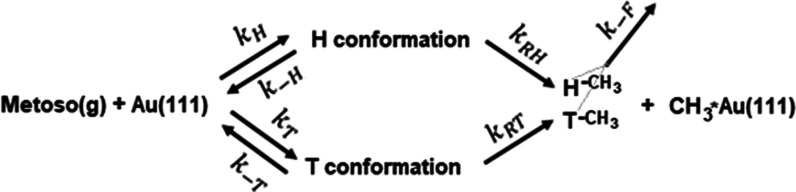
Proposed kinetic model.

References

    1. Love J. C.; Estroff L. A.; Kriebel J. K.; Nuzzo R. G.; Whitesides G. M. Self-Assembled Monolayers of Thiolates on Metals as a Form of Nanotechnology. Chem. Rev. 2005, 105, 1103–1169. 10.1021/cr0300789. - DOI - PubMed
    1. Ulman A. Formation and Structure of Self-Assembled Monolayers. Chem. Rev. 1996, 96, 1533.10.1021/cr9502357. - DOI - PubMed
    1. Singh M.; Kaur N.; Comini E. Role of Self-Assembled Monolayers in Electronic Devices. J. Mater. Chem. C 2020, 8, 3938–3955. 10.1039/D0TC00388C. - DOI
    1. Casalini S.; Bortolotti C. A.; Leonardi F.; Biscarini F. Self-assembled monolayers in organic electronics. Chem. Soc. Rev. 2017, 46, 40.10.1039/C6CS00509H. - DOI - PubMed
    1. Habibi N.; Kamaly N.; Memic A.; Shafiee H. Self-assembled peptide-based nanostructures: Smart nanomaterials toward targeted drug delivery. Nano Today 2016, 11, 41–60. 10.1016/j.nantod.2016.02.004. - DOI - PMC - PubMed