. 2023 Feb 20;8(5):1034-1042.
doi: 10.1016/j.ekir.2023.02.1079. eCollection 2023 May.

Renal Functional Response-Association With Birth Weight and Kidney Volume

Affiliations

Renal Functional Response-Association With Birth Weight and Kidney Volume

Bjørn Steinar Lillås et al. Kidney Int Rep. .

Abstract

Introduction: Renal functional response (RFR) is the acute increase in glomerular filtration rate (GFR) after a protein load. Low RFR is a marker of single nephron hyperfiltration. Low birth weight (LBW) is associated with reduced number of nephrons, lower kidney function, and smaller kidneys in adults. In the present study, we investigate the associations among LBW, kidney volume, and RFR.

Methods: We studied adults aged 41 to 52 years born with either LBW (≤2300 g) or normal birth weight (NBW; 3500-4000 g). GFR was measured using plasma clearance of iohexol. A stimulated GFR (sGFR) was measured on a separate day after a protein load of 100 g using a commercially available protein powder, and RFR was calculated as delta GFR. Kidney volume was estimated from magnetic resonance imaging (MRI) images using the ellipsoid formula.

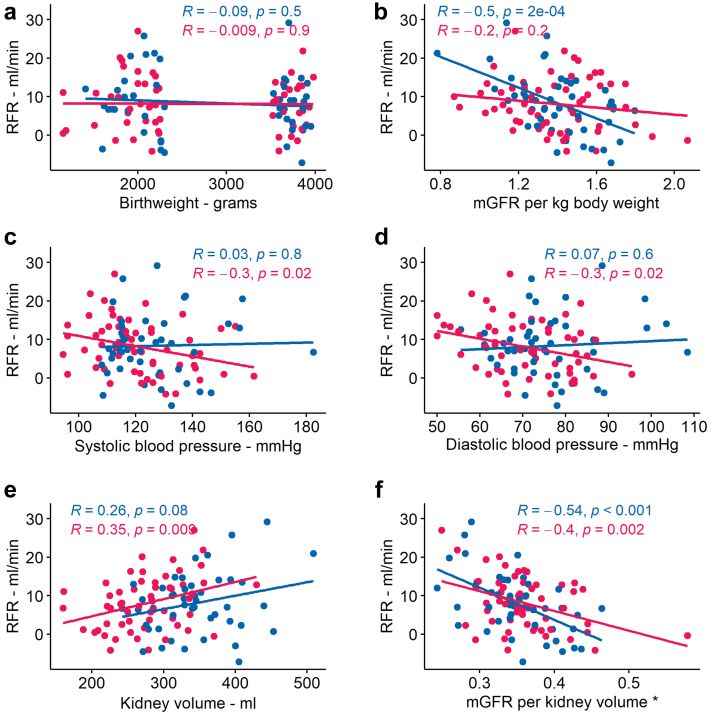
Results: A total of 57 women and 48 men participated. The baseline mean ± SD GFR was 118 ± 17 ml/min for men and 98 ± 19 ml/min for women. The overall mean RFR was 8.2 ± 7.4 ml/min, with mean RFR of 8.3 ± 8.0 ml/min and 8.1 ± 6.9 ml/min in men and women, respectively (P = 0.5). No birth-related variables were associated with RFR. Larger kidney volume was associated with higher RFR, 1.9 ml/min per SD higher kidney volume (P = 0.009). Higher GFR per kidney volume was associated with a lower RFR, -3.3ml/min per SD (P < 0.001).

Conclusion: Larger kidney size and lower GFR per kidney volume were associated with higher RFR. Birth weight was not shown to associate with RFR in mainly healthy middle-aged men and women.

Keywords: iohexol clearance; kidney volume; low birth weight; measured GFR; renal functional reserve; renal functional response; renal stress test.


Figures

None
Graphical abstract
Figure 1
Figure 1
Changes in GFR after protein load. Individual changes from baseline GFR after stimulation with 100 g protein in the form of a protein shake. Results are stratified by birth weight group and by sex. LBW = Low birth weight (<2300 g) and NBW = Normal birth weight (3500–4000 g). Mean RFR ± SD in % given for each group. LBW, low birth weight; NBW, normal birth weight; RFR, renal functional response.
Figure 2
Figure 2
Association between RFR and various variables using regression Legend: Blue dots, lines, and text represent male participants; pink dots, lines, and text represent female participants. For all plots, dependent variable is RFR (ml/min). The independent variables are as follows: (a) birth weight in grams, (b) mGFR per kg body weight in ml/min/kg, (c) systolic blood pressure in mmHg, (d) diastolic blood pressure in mm Hg, (e) kidney volume in ml, and (f) measured GFR per kidney volume in ml/min/ml. mGFR, measured GFR; RFR, renal functional response.
Figure 3
Figure 3
Kidney volume mediates effect of body size and body composition on renal functional response. (a) Example model, (b) Weight, (c) Body mass index, and (d) Body surface area. Each figure represents 3 regression equations as follows: (i) Independent variable-dependent variable, β1 is the effect estimate (with 95% confidence interval); (ii) Independent variable-mediator, with β2 as the effect estimate; and (iii) independent variable and mediator-dependent variable, with β3 as the effect estimate of the mediator and β4 as the effect estimate of the independent variable. The direct effect of the independent variable is given as β4, whereas the indirect (mediated) effect is β2 × β3 or also β4−β1.

References

    1. De Moor B., Vanwalleghem J.F., Swennen Q., Stas K.J., Meijers B.K.I. Haemodynamic or metabolic stimulation tests to reveal the renal functional response: requiem or revival? Clin Kidney J. 2018;11:623–654. doi: 10.1093/ckj/sfy022. - DOI - PMC - PubMed
    1. Bosch J.P., Saccaggi A., Lauer A., Ronco C., Belledonne M., Glabman S. Renal functional reserve in humans. Effect of protein intake on glomerular filtration rate. Am J Med. 1983;75:943–950. doi: 10.1016/0002-9343(83)90873-2. - DOI - PubMed
    1. Ronco C., Bellomo R., Kellum J. Understanding renal functional reserve. Intensive Care Med. 2017;43:917–920. doi: 10.1007/s00134-017-4691-6. - DOI - PubMed
    1. Bosch J.P., Lauer A., Glabman S. Short-term protein loading in assessment of patients with renal disease. Am J Med. 1984;77:873–879. doi: 10.1016/0002-9343(84)90529-1. - DOI - PubMed
    1. Sharma A., Zaragoza J.J., Villa G., et al. Optimizing a kidney stress test to evaluate renal functional reserve. Clin Nephrol. 2016;86:18–26. doi: 10.5414/CN108497. - DOI - PubMed

LinkOut - more resources