


Spinal cords: Symphonies of interneurons across species
- PMID: 37180760
- PMCID: PMC10169611
- DOI: 10.3389/fncir.2023.1146449
Spinal cords: Symphonies of interneurons across species
Abstract
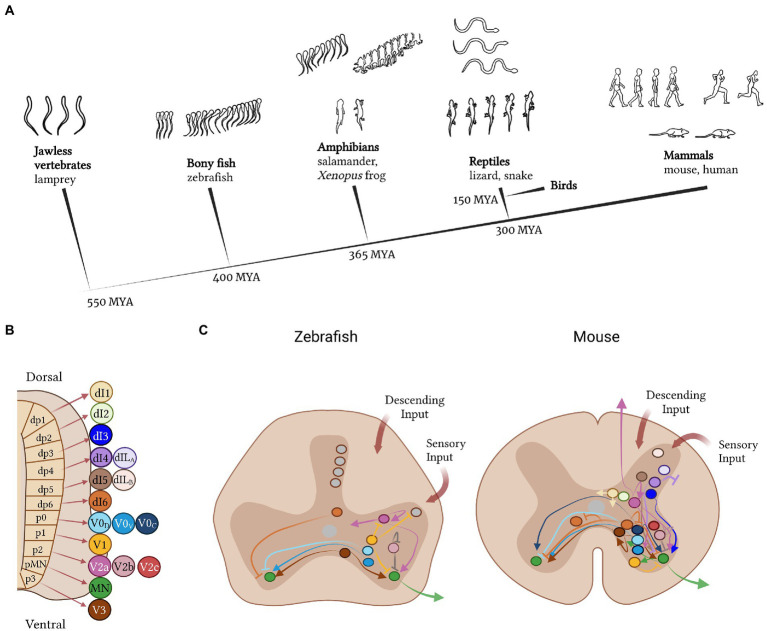
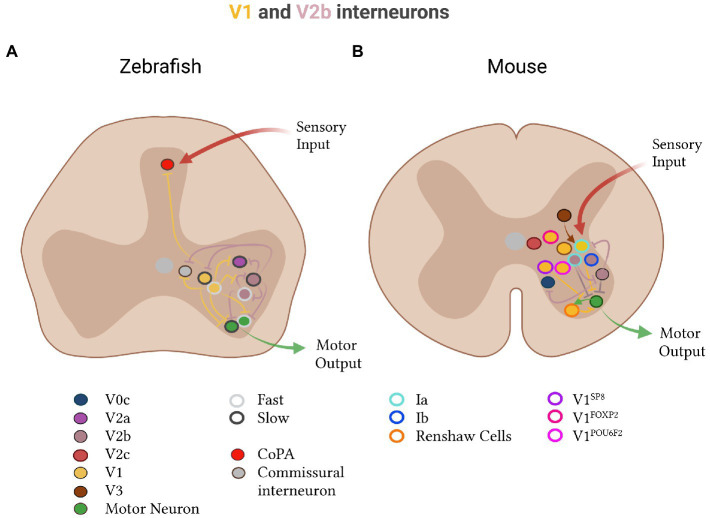
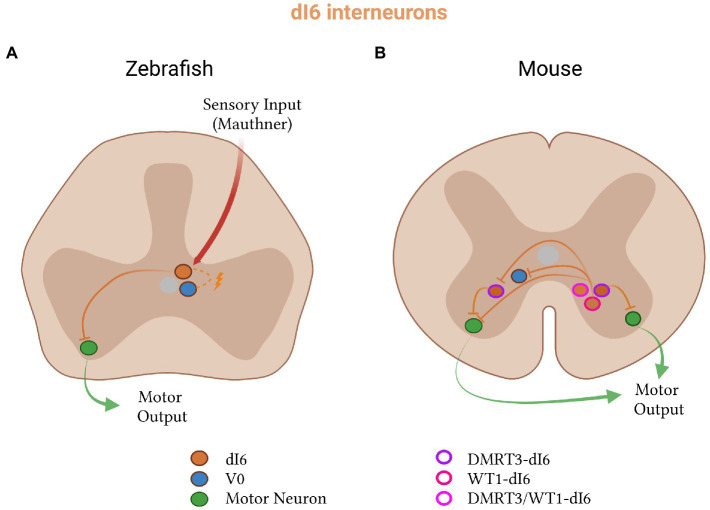
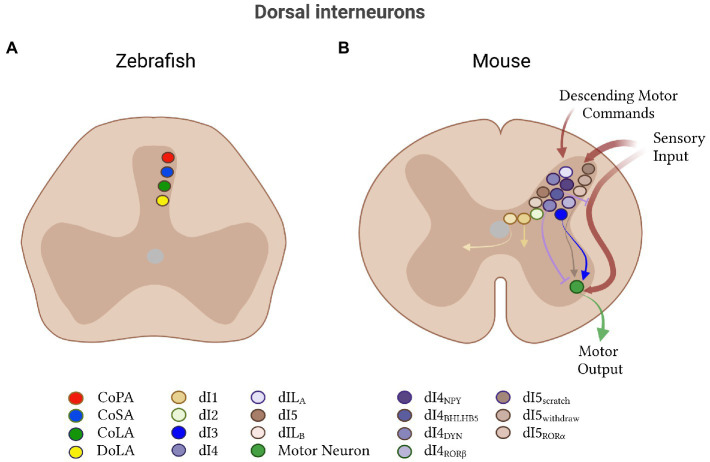
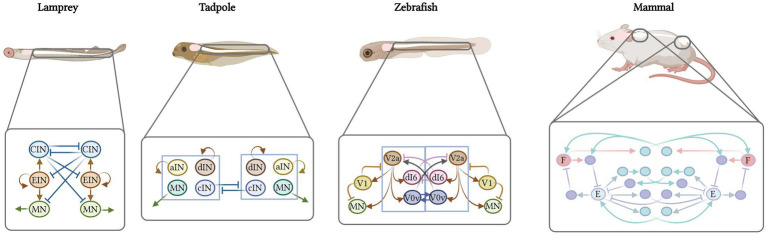
Vertebrate movement is orchestrated by spinal inter- and motor neurons that, together with sensory and cognitive input, produce dynamic motor behaviors. These behaviors vary from the simple undulatory swimming of fish and larval aquatic species to the highly coordinated running, reaching and grasping of mice, humans and other mammals. This variation raises the fundamental question of how spinal circuits have changed in register with motor behavior. In simple, undulatory fish, exemplified by the lamprey, two broad classes of interneurons shape motor neuron output: ipsilateral-projecting excitatory neurons, and commissural-projecting inhibitory neurons. An additional class of ipsilateral inhibitory neurons is required to generate escape swim behavior in larval zebrafish and tadpoles. In limbed vertebrates, a more complex spinal neuron composition is observed. In this review, we provide evidence that movement elaboration correlates with an increase and specialization of these three basic interneuron types into molecularly, anatomically, and functionally distinct subpopulations. We summarize recent work linking neuron types to movement-pattern generation across fish, amphibians, reptiles, birds and mammals.
Keywords: cross-species comparison; interneuron; motor control; movement; spinal cord; vertebrate evolution.
Copyright © 2023 Wilson and Sweeney.
Conflict of interest statement
The authors declare that the research was conducted in the absence of any commercial or financial relationships that could be construed as a potential conflict of interest.
Figures
References
Publication types
MeSH terms
LinkOut - more resources
Full Text Sources
Other Literature Sources
Molecular Biology Databases
