Review
. 2023 Apr 25;9(5):e15700.
doi: 10.1016/j.heliyon.2023.e15700. eCollection 2023 May.

Beyond mechanical loading: The metabolic contribution of obesity in osteoarthritis unveils novel therapeutic targets

Affiliations
Review

Beyond mechanical loading: The metabolic contribution of obesity in osteoarthritis unveils novel therapeutic targets

Basma H Sobieh et al. Heliyon. .

Abstract

Osteoarthritis (OA) is a prevalent progressive disease that frequently coexists with obesity. For several decades, OA was thought to be the result of ageing and mechanical stress on cartilage. Researchers' perspective has been greatly transformed when cumulative findings emphasized the role of adipose tissue in the diseases. Nowadays, the metabolic effect of obesity on cartilage tissue has become an integral part of obesity research; hoping to discover a disease-modifying drug for OA. Recently, several adipokines have been reported to be associated with OA. Particularly, metrnl (meteorin-like) and retinol-binding protein 4 (RBP4) have been recognized as emerging adipokines that can mediate OA pathogenesis. Accordingly, in this review, we will summarize the latest findings concerned with the metabolic contribution of obesity in OA pathogenesis, with particular emphasis on dyslipidemia, insulin resistance and adipokines. Additionally, we will discuss the most recent adipokines that have been reported to play a role in this context. Careful consideration of these molecular mechanisms interrelated with obesity and OA will undoubtedly unveil new avenues for OA treatment.

Keywords: Adipokines; Dyslipidemia; Insulin resistance; Metrnl; Obesity; Osteoarthritis.


Conflict of interest statement

The authors declare no competing interests.

Figures
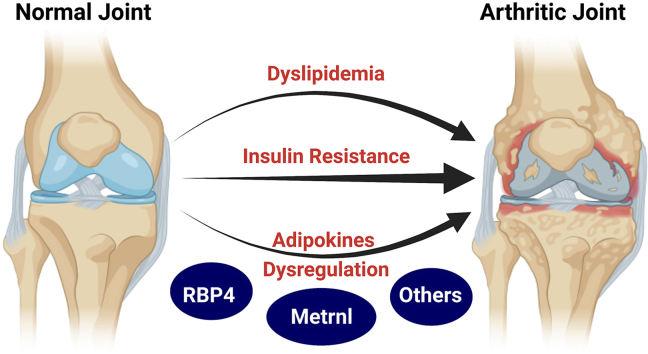
Image 1
Graphical abstract
Fig. 1
Fig. 1
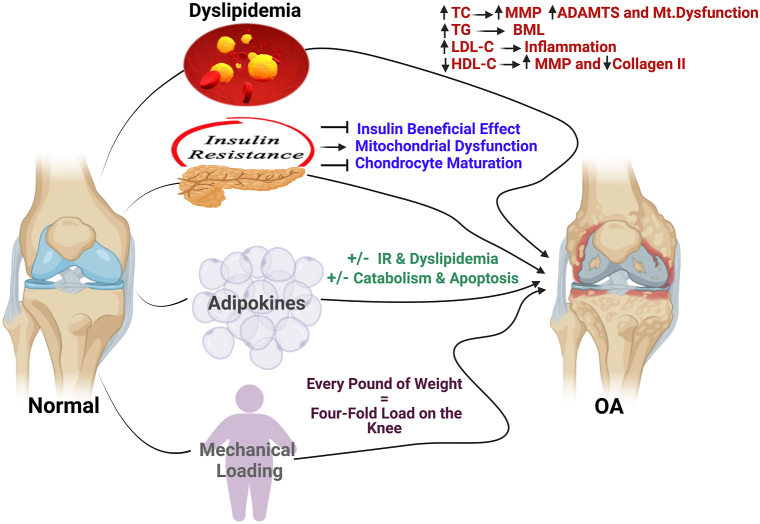
Multi-factorial interplay between obesity and OA. Dyslipidemia, insulin resistance, adipokines and mechanical loading are the four aspects by which obesity affects normal knee and induces OA. The arrows represent a summary of how each aspect leads to OA development. ADAMTS: a disintegrin and metalloproteinase with thrombospondin motifs, BML: bone marrow lesions, HDL-C: high-density lipoprotein cholesterol, IR: insulin resistance, LDL-C: low-density lipoprotein cholesterol, MMP: matrix metalloproteinases, Mt. dysfunction: mitochondrial dysfunction, OA: osteoarthritis, TC: total cholesterol and TAG: triglycerides. Created by Biorender.com.
Fig. 2
Fig. 2
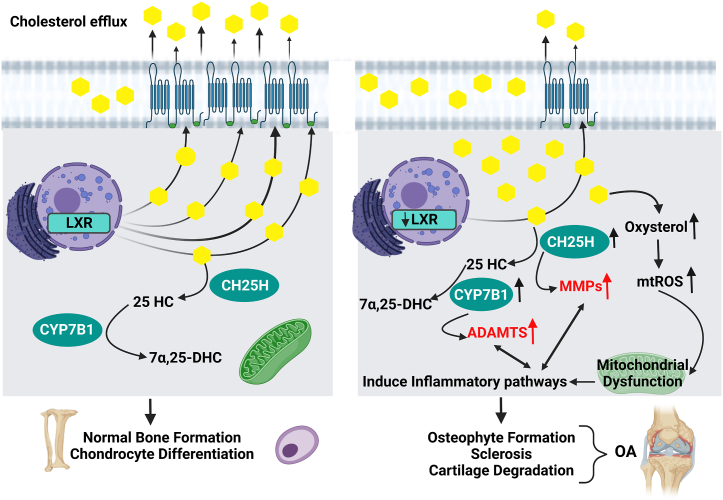
Hypercholesterolemia and OA interplay. During chondrocytes differentiation and bone formation, there is an increase in the expression of cholesterol efflux receptors. On the other hand, during OA, these receptors are downregulated that leads to cholesterol accumulation. Cholesterol hydroxylases are upregulated as well. As a result, degradative enzymes, catabolic factors and cholesterol byproducts increase leading to OA. ADAMTS: a disintegrin and metalloproteinase with thrombospondin motifs, CH25H: cholesterol 25-hydroxylase, CYP7B1: 25-hydroxycholesterol 7α-hydroxylase, 7α,25-DHC: 7α,25-dihydroxy cholesterol, 25-HC: 25-hydroxy cholesterol, LXR: liver X receptor, MMP: matrix metalloproteinases, mtROS: mitochondrial-reactive oxygen species, and OA: osteoarthritis. Created by Biorender.com.
Fig. 3
Fig. 3
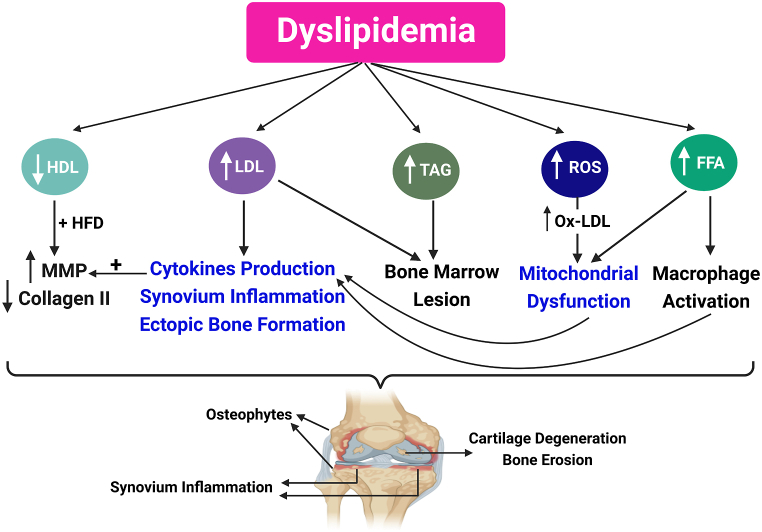
Multiple aspects of the contribution of dyslipidemia in the OA process. Dyslipidemia is characterized by high levels of LDL, TAG, FFA and ROS, and low levels of HDL. All these factors contribute to OA development and progression via several mechanisms. FFA: free fatty acids, HDL: high-density lipoprotein, HFD: high-fat diet, LDL: low-density lipoprotein, MMP: matrix metalloproteinases, Ox-LDL: oxidized low-density lipoprotein, ROS: reactive oxygen species, and TAG: triglycerides. Created by Biorender.com.
Fig. 4
Fig. 4
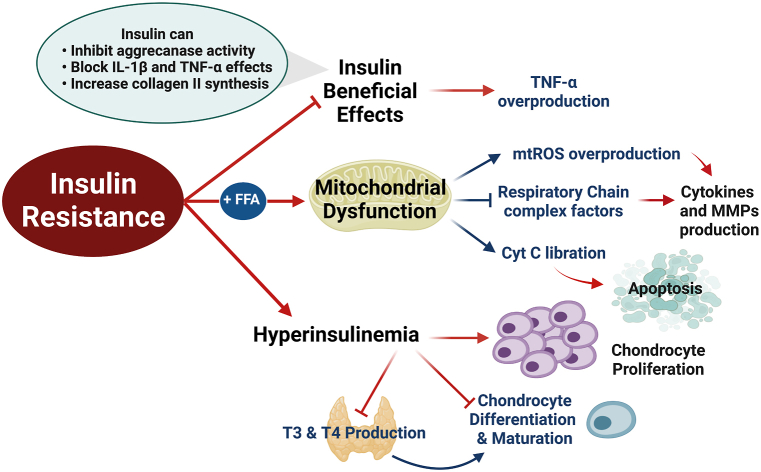
The role of insulin resistance in the OA degenerative process. During IR, the insulin receptors in chondrocytes and synovium become less responsive to insulin’s beneficial effects leading to the overproduction of cytokines. There is also an increase in FFA which leads to mitochondrial dysfunction which ultimately leads to cytokines release and apoptosis. Furthermore, hyperinsulinemia hinders the formation of mature chondrocytes by increasing the proliferation of chondrocytes, preventing their differentiation, and reducing the circulating levels of thyroid hormones. Red arrows with pointed ends imply the processes which are ultimately induced because of IR, while those with blunt ends imply processes which are ultimately inhibited as a consequence of IR. Cyt C: cytochrome C, FFA: free fatty acids, IL-1β: interleukin-1β, MMP: matrix metalloproteinases, mtROS: mitochondrial-reactive oxygen species, T3 and T4: thyroid hormones, and TNF-α: tumor necrosis factor α. Created by Biorender.com.
Fig. 5
Fig. 5
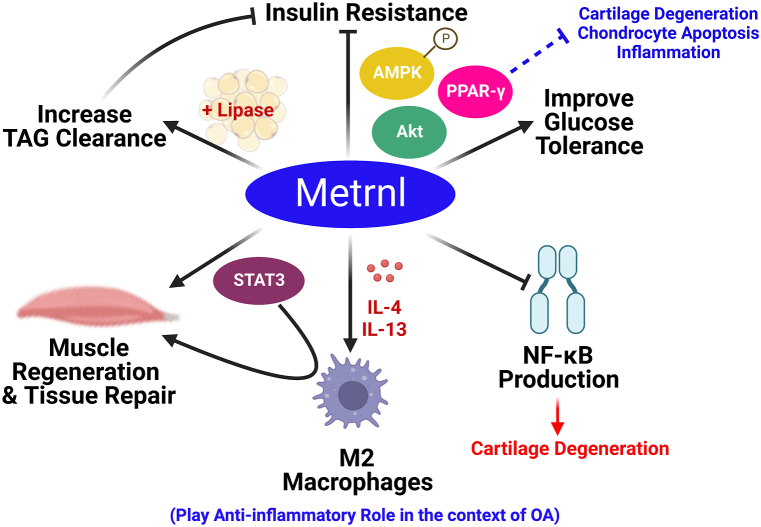
Metrnl beneficial effects as well as the reported/suggested pathways by which metrnl contributes to OA. Metrnl has several beneficial effects such as improving glucose tolerance and hence alleviating insulin resistance. This is mediated via the activation of PPAR-γ, Akt and AMPK. Metrnl has anti-inflammatory effects via inhibiting NF-κB signalling and activating M2 macrophages, the anti-inflammatory type. Additionally, Metrnl can regulate muscle regeneration and tissue repairs via the activation of STAT3 and M2 macrophages. Akt: protein kinase B, AMPK: adenosine monophosphate-activated protein kinase, IL: interleukin, NF-κB: nuclear factor-kappa B, PPAR-γ: peroxisome proliferator-activated receptor gamma, STAT3: signal transducer and activator of transcription protein-3, and TAG: triglycerides. Created by Biorender.com.
Fig. 6
Fig. 6
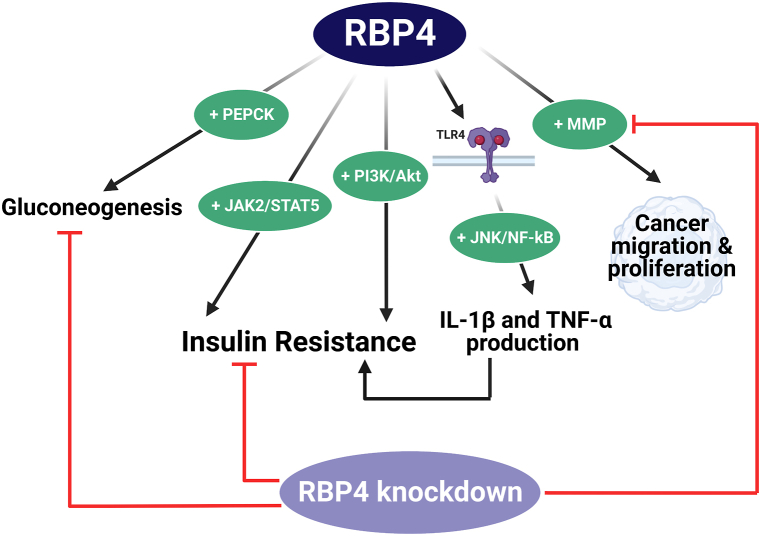
The reported effects of RBP4 by which it possibly contributes to OA pathogenesis. RBP4 induces IR by stimulating PI3K/Akt and JAK2/STAT5 pathways. In addition, RBP4 activates the inflammatory pathways (JNK and NF-κB) after binding with its receptor (TLR4). This leads to overproduction of inflammatory cytokines such as IL-1β and TNF-α. This also leads to IR development. RBP4 also induces gluconeogenesis by stimulating the gluconeogenic enzyme; PEPCK. RBP4 can promote MMP release in various tissues such as cancerous cells to enhance their migration and proliferation. Knockdown of RBP4 can suppress MMP production and gluconeogenesis and enhance insulin sensitivity. Akt: protein kinase B, IL-1β: interleukin-1β, IR: insulin resistance, JAK2/STAT5: Janus kinase 2/signal transducer and activator of transcription protein-5, JNK: c-Jun N-terminal kinases, MMP: matrix metalloproteinases, NF-κB: nuclear factor-kappa B, OA: osteoarthritis, PEPCK: phosphoenolpyruvate carboxykinase, PI3K: Phosphoinositide-3-kinases RBP4: retinol-binding protein 4, TLR4: toll-like receptor 4, and TNF-α: tumor necrosis factor α. Created by Biorender.com.

References

    1. Leifer V.P., Katz J.N., Losina E. The burden of OA-health services and economics. Osteoarthritis Cartilage. 2022;30(1):10–16. doi: 10.1016/j.joca.2021.05.007. - DOI - PMC - PubMed
    1. Dobson G.P., Letson H.L., Grant A., McEwen P., et al. Defining the osteoarthritis patient: back to the future. Osteoarthritis Cartilage. 2018;26(8):1003–1007. doi: 10.1016/j.joca.2018.04.018. - DOI - PubMed
    1. OARSI, Osteoarthritis Research Society International Rsearch . Osteoarthritis: A Serious Disease. 2016. https://www.oarsi.org/research/oa-serious-disease
    1. Bindu S., Mazumder S., Bandyopadhyay U. Non-steroidal anti-inflammatory drugs (NSAIDs) and organ damage: a current perspective. Biochem. Pharmacol. 2020;180 doi: 10.1016/j.bcp.2020.114147. - DOI - PMC - PubMed
    1. Anil U., Markus D.H., Hurley E.T., Manjunath A.K., et al. The efficacy of intra-articular injections in the treatment of knee osteoarthritis: a network meta-analysis of randomized controlled trials. Knee. 2021;32:173–182. doi: 10.1016/j.knee.2021.08.008. - DOI - PubMed

LinkOut - more resources