. 2023 Apr 26:21:2767-2779.
doi: 10.1016/j.csbj.2023.04.023. eCollection 2023.

PRO-Simat: Protein network simulation and design tool

Affiliations

PRO-Simat: Protein network simulation and design tool

Rana Salihoglu et al. Comput Struct Biotechnol J. .

Abstract

PRO-Simat is a simulation tool for analysing protein interaction networks, their dynamic change and pathway engineering. It provides GO enrichment, KEGG pathway analyses, and network visualisation from an integrated database of more than 8 million protein-protein interactions across 32 model organisms and the human proteome. We integrated dynamical network simulation using the Jimena framework, which quickly and efficiently simulates Boolean genetic regulatory networks. It enables simulation outputs with in-depth analysis of the type, strength, duration and pathway of the protein interactions on the website. Furthermore, the user can efficiently edit and analyse the effect of network modifications and engineering experiments. In case studies, applications of PRO-Simat are demonstrated: (i) understanding mutually exclusive differentiation pathways in Bacillus subtilis, (ii) making Vaccinia virus oncolytic by switching on its viral replication mainly in cancer cells and triggering cancer cell apoptosis and (iii) optogenetic control of nucleotide processing protein networks to operate DNA storage. Multilevel communication between components is critical for efficient network switching, as demonstrated by a general census on prokaryotic and eukaryotic networks and comparing design with synthetic networks using PRO-Simat. The tool is available at https://prosimat.heinzelab.de/ as a web-based query server.

Keywords: Network simulation; Protein analysis; Signalling pathways, dynamic protein-protein interactions, optogenetics, oncolytic virus, DNA storage.


Conflict of interest statement

All authors (RS, MS, CL, KL, AS, EB and TD) declare that they have no competing interests. This includes no financial interests.

Figures

ga1
Graphical abstract
Fig. 1
Fig. 1
The workflow of the PRO-Simat web tool. Upper left panel: The protein data input and visualisation of the PPI network. Right panel: The GO enrichment and KEGG pathway analyses (data upload for differential expression gene, ID converter, statistical filtering). Lower left panel: Dynamic simulation with the integration of Jimena software and visualisation (e.g., simulation matrix, prediction heat-map) via SQUADD.
Fig. 2
Fig. 2
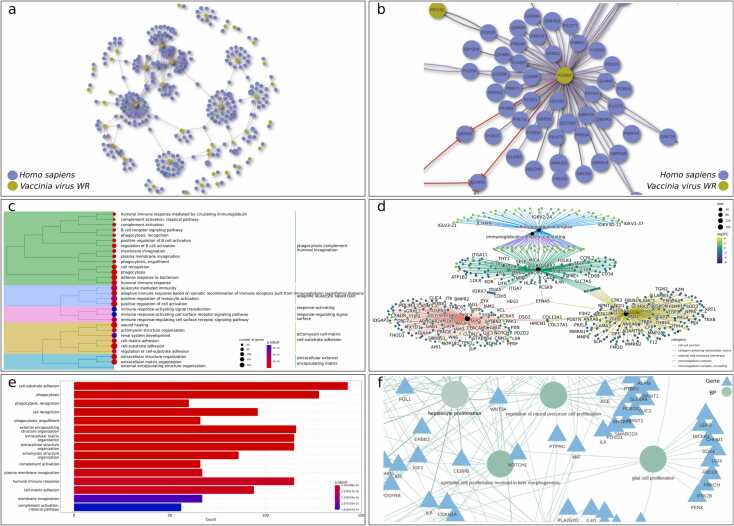
Sample GO enrichment output generated by PRO-Simat. (a)Homo sapiens-Vaccinia virus WR strain PPI zoomed out network overview. (b)Homo sapiens-Vaccinia virus WR strain PPI in detail, zoomed into the network. (c) Functional grouping tree diagram of the result of GO over-representation analysis of lung adenocarcinoma data. (d) Cnet plot image depicting five category connections of genes and GO cellular component biological concepts as a network. (e) Barplot displaying 15 sub-categories of enriched GO terms belonging to the main category of the biological process based on the p-adjust values as enrichment score and gene number. (f) The proliferation category of the Cnet plot showing the enriched GO terms of PRO-Simat and the associated genes.
Fig. 3
Fig. 3
Visualisation of KEGG pathway output and Jimena dynamic simulation embedded in the PRO-Simat tool. (a) Emap plot as a result of KEGG enrichment analysis using lung adenocarcinoma data. (b) The pathview plot of KEGG pathway analysis. (c) The results of enrichment analysis given as a list in the table appearing in the PRO-Simat web tool. (d) Dynamic modelling of protein network using Jimena. (e) The simulation graphs selected human proteins using the SQUADD analysis. (f) Heatmap illustrates the analysis results obtained by Jimena. (g) PCA analysis of Jimena analysis.
Fig. 4
Fig. 4
Dynamic modeling of B. subtilis differentiation network, oncolytic Vaccinia virus GLV-1h68 and synthetic light-controlled nucleotide processing networks by PRO-Simat. The individual protein activities and trajectories in the B. subtilis regulatory network compared different differentiation statuses of the network and different pathway activities d as follows: (a) Simulation of spo0A activity. Activation of the Spo0A protein downregulates the repressor SinR and activates the genes involved in sporulation, resulting in biofilm formation. (b) Simulation of DegU activity. DegU is a crucial gene regulator, which controls competence, motility and degradative enzyme secretion. DegS Kinase phosphorylates master regulator DegU and is activated by starvation or salt stress. Activation of DegU promotes the subpopulation of cells called ‘miners’, which promote degradation of large biopolymers into nutritive peptides (cannibalism). (c) Overview on the Homo sapiens-Vaccinia virus GLV-1h68 protein-protein interaction network. (d) Detail of the Homo sapiens-Vaccinia virus GLV-1h68 protein-protein interaction network: The genome modifications (red triangles) inhibit virulence pathways and reduce vaccinia replication. (e) Increased apoptosis with Vaccinia virus GLV-1h68 activation analysed by Jimena. (f) Attachment of BLUF light-gating protein domain to polA polymerase. This protein engineering modification is modelled in PRO-Simat by rearranging the PPI network such that the BLUF protein domain (left, light blue) activates pol A polymerase. (g) DNA replication pathway as a result of KEGG pathway analysis including the added light-gated polymerase and shining of blue light on the BLUF domain to activate the DNA polymerase: active DNA replication is the result.

References

    1. Harris M.A., et al. (57 authors). Gene Ontology Consortium. 2004. The Gene Ontology (GO) database and informatics resource. Nucleic Acids Res. 2004;32:D258–D261. - PMC - PubMed
    1. Zhou X., Su Z. EasyGO: gene Ontology-based annotation and functional enrichment analysis tool for agronomical species. BMC Genom. 2007;8(1):1–4. - PMC - PubMed
    1. Wei Q., Khan I.K., Ding Z., Yerneni S., Kihara D. NaviGO: interactive tool for visualization and functional similarity and coherence analysis with gene ontology. BMC Bioinforma. 2017;18(1):1–13. - PMC - PubMed
    1. Thanati F., Karatzas E., Baltoumas F.A., Stravopodis D.J., Eliopoulos A.G., Pavlopoulos G.A. Flame: a web tool for functional and literature enrichment analysis of multiple gene lists. Biol (Basel) 2021;10(7):665. - PMC - PubMed
    1. Rao V.Srinivasa, et al. Protein-protein interaction detection: methods and analysis. Int J Proteom. 2014 - PMC - PubMed

LinkOut - more resources