


Effects of household access to water, sanitation, and hygiene services on under-five mortality in Sub-Saharan Africa
- PMID: 37181724
- PMCID: PMC10173862
- DOI: 10.3389/fpubh.2023.1136299
Effects of household access to water, sanitation, and hygiene services on under-five mortality in Sub-Saharan Africa
Erratum in
-
Corrigendum: Effects of household access to water, sanitation, and hygiene services on under-five mortality in Sub-Saharan Africa.Front Public Health. 2023 Sep 28;11:1280610. doi: 10.3389/fpubh.2023.1280610. eCollection 2023. Front Public Health. 2023. PMID: 37841723 Free PMC article.
Abstract
Introduction: Sub-Saharan Africa has the highest under-five mortality rate and is among the regions where people have the least access to adequate Water, Sanitation, and Hygiene (WASH) services. The work aimed to investigate the effects of WASH conditions faced by children on under-five mortality in Sub-Saharan Africa.
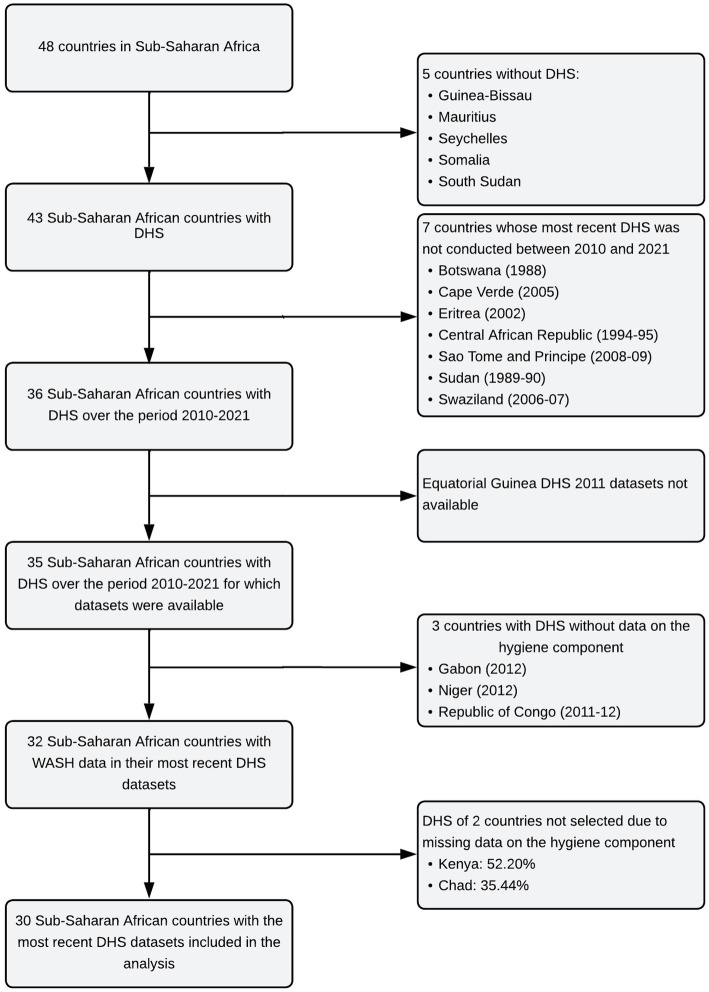
Methods: We carried out secondary analyses using the Demographic and Health Survey datasets of 30 countries in Sub-Saharan Africa. The study population consisted of children born within 5 years preceding the selected surveys. The dependent variable was the child's status (1 = deceased versus 0 = alive) on the survey day. The individual WASH conditions in which children live were assessed in their immediate environment, i.e., at the level of their households of residence. The other explanatory variables were related to the child, mother, household, and environment. Following a description of the study variables, we identified the predictors of under-five mortality using a mixed logistic regression.
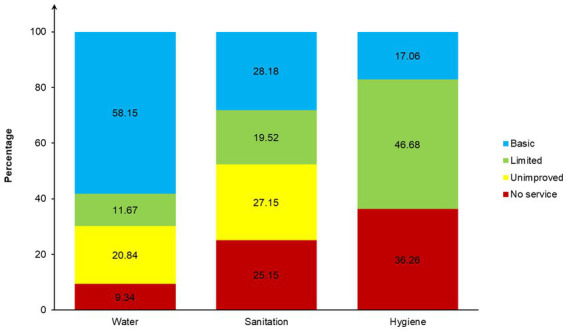
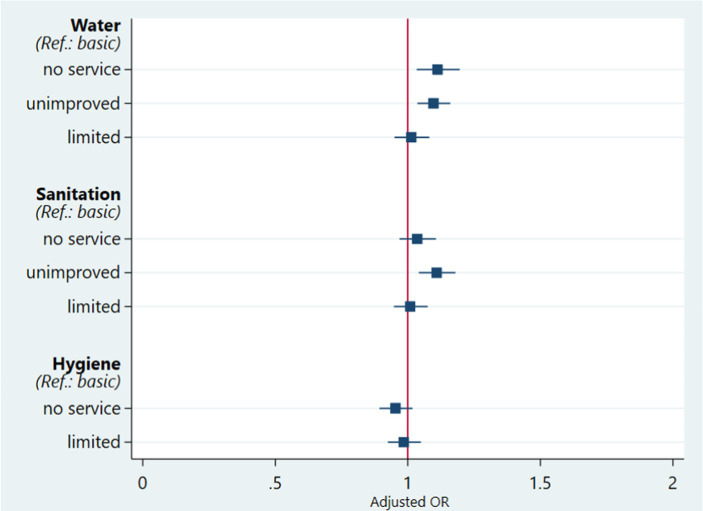
Results: The analyses involved 303,985 children. Overall, 6.36% (95% CI = 6.24-6.49) of children died before their fifth birthday. The percentage of children living in households with access to individual basic WASH services was 58.15% (95% CI = 57.51-58.78), 28.18% (95% CI = 27.74-28.63), and 17.06% (95% CI = 16.71-17.41), respectively. Children living in households using unimproved water facilities (aOR = 1.10; 95% CI = 1.04-1.16) or surface water (aOR = 1.11; 95% CI = 1.03-1.20) were more likely to die before five than those coming from households with basic water facilities. The risk of under-five mortality was 11% higher for children living in households with limited sanitation facilities (aOR = 1.11; 95% CI = 1.04-1.18) than for those with basic sanitation services. We found no evidence to support a relationship between household access to hygiene services and under-five mortality.
Conclusion: Interventions to reduce under-five mortality should focus on strengthening access to basic water and sanitation services. Further studies are needed to investigate the contribution of access to basic hygiene services on under-five mortality.
Keywords: Sub-Saharan Africa; child; demographic and health survey; household; hygiene; sanitation; under-five mortality; water.
Copyright © 2023 Gaffan, Kpozehouen, Degbey, Ahanhanzo and Paraïso.
Conflict of interest statement
The authors declare that the research was conducted in the absence of any commercial or financial relationships that could be construed as a potential conflict of interest.
Figures
References
-
- You D, Hug L, Ejdemyr S, Idele P, Hogan D, Mathers C, et al. United Nations inter-agency Group for Child Mortality Estimation. Global, regional, and national levels and trends in under-5 mortality between 1990 and 2015, with scenario-based projections to 2030: a systematic analysis by the UN inter-agency Group for Child Mortality Estimation. Lancet Lond Engl. (2015) 386:2275–86. doi: 10.1016/S0140-6736(15)00120-8 - DOI - PubMed
MeSH terms
Substances
LinkOut - more resources
Full Text Sources
