. 2023 Aug;11(8):2534-2541.e2.
doi: 10.1016/j.jaip.2023.05.005. Epub 2023 May 12.

Detection of SARS-CoV-2 Antibodies in Immunoglobulin Products

Affiliations

Detection of SARS-CoV-2 Antibodies in Immunoglobulin Products

Kimberley Cousins et al. J Allergy Clin Immunol Pract. 2023 Aug.

Abstract

Background: For patients with primary antibody deficiency, the first line of therapy is replacement with immunoglobulin (Ig) products. Prior to the severe acute respiratory syndrome coronavirus 2 (SARS-CoV-2) pandemic, Ig products did not contain antibodies with specificity for this virus, and there have been limited data on the antibodies present in the Ig products in current use.

Objective: To quantitatively examine SARS-CoV-2 antibodies in current Ig products.

Methods: We examined 142 unique lots of 11 different Ig products intended for intravenous and/or subcutaneous delivery for IgG-binding activities against recombinant SARS-CoV-2 receptor binding domain, spike, and nucleocapsid proteins by enzyme-linked immunosorbent assays. In addition, to assess functionality, 48 of these unique lots were assessed for their ability to inhibit the variants SARS-CoV-2 Ancestral, Alpha, Beta, Delta, and Omicron spike binding to angiotensin-converting enzyme 2 (ACE2).

Results: Significantly increased antibody values were observed for products manufactured after the year 2020 (expiration dates 2023-2024), as compared with Ig products before 2020 (prepandemic). Sixty percent and 85% of the Ig products with expiration dates of 2023 and 2024 were positive for antibody to SARS-CoV-2 proteins, respectively. The area under the curve values were significantly higher in products with later expiration dates. Later dates of expiration were also strongly correlated with inhibition of ACE2-binding activity; however, a decline in inhibition activity was observed with later variants.

Conclusions: Overall, more recent Ig products (expiration dates 2023-2025) contained significantly higher binding and inhibition activities against SARS-CoV-2 proteins, compared with earlier, or prepandemic products. Normal donor SARS-CoV-2 antibodies are capable of inhibiting ACE2-binding activities and may provide a therapeutic benefit for patients who do not make a robust vaccine response.

Keywords: Enzyme-linked immunosorbent assays (ELISA); Primary antibody deficiency immunoglobulin (Ig) products; Recombinant SARS-CoV-2 receptor binding domain (RBD); Severe acute respiratory syndrome coronavirus 2 (SARS-CoV-2); Spike proteins.


Figures

Figure 1
Figure 1
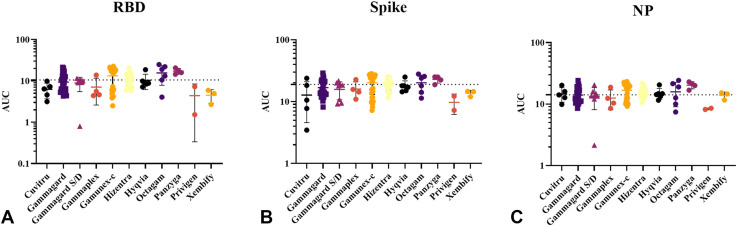
Products with expiration dates ranging from 2020 or earlier to 2024 were analyzed for IgG-binding activities, against recombinant (A) SARS-CoV-2 RBD, (B) spike, and (C) NP using ELISA. Data points represent the AUC signifying binding activity. A number of brands had a mean binding activity above the cut-off values, denoting a positive result. Although all products did not have a positive result according to the mean, a majority of brands (9 of 11) had some samples that tested above the cut-off values. Error bars indicate mean and SD. Cut-off values are mean + 3 SD of AUC of prepandemic samples.
Figure 2
Figure 2
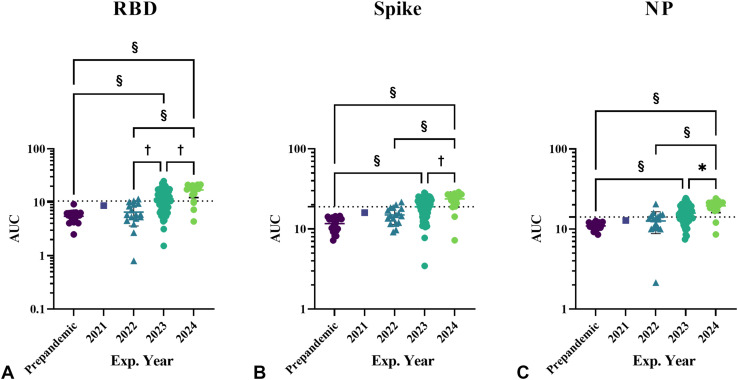
Products were analyzed by expiration year, for IgG binding activities against (A) recombinant SARS-CoV-2 RBD, (B) spike, and (C) NP using ELISA. Data points represent area under the ELISA curve, separated by product expiration year. These was a significant increase in AUC in Ig products with expiration dates of 2023 compared with prepandemic products. The increasing trend in AUC continued across all 3 protein assays for expiration years 2023 and 2024. Error bars indicate mean and SD. Exp., Expiration. ∗P < .05; †P <.01; ‡P < .001; §P < .0001. A 1-way analysis of variance with Kruskal-Wallis test was performed for statistical analysis
Figure 3
Figure 3
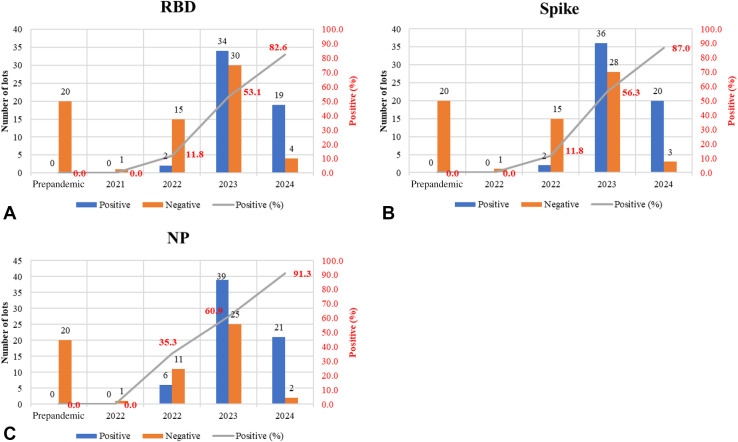
Products analyzed by expiration year for IgG binding activities against (A) recombinant SARS-CoV-2 RBD, (B) spike, and (C) NP using ELISA. Graph represents the number of samples testing positive and negative for binding to SARS-CoV-2 proteins. A clear upward trend emerges, with approximately 60% and 85% of the Ig products with expiration dates of 2023 and 2024 testing positive for binding to SARS-CoV-2 proteins, respectively.
Figure 4
Figure 4
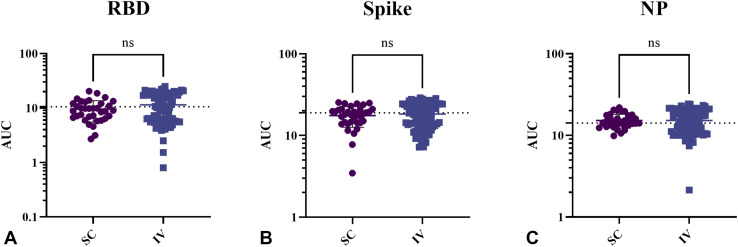
Products by route of administration analyzed for IgG binding activities against recombinant SARS-CoV-2 proteins. (A) RBD, (B) spike, and (C) NP using ELISA. Data points represent area under the ELISA curve, demarcated by route of infusion. The AUC values were higher in IV products than in SC products across all 3 protein assays. Error bars indicate mean and SD. ns, Not significant.
Figure 5
Figure 5
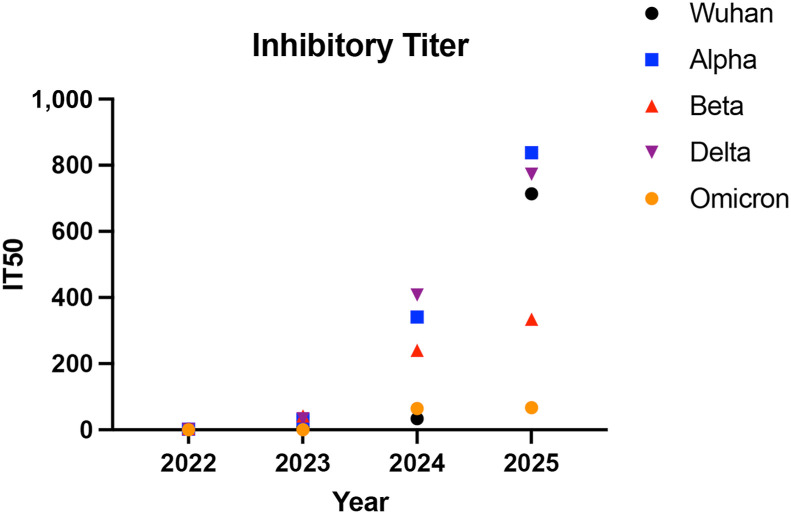
Neutralization activity assessment using inhibitory titer 50 (IT 50) in products sorted by expiration date against COVID-19 variants. The IT 50 values were derived from neutralization curves, with higher titers indicating greater neutralizing capacity at higher dilutions for 50% of spike-ACE2 protein interactions. The IT 50 values for products expiring in 2021 were excluded owing to limited product quantity.
Figure 6
Figure 6
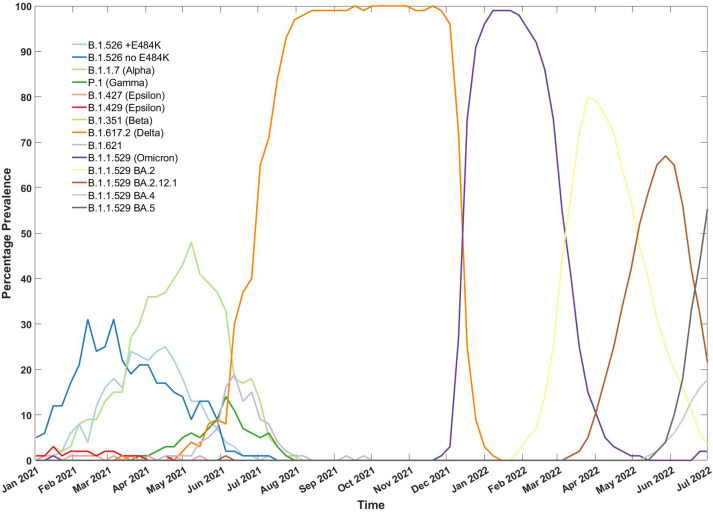
Prevalence of COVID-19 variants in circulation in New York City from January 2021 to July 2022. Legend indicates each genetic variant of SARS-CoV-2 in circulation, followed by World Health Organization nomenclature in parentheses where available. (Data generated from the NYC Department of Health and Mental Hygiene (NYC Department of Health and Mental Hygiene. Hygiene. Coronavirus Disease 2019 (COVID-19) in New York City (NYC) 2022. Accessed July 14. 2022. https://github.com/nychealth/coronavirus-data.15)
Figure E1
Figure E1
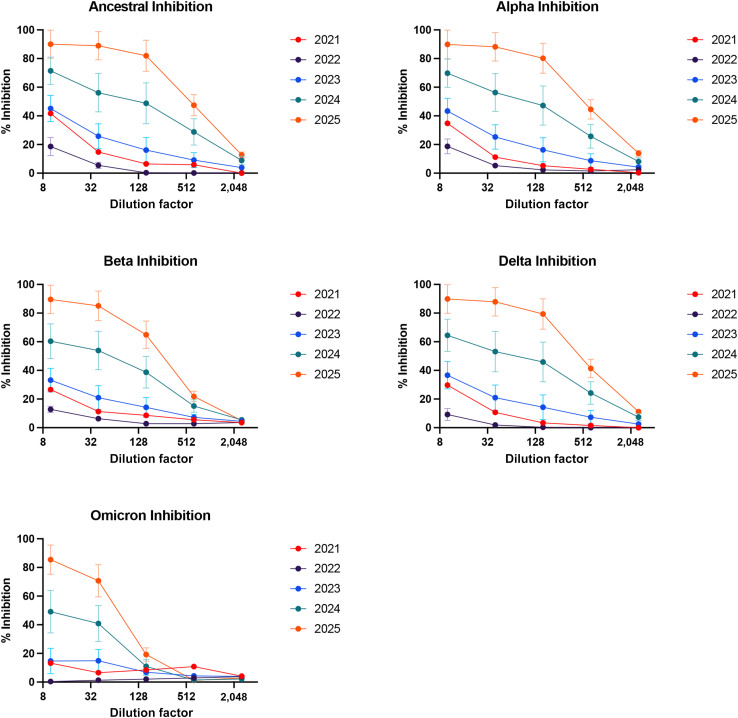
Products with different expiration dates analyzed for inhibition activity at different dilution factors of immunoglobulin samples using angiotensin-converting enzyme 2 assay against different strains of coronavirus including the Ancestral, Alpha, Beta, Delta, and Omicron strains. Data points represent the percentage inhibition activity for product grouped based on the expiration date. Error bars indicating the standard error of the mean for product with expiration dates ranging between 2023 and 2025.
Figure E2
Figure E2
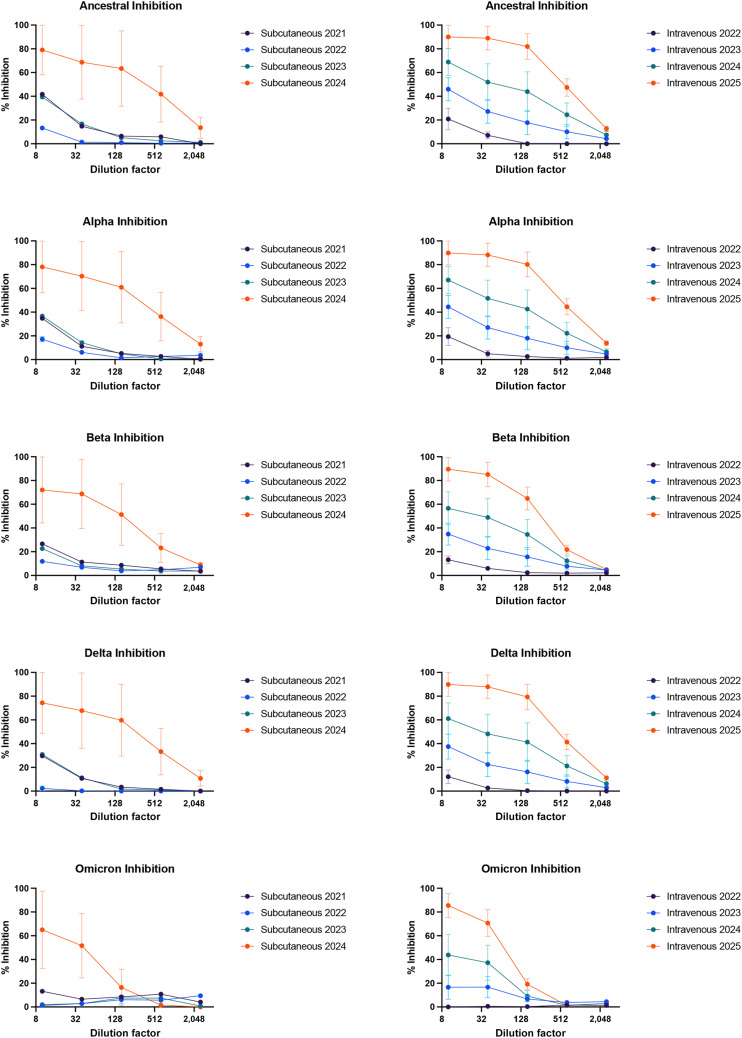
Products by route of administration (subcutaneous vs intravenous) grouped by expiration dates analyzed for inhibition activity at different dilution factors of immunoglobulin samples using angiotensin-converting enzyme 2 assay against different strains of coronavirus including the Ancestral, Alpha, Beta, Delta, and Omicron strains. Data points represent the percentage inhibition activity for product groups based on expiration dates for both subcutaneous and intravenous. Error bars indicate the standard error of the mean for products with expiration dates ranging between 2024 and 2025.

References

    1. Hu B., Guo H., Zhou P., Shi Z.L. Characteristics of SARS-CoV-2 and COVID-19. Nat Rev Microbiol. 2021;19:141–154. - PMC - PubMed
    1. Huang C., Wang Y., Li X., Ren L., Zhao J., Hu Y., et al. Clinical features of patients infected with 2019 novel coronavirus in Wuhan, China. Lancet. 2020;395:497–506. - PMC - PubMed
    1. World Health Organization WHO Coronavirus (COVID-19) Dashboard Geneva. https://covid19.who.int/table
    1. Wang H., Paulson K.R., Pease S.A., Watson S., Comfort H., Zheng P., et al. Estimating excess mortality due to the COVID-19 pandemic: a systematic analysis of COVID-19-related mortality, 2020–21. Lancet. 2022;399:1513–1536. - PMC - PubMed
    1. Sanyaolu A., Okorie C., Marinkovic A., Patidar R., Younis K., Desai P., et al. Comorbidity and its impact on patients with COVID-19. SN Compr Clin Med. 2020;2:1069–1076. - PMC - PubMed

Publication types

Substances