. 2023 Aug 20:887:164143.
doi: 10.1016/j.scitotenv.2023.164143. Epub 2023 May 13.

A long-term passive sampling approach for wastewater-based monitoring of SARS-CoV-2 in Leipzig, Germany

Affiliations

A long-term passive sampling approach for wastewater-based monitoring of SARS-CoV-2 in Leipzig, Germany

Marc Breulmann et al. Sci Total Environ. .

Abstract

Wastewater-based monitoring of SARS-CoV-2 has become a promising and useful tool in tracking the potential spread or dynamics of the virus. Its recording can be used to predict how the potential number of infections in a population will develop. Recent studies have shown that the use of passive samplers is also suitable for the detection of SARS-CoV-2 genome copies (GC) in wastewater. They can be used at any site, provide timely data and may collect SARS-CoV-2 GC missed by traditional sampling methods. Therefore, the aim of this study was to evaluate the suitability of passive samplers for the detection of SARS-CoV-2 GC in wastewater in the long-term at two different scales. Polyethylene-based plastic passive samplers were deployed at the city-scale level of Leipzig at 13 different locations, with samples being taken from March 2021 to August 2022. At the smaller city district level, three types of passive samplers (cotton-cloth, unravelled polypropylene plastic rope and polyethylene-based plastic strips) were used and sampled on a weekly basis from March to August 2022. The results are discussed in relation to wastewater samples taken at the individual passive sampling point. Our results show that passive samplers can indicate at a city-scale level an accurate level of positive infections in the population (positive-rate: 86 %). On a small-scale level, the use of passive samplers was also feasible and effective to detect SARS-CoV-2 GC easily and cost-effectively, mirroring a similar trend to that at a city-scale level. Thus, this study demonstrated that passive samplers provide reproducible SARS-CoV-2 GC signals from wastewater and a time-integrated measurement of the sampled matrix with greater sensitivity compared to wastewater. We thus recommend the use of passive samplers as an alternative method for wastewater-based epidemiology. Passive samplers can in particular be considered for a better estimation of infections compared to incidence levels.

Keywords: COVID-19; Monitoring; Passive sampling; SARS-CoV-2; Wastewater; Wastewater-based epidemiology.


Conflict of interest statement

Declaration of competing interest The authors declare that they have no known competing financial interests or personal relationships that could have appeared to influence the work reported in this paper.

Figures
Unlabelled Image
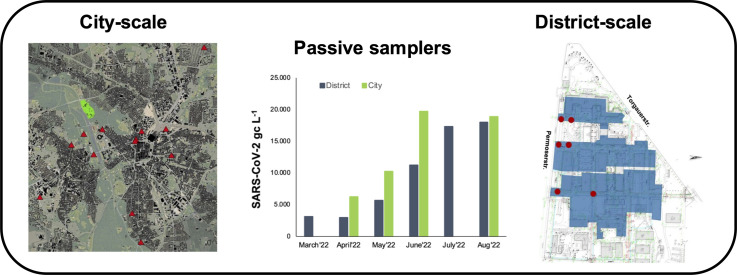
Graphical abstract
Fig. 1
Fig. 1
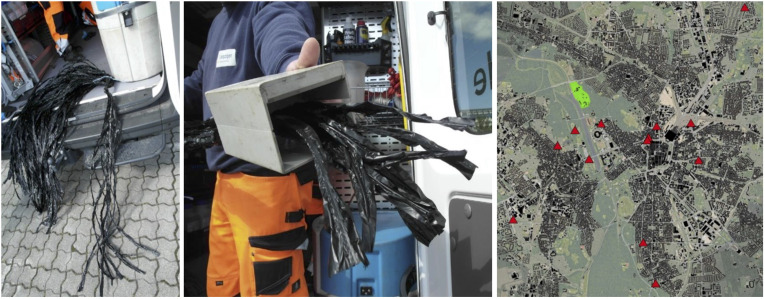
Polyethylene-based plastic passive samplers used for the detection of SARS-CoV-2 GC in wastewater (left and middle photos), and the location of the 13 passive samplers (red) across the city of Leipzig. Green: Location of the WWTP.
Fig. 2
Fig. 2
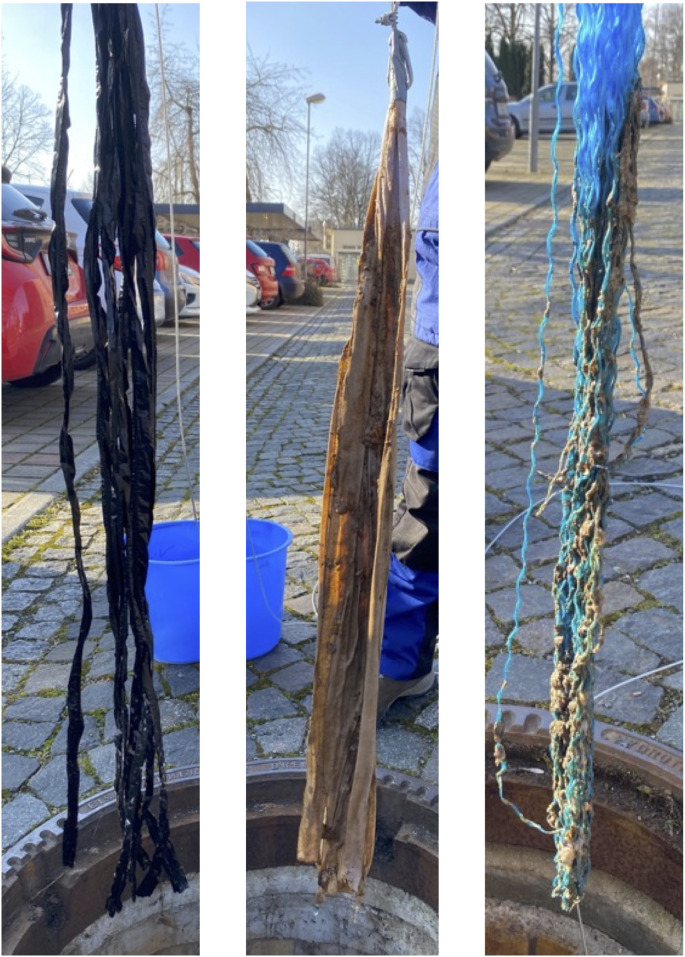
Passive samplers used for the detection of SARS-CoV-2 GC in wastewater at district-scale level. From left: polyethylene-based plastic sampler, cotton-cloth sampler and unravelled polypropylene plastic rope sampler.
Fig. 3
Fig. 3
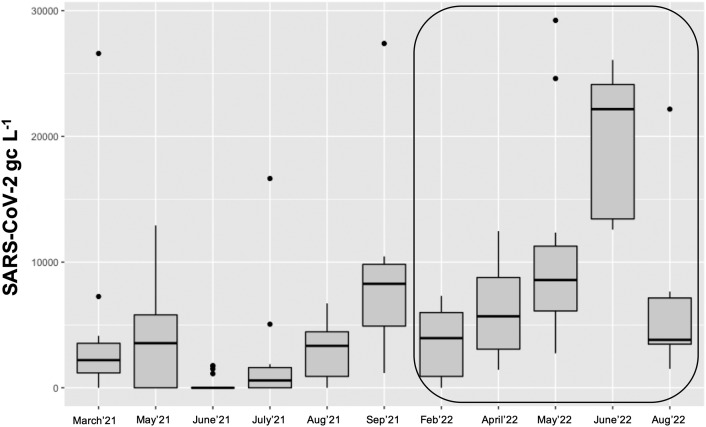
Detection of SARS-CoV-2 GC in passive samplers in wastewater as aggregate data across the city of Leipzig in 2021 and 2022 (framed). Solid line, boxes, and whiskers: median, IQR and 1.5 × IQR, respectively.
Fig. 4
Fig. 4
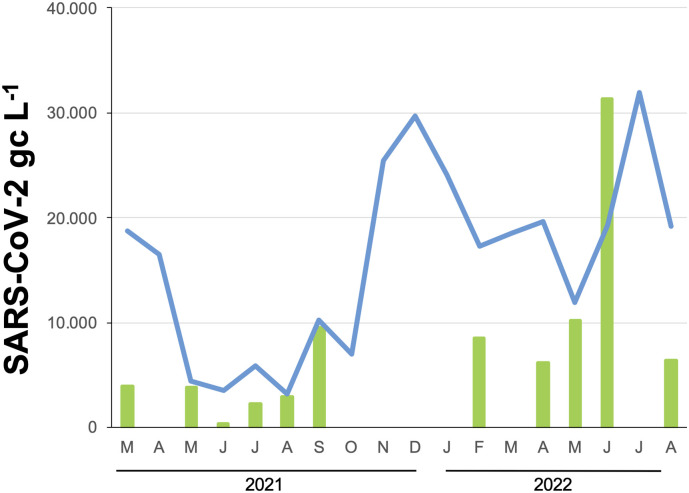
Comparison of detected SARS-CoV-2 GC in passive samplers (green) across the city of Leipzig and in wastewater (blue) at the municipal treatment plant in Leipzig for 2021 and 2022, presented as aggregate data. Passive samplers were not sampled in the months April, Oct.-Dez. 2021 and March and July 2022.
Fig. 5
Fig. 5
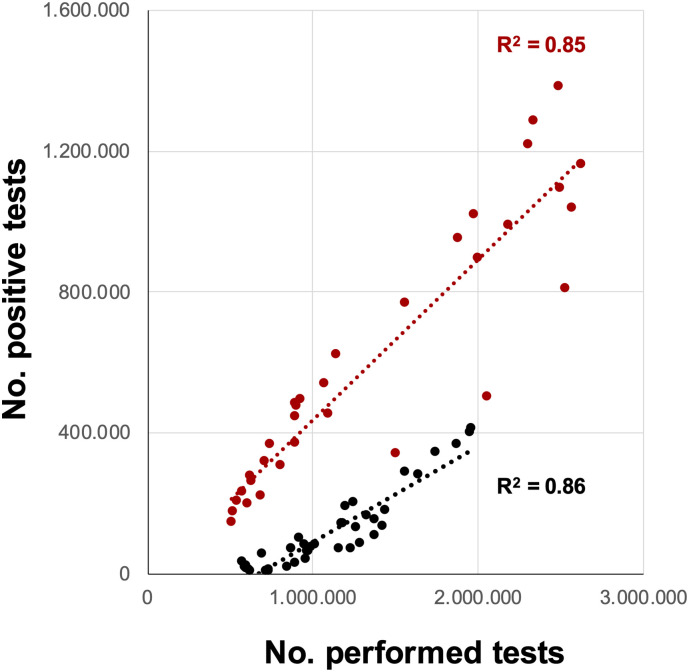
Relationship between the weekly number of performed RT-qPCR tests carried out and the number of positive RT-qPCR tests from March 2021 to August 2022, separated for the year 2021 (black) and 2022 (red). Data on the number of RT-qPCR tests carried out and positive RT-qPCR tests were retrieved from the ‘Robert Koch Institute (RKI)’ (www.rki.de), which is the German federal government agency and research institute responsible for disease control and prevention.
Fig. 6
Fig. 6
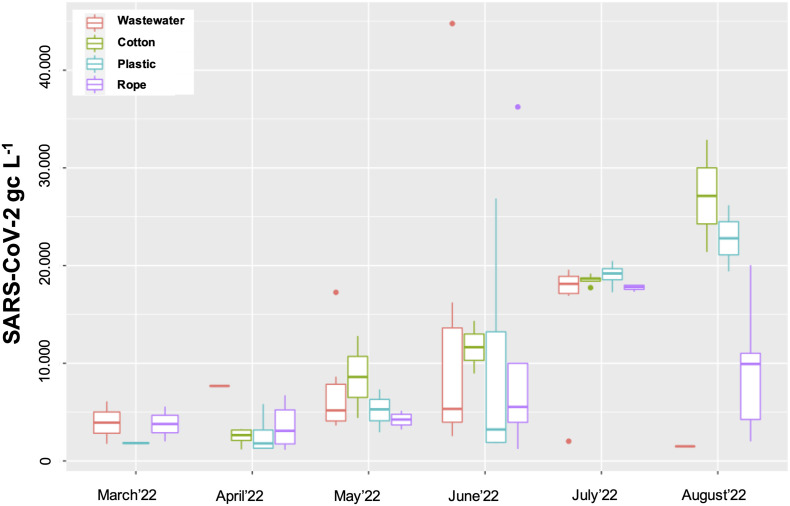
Detection of SARS-CoV-2 GC in wastewater as well as in passive samplers made of three different materials: cotton-cloth; plastic and unravelled rope in wastewater at district level in 2022. Solid line, boxes, and whiskers: median, IQR and 1.5 × IQR, respectively.
Fig. 7
Fig. 7
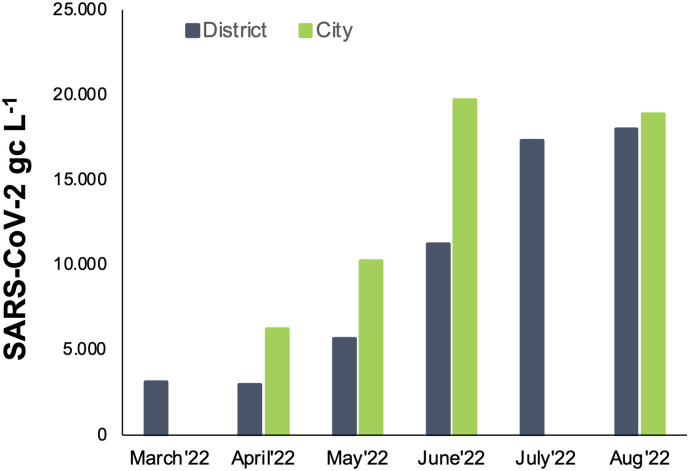
Comparison of detected SARS-CoV-2 GC in passive samplers at city-scale level (green) and district-scale level (dark blue) in wastewater from March–August 2022, presented as aggregate data.

References

    1. Acer P.T., Kelly L.M., Lover A.A., Butler C.S. Quantifying the relationship between SARS-CoV-2 wastewater concentrations and building-level COVID-19 prevalence at an isolation residence: a passive sampling approach. Int. J. Environ. Res. Public Health. 2022;19 - PMC - PubMed
    1. Ahmed W., Angel N., Edson J., Bibby K., Bivins A., O’Brien J.W., et al. First confirmed detection of SARS-CoV-2 in untreated wastewater in Australia: a proof of concept for the wastewater surveillance of COVID-19 in the community. Sci. Total Environ. 2020;728 - PMC - PubMed
    1. Ahmed W., Bertsch P.M., Angel N., Bibby K., Bivins A., Dierens L., et al. Detection of SARS-CoV-2 RNA in commercial passenger aircraft and cruise ship wastewater: a surveillance tool for assessing the presence of COVID-19 infected travellers. J. Travel Med. 2020;27 - PMC - PubMed
    1. Ahmed W., Simpson S.L., Bertsch P.M., Bibby K., Bivins A., Blackall L.L., et al. Minimizing errors in RT-PCR detection and quantification of SARS-CoV-2 RNA for wastewater surveillance. Sci. Total Environ. 2022;805 - PMC - PubMed
    1. Balboa S., Mauricio-Iglesias M., Rodriguez S., Martinez-Lamas L., Vasallo F.J., Regueiro B., et al. The fate of SARS-COV-2 in WWTPS points out the sludge line as a suitable spot for detection of COVID-19. Sci. Total Environ. 2021;772 - PMC - PubMed