Review
. 2023 Aug;39(4-6):390-409.
doi: 10.1089/ars.2022.0164. Epub 2023 Jun 28.

Stress Granules as Causes and Consequences of Translation Suppression

Affiliations
Review

Stress Granules as Causes and Consequences of Translation Suppression

Max Baymiller et al. Antioxid Redox Signal. 2023 Aug.

Abstract

Significance: Stress granules (SGs) are biomolecular condensates that form upon global translation suppression during stress. SGs are enriched in translation factors and messenger RNAs (mRNAs), which they may sequester away from the protein synthesis machinery. While this is hypothesized to remodel the functional transcriptome during stress, it remains unclear whether SGs are a cause, or simply a consequence, of translation repression. Understanding the function of SGs is particularly important because they are implicated in numerous diseases including viral infections, cancer, and neurodegeneration. Recent Advances: We synthesize recent SG research spanning biological scales, from observing single proteins and mRNAs within one cell to measurements of the entire transcriptome or proteome of SGs in a cell population. We use the emerging understanding from these studies to suggest that SGs likely have less impact on global translation, but instead may strongly influence the translation of individual mRNAs localized to them. Critical Issues: Development of a unified model that links stress-induced RNA-protein condensation to regulation of downstream gene expression holds promise for understanding the mechanisms of cellular resilience. Future Directions: Therefore, upcoming research should clarify what influence SGs exert on translation at all scales as well as the molecular mechanisms that enable this. The resulting knowledge will be required to drive discovery in how SGs allow organisms to adapt to challenges and support health or go awry and lead to disease. Antioxid. Redox Signal. 39, 390-409.

Keywords: RNP granules; biomolecular condensates; stress granules; stress response; translation.


Conflict of interest statement

The authors declare no competing financial interests.

Figures

FIG. 1.
FIG. 1.
Diverse stresses and multiple signaling pathways cause inhibition of translation initiation and formation of stress granules. A variety of stressors can activate any of four kinases for the key initiation factor eIF2α. This phosphorylation event enhances binding of the eIF2 complex to eIF2B, preventing GDP/GTP exchange and eIF2 release, and therefore limiting formation of the ternary complex containing GTP, the initiator Met-tRNAiMet, and eIF2. The ternary complex is essential for start codon recognition and is typically a component of the 48S PIC containing the mRNA, 40S ribosome subunit, and various other initiation factors. Among these is the 5′ cap binding complex, eIF4F. Inactivation of the kinase mTOR during conditions such as starvation leads to hypophosphorylated 4E-BP, which in turn binds and sequesters one of the cap binding complex components, eIF4E. This prevents assembly of the cap binding complex, inhibiting PIC formation and translation initiation. In both of these cases, translationally repressed mRNAs are recruited to stress granules, along with select PIC components. 4E-BP, eukaryotic translation initiation factor 4E-binding protein; eIF2B, eukaryotic translation initiation factor 2B; eIF4E, eukaryotic translation initiation factor 4E; mRNA, messenger RNA; mTOR, mammalian target of rapamycin; PIC, preinitiation complex.
FIG. 2.
FIG. 2.
Different modes of translation inhibition promote or prevent interaction networks required for stress granule assembly. Small-molecule inhibition of translation initiation at multiple points by pateamine A or hippuristanol leads to stress granule formation. However, inhibition of elongation by any of three small molecules does not lead to stress granule formation. Among these, puromycin allows ribosome removal from the mRNA, and does not prevent stress granule formation upon stress. The ribosome-vacant mRNA then participates in a network of interactions with “hub” RBPs (hub defined as binding valency n ≥ 3) as well as other RNAs. This exclusive and interconnected network leads to phase separation and stress granule assembly. When ribosomes remain on mRNA, such as during normal translation or when trapped with inhibitors cycloheximide or emetine, interactions with RBPs and other RNAs are prevented or decreased. This, as well as inhibition of RBPs by “cap” proteins, conformational changes, or PTMs, prevents stress granule assembly. PTM, posttranslational modification; RBP, RNA-binding protein.
FIG. 3.
FIG. 3.
Stress granules are dynamic condensates with discrete substructures. Stress granules display properties of liquid–liquid phase separation within the cell, including spherical shape and the ability to merge and split. Many stress granule components are characterized by rapid movement of molecules within, as well as frequent exchange with surroundings, which is proposed to indicate the presence of a highly dynamic “shell” layer. In contrast, numerous putative “core” regions within one stress granule are smaller, more densely packed, have less internal movement, and slower exchange with the surroundings. Substantial variability in, and biphasic distribution of, molecule lifetimes within the stress granule may also indicate these two distinct core and shell states.
FIG. 4.
FIG. 4.
The RNA and protein composition of stress granules. Transcriptomic studies of purified stress granule cores suggest that they contain ∼80% mRNAs and 20% noncoding RNAs. While the vast majority of cellular mRNA species are present in the stress granule, relative enrichment varies greatly. A primary determinant of mRNA localization to stress granules is the low translation efficiency and ribosome occupancy, leaving sites available for interactions with RNA binding proteins. In contrast, mRNAs that continue to translate during stress may be excluded. A further important factor determining RNA localization to stress granules is the RNA length, with greater length providing more interaction sites and therefore increased valency “n.” Proteins present in stress granules are greatly enriched in RNA binding functions and include translation factors. Also present are various helicase and chaperone proteins. Proteins within stress granules are enriched in (and tend to have longer) IDRs, LCDs, and prion-like domains, all of which are implicated in phase separation. IDR, intrinsically disordered region; LCD, low-complexity domain.
FIG. 5.
FIG. 5.
Stress granules can regulate translation at global and transcript-specific levels. Formation of stress granules has been shown to activate PKR through an unknown mechanism, thereby causing global translation inhibition. Sequestration of a portion of cellular mRNAs and translation factors may also contribute to global translation repression. However, the proportion of these components relative to total cellular supply is likely minimal, because only ∼10% of total mRNA is highly enriched in stress granules and are expected to be present in a 1:1 stoichiometry of mRNA to most translation initiation factors. Induced stress granule formation using overexpression or forced oligomerization of key stress granule hubs (e.g., G3BP1) suggests that RNA-protein interactions may compete to some extent with the translation machinery. Finally, while translating mRNAs interact only transiently with stress granules, translationally repressed mRNAs can enter long-lived associations with stress granules that likely sequester them away from the translation machinery. PKR, protein kinase R.
FIG. 6.
FIG. 6.
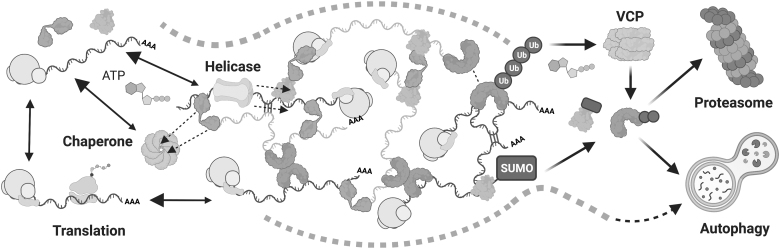
Disassembly and clearance of stress granules may occur by many distinct mechanisms. The action of ATPases such as helicases, chaperones, and VCP may dynamically disrupt interactions between, or extract components from, the stress granule. For mRNAs leaving the granule by these or other mechanisms, entering the translating pool would prohibit re-entry to the stress granule and promote disassembly. Ub modifications may be a mode of targeting stress granule proteins for removal, particularly during heat stress by VCP. The related SUMO modification may play a similar role in other conditions. Once removed, stress granule proteins may be degraded by the proteasome or autophagy pathways. It is also possible that autophagy clears intact stress granules or their cores. SUMO, small ubiquitin-related modifier; Ub, ubiquitin; VCP, valosin-containing protein.

References

    1. Adjibade P, Simoneau B, Ledoux N, et al. Treatment of cancer cells with lapatinib negatively regulates general translation and induces stress granules formation. PLoS One 2020;15(5):e0231894. - PMC - PubMed
    1. Adjibade P, St-Sauveur VG, Quevillon Huberdeau M, et al. Sorafenib, a multikinase inhibitor, induces formation of stress granules in hepatocarcinoma cells. Oncotarget 2015;6(41):43927–43943. - PMC - PubMed
    1. Ainger K, Avossa D, Morgan F, et al. Transport and localization of exogenous myelin basic protein mRNA microinjected into oligodendrocytes. J Cell Biol 1993;123(2):431–441. - PMC - PubMed
    1. Alberti S, Gladfelter A, Mittag T. Considerations and challenges in studying liquid-liquid phase separation and biomolecular condensates. Cell 2019;176(3):419–434. - PMC - PubMed
    1. Altman T, Ionescu A, Ibraheem A, et al. Axonal TDP-43 condensates drive neuromuscular junction disruption through inhibition of local synthesis of nuclear encoded mitochondrial proteins. Nat Commun 2021;12(1):6914. - PMC - PubMed

Publication types

LinkOut - more resources