Review
. 2023 Sep 1;146(9):3587-3597.
doi: 10.1093/brain/awad150.

Advances in understanding the function of alpha-synuclein: implications for Parkinson's disease

Affiliations
Review

Advances in understanding the function of alpha-synuclein: implications for Parkinson's disease

Paolo Calabresi et al. Brain. .

Abstract

The critical role of alpha-synuclein in Parkinson's disease represents a pivotal discovery. Some progress has been made over recent years in identifying disease-modifying therapies for Parkinson's disease that target alpha-synuclein. However, these treatments have not yet shown clear efficacy in slowing the progression of this disease. Several explanations exist for this issue. The pathogenesis of Parkinson's disease is complex and not yet fully clarified and the heterogeneity of the disease, with diverse genetic susceptibility and risk factors and different clinical courses, adds further complexity. Thus, a deep understanding of alpha-synuclein physiological and pathophysiological functions is crucial. In this review, we first describe the cellular and animal models developed over recent years to study the physiological and pathological roles of this protein, including transgenic techniques, use of viral vectors and intracerebral injections of alpha-synuclein fibrils. We then provide evidence that these tools are crucial for modelling Parkinson's disease pathogenesis, causing protein misfolding and aggregation, synaptic dysfunction, brain plasticity impairment and cell-to-cell spreading of alpha-synuclein species. In particular, we focus on the possibility of dissecting the pre- and postsynaptic effects of alpha-synuclein in both physiological and pathological conditions. Finally, we show how vulnerability of specific neuronal cell types may facilitate systemic dysfunctions leading to multiple network alterations. These functional alterations underlie diverse motor and non-motor manifestations of Parkinson's disease that occur before overt neurodegeneration. However, we now understand that therapeutic targeting of alpha-synuclein in Parkinson's disease patients requires caution, since this protein exerts important physiological synaptic functions. Moreover, the interactions of alpha-synuclein with other molecules may induce synergistic detrimental effects. Thus, targeting only alpha-synuclein might not be enough. Combined therapies should be considered in the future.

Keywords: Parkinson’s disease; alpha-synuclein; dopamine; striatum; synaptic plasticity.


Conflict of interest statement

P.C. received/receives research support, speaker honoraria, and support to attend national and international conferences (not related to the present study) from: Abbvie, Bial, Bayer Schering, Biogen-Dompè, Biogen-Idec, Eisai, Lilly, Lundbeck, Lusofarmaco, Merck-Serono, Novartis, Sanofi-Genzyme, Teva, UCB Pharma, Zambon. The other authors report no competing interests.

Figures
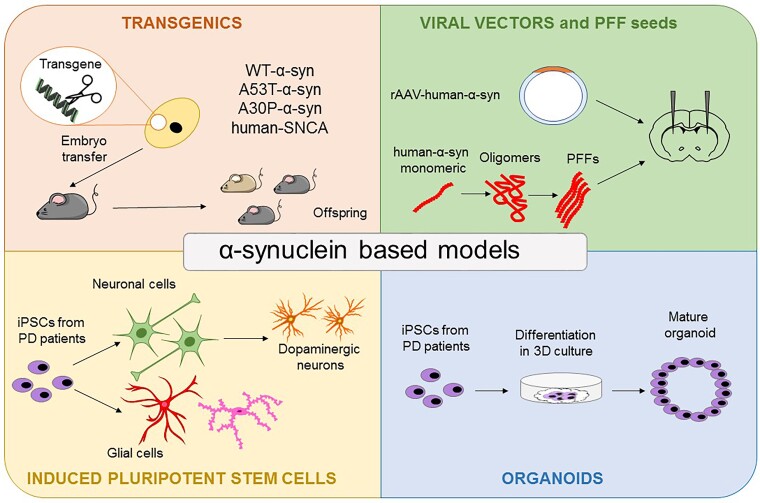
Figure 1
Figure 1
α-Syn-based experimental models. The top left panel shows genome-editing techniques that allow for the creation of transgenic parkinsonian animals carrying specific α-syn mutations. The top right panel represents animal models obtained either by brain inoculation of adeno-associated viral vectors (AAV) carrying mutant α-syn or of α-syn preformed fibrils (PFFs). The bottom left panel shows in vitro models using induced pluripotent stem cells (iPSCs) derived from patients with Parkinson's disease (PD) to obtain dopaminergic neurons or glial cells. In the bottom right panel, the generation of 3D organoids is shown. WT = wild-type.
Figure 2
Figure 2
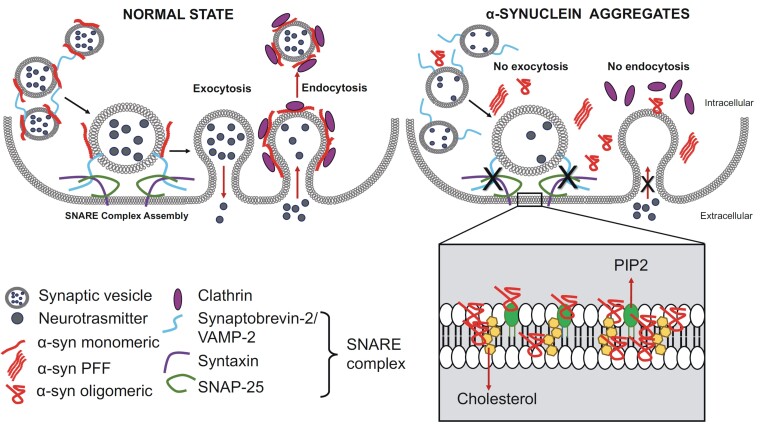
Physiological and pathological functions of α-syn in vesicle trafficking and its interaction with membrane lipids. The left panel shows the physiological condition in which α-syn monomers control exocytosis by interacting with synaptic vesicle proteins such as VAMP2/synaptobrevin-2, syntaxin and SNAP-25, promoting SNARE complex formation to control the exocytosis process. Monomeric α-syn also controls endocytosis through functional interactions with clathrin. The right panel describes the pathological state in which the accumulation of α-syn aggregates [oligomers and preformed fibrils (PFF)] interferes with presynaptic function. Under this condition, SNARE-mediated vesicle fusion to the plasma membrane is inhibited, leading to abnormal control of neurotransmitter release and transmembrane trafficking. α-Syn aggregates also arrest clathrin-mediated endocytosis. The inset shows how α-syn oligomers interact with membrane lipids, cholesterol and phosphatidylinositol 4,5-bisphosphate (PIP2), altering synaptic membrane function and integrity.
Figure 3
Figure 3
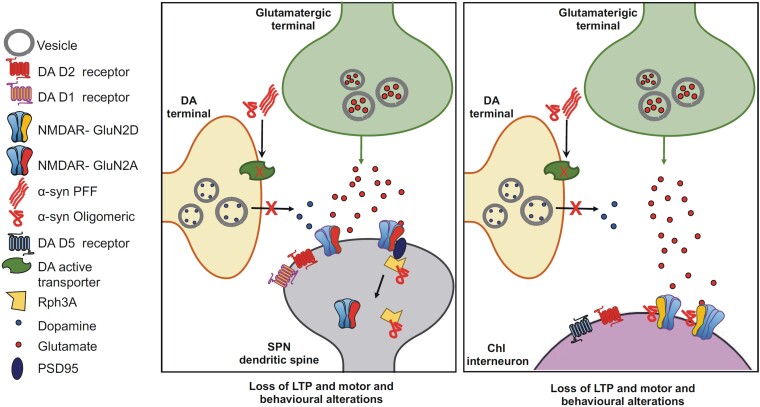
Schematic representation of α-syn-mediated synaptic alterations in striatal SPNs and ChIs in models of early PD. The left panel shows how extracellular α-syn aggregates cause reduced striatal DAT levels and dopamine release from the dopaminergic terminal. α-Syn oligomers perturb the functional interaction between rabphilin 3A (Rph3A) and the GluN2A-expressing NMDAR in the postsynaptic density of spiny projection neurons (SPN). The right panel represents how α-syn oligomers interact with the NMDAR-expressing GluN2D subunit in the striatal cholinergic interneurons (ChI). These synaptic changes block the induction of long-term potentiation (LTP) in both neuronal types (SPNs and ChIs), causing motor and behavioural alterations. DA = dopamine; PFF = preformed finril.
Figure 4
Figure 4
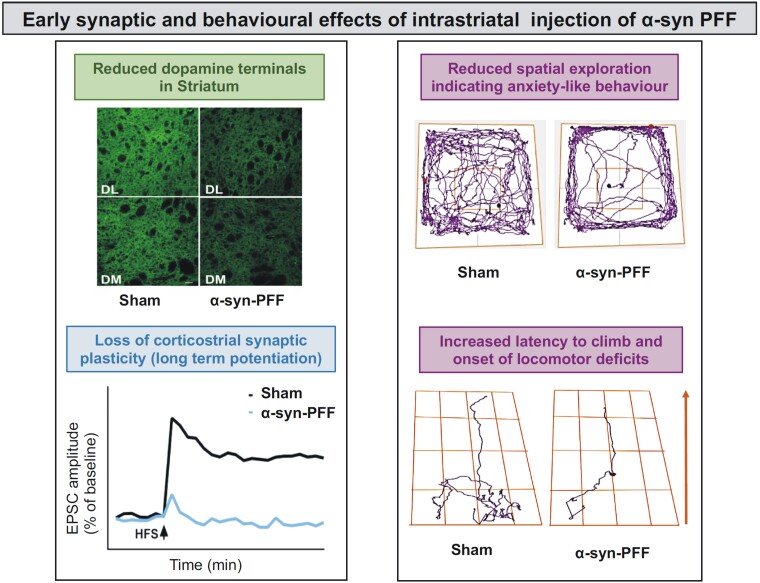
Early synaptic and behavioural effects of intrastriatal injection of α-syn PFF in a rat model. Top left: The reduction in the number of dopaminergic terminals in the dorsolateral (DL) and dorsomedial (DM) striatal regions following α-syn-PFF injection is shown. Bottom left: The loss of corticostriatal long-term potentiation in the spiny projection neurons (SPNs) under the same experimental conditions is represented. The right panel shows how α-syn-PFF intrastriatal injections produce behavioural and motor defects. Top right: Representative track plots of the animal’s exploratory activity in the open field arena show a marked reduction of motor activity and poor exploration in α-syn-PFF-injected rats compared to controls, suggesting the emergence of anxiety-like behaviours. Bottom right: Representative track plots of the animal’s movements in the grid walking setting show a reduced activity that results in an increased latency to climb and a higher immobility time in α-syn-PFF-injected rats compared to the sham-operated rats, suggesting the onset of locomotor deficits (modified from Tozzi et al.). EPSC = evoked excitatory postsynaptic current; PFF = preformed fibril.
Figure 5
Figure 5
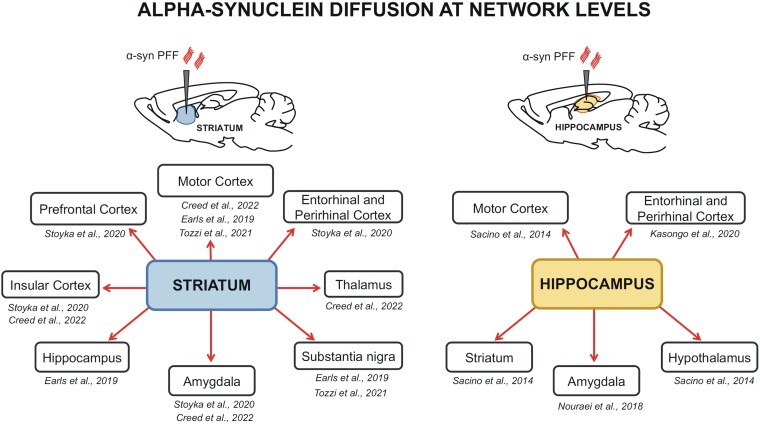
Misfolded α-syn diffusion after in vivo intracerebral injection of PFF in rodent PD models. Schematic representations of the brain regions containing pathological inclusions of α-syn after intracerebral injections of aggregates in the striatum (left) or the hippocampus (right). References to the morphological studies relevant to the brain areas analysed are also reported.,

References

    1. Goedert M, Jakes R, Spillantini MG. The synucleinopathies: twenty years on. J Parkinsons Dis. 2017;7(s1):S51–S69. - PMC - PubMed
    1. Vázquez-Vélez GE, Zoghbi HY. Parkinson's disease genetics and pathophysiology. Annu Rev Neurosci. 2021;44:87–108. - PubMed
    1. Grosso Jasutkar H, Oh SE, Mouradian MM. Therapeutics in the pipeline targeting. Pharmacol Rev. 2022;74:207–237. - PMC - PubMed
    1. Teil M, Arotcarena ML, Faggiani E, Laferriere F, Bezard E, Dehay B. Targeting α-synuclein for PD therapeutics: a pursuit on all fronts. Biomolecules. 2020;10:391. - PMC - PubMed
    1. Pagano G, Taylor KI, Anzures-Cabrera J, et al. Trial of prasinezumab in early-stage Parkinson's disease. N Engl J Med. 2022;387:421–432. - PubMed

Publication types

Substances