. 2023 Mar 31;45(4):2817-2831.
doi: 10.3390/cimb45040184.

Apolipoprotein E (APOE) Haplotypes in Healthy Subjects from Worldwide Macroareas: A Population Genetics Perspective for Cardiovascular Disease, Neurodegeneration, and Dementia

Affiliations

Apolipoprotein E (APOE) Haplotypes in Healthy Subjects from Worldwide Macroareas: A Population Genetics Perspective for Cardiovascular Disease, Neurodegeneration, and Dementia

Paolo Abondio et al. Curr Issues Mol Biol. .

Abstract

Human APOE is a 299-amino acid long protein expressed and secreted in several tissues and body districts, where it exerts different functions mainly related to lipid metabolism, with specific activities around cholesterol transport and absorption/elimination. It has three main isoforms, determined by the pair of mutations rs7412-C/T and rs429358-C/T, which gives rise to the functionally different APOE variants ε2, ε3, and ε4. These have a distinct impact on lipid metabolism and are differentially implicated in Alzheimer's disease and neurodegeneration, cardiovascular disease, and dyslipidemia. A plethora of other single nucleotide variants along the sequence of the APOE gene have been studied in cohorts of affected individuals, where they also modulate the influence of the three main isoforms to determine the risk of developing the disease. However, no contextual analysis of gene-long haplotypes has been carried out so far, and never extensively in cohorts of healthy individuals from different worldwide populations. Leveraging a rich population genomics dataset, this study elucidates the distribution of APOE variants and haplotypes that are shared across populations and to specific macroareas, revealing a variety of risk-allele associations that distinguish specific ancestral backgrounds and can be leveraged for specific ancestry-informed screenings in medicine and public health.

Keywords: Alzheimer’s disease; apolipoprotein E; cardiovascular disease; dementia; haplotype; medicine; mutation; neurodegeneration; population genetics; public health.


Conflict of interest statement

The authors declare no conflict of interest.

Figures
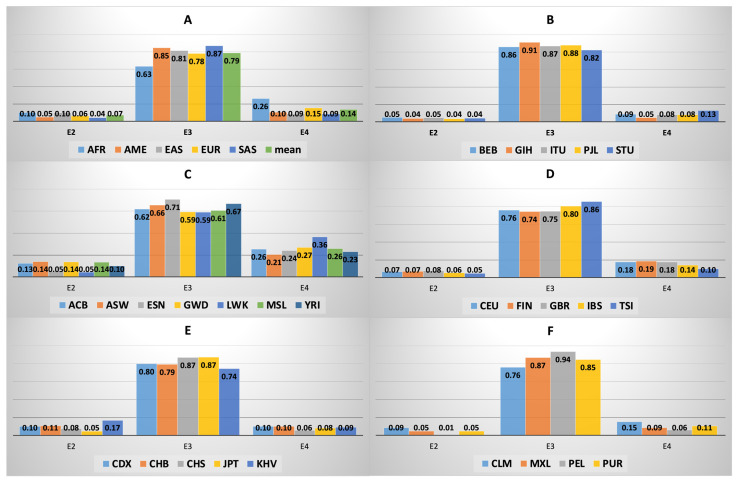
Figure 1
Figure 1
Distribution of APOE ε2, ε3 and ε4 isoforms: (A) across macroareas; (B) across the South Asian populations; (C) across the African populations; (D) across the European populations; (E) across the East Asian populations; (F) across the American populations.
Figure 2
Figure 2
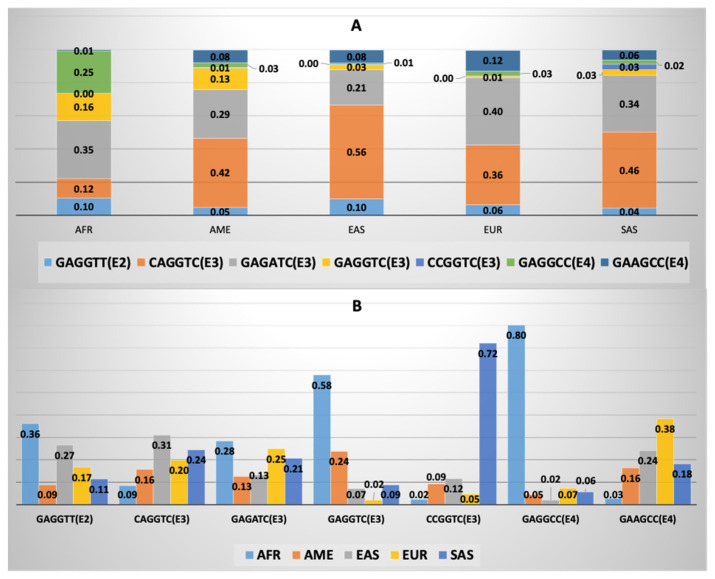
Core haplotype frequencies across macroareas. (A) Distribution of haplotype frequencies in each macroarea: (B) proportion of contribution from each macroarea to a specific haplotype.
Figure 3
Figure 3
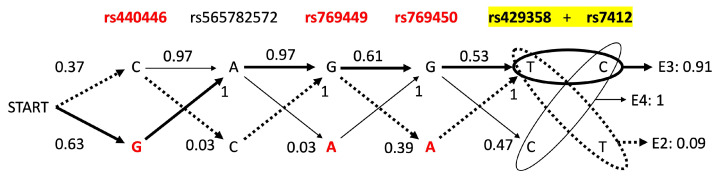
Step-by-step frequency graph for the core haplotypes. AD-related variants (and the specific risk allele) are highlighted in red; variants contributing to APOE isoforms are highlighted in yellow. The most frequent theoretical haplotype is indicated by solid, bold arrows and circles; the least frequent theoretical haplotype is indicated by dashed arrows and circles.
Figure 4
Figure 4
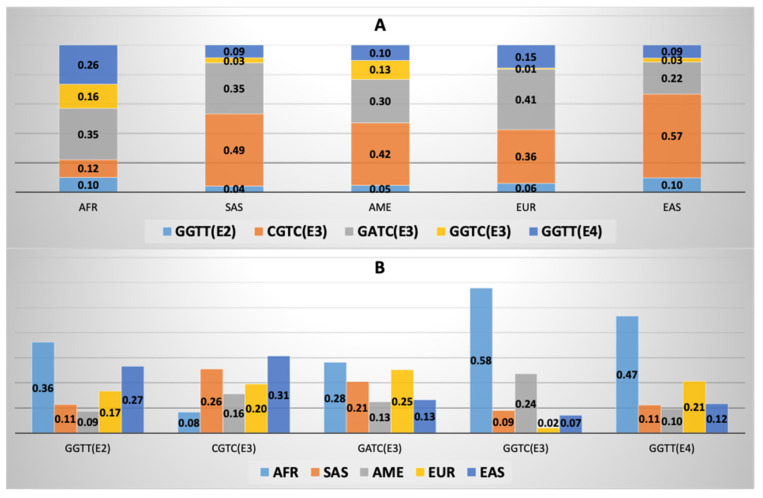
Super-core haplotype frequencies across macroareas. (A) Distribution of haplotype frequencies in each macroarea: (B) proportion of contribution from each macroarea to a specific haplotype.
Figure 5
Figure 5
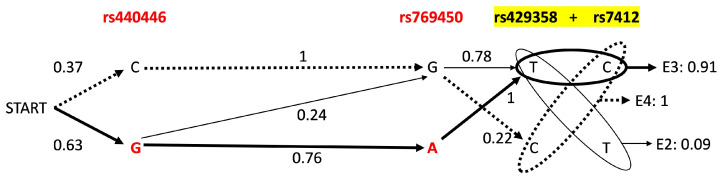
Step-by-step frequency graph for the super-core haplotypes. AD-related variants (and the specific risk allele) are highlighted in red; variants contributing to APOE isoforms are highlighted in yellow. The most frequent theoretical haplotype is indicated by solid, bold arrows and circles; the least frequent theoretical haplotype is indicated by dashed arrows and circles. Variants have been located in the same positions as Figure 3 to facilitate comparison.
Figure 6
Figure 6
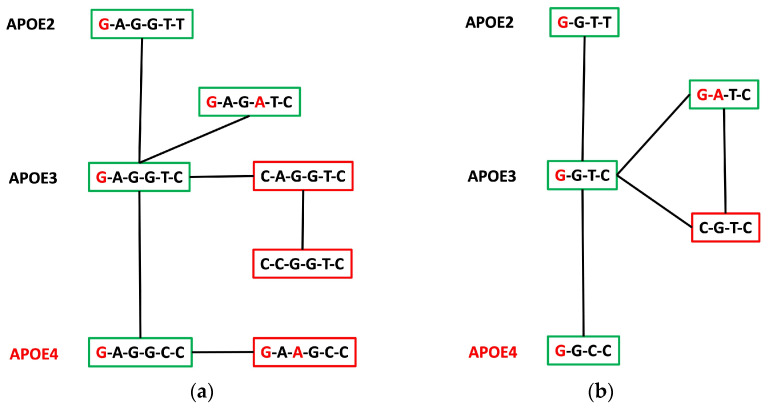
Stepping-stone model for the change from one haplotype to another with a maximum of one mutation. (a) Model for the six-variant core haplotype. (b) Model for the four-variant super-core haplotype. Green haplotypes are more frequent in the AFR macroarea; red haplotypes are less frequent.

References

    1. Kockx M., Traini M., Kritharides L. Cell-specific production, secretion, and function of apolipoprotein E. J. Mol. Med. 2018;96:361–371. doi: 10.1007/s00109-018-1632-y. - DOI - PubMed
    1. Chernick D., Ortiz-Valle S., Jeong A., Qu W., Li L. Peripheral versus central nervous system APOE in Alzheimer’s disease: Interplay across the blood-brain barrier. Neurosci. Lett. 2019;708:134306. doi: 10.1016/j.neulet.2019.134306. - DOI - PMC - PubMed
    1. Fernández-Calle R., Konings S.C., Frontiñán-Rubio J., García-Revilla J., Camprubí-Ferrer L., Svensson M., Martinson I., Boza-Serrano A., Venero J.L., Nielsen H.M., et al. APOE in the bullseye of neurodegenerative diseases: Impact of the APOE genotype in Alzheimer’s disease pathology and brain diseases. Mol. Neurodegener. 2022;17:62. doi: 10.1186/s13024-022-00566-4. - DOI - PMC - PubMed
    1. Mahley R.W., Weisgraber K.H., Huang Y. Apolipoprotein E: Structure determines function, from atherosclerosis to Alzheimer’s disease to AIDS. J. Lipid Res. 2009;50:S183–S188. doi: 10.1194/jlr.R800069-JLR200. - DOI - PMC - PubMed
    1. Chen Y., Strickland M.R., Soranno A., Holtzman D.M. Apolipoprotein E: Structural Insights and Links to Alzheimer Disease Pathogenesis. Neuron. 2021;109:205–221. doi: 10.1016/j.neuron.2020.10.008. - DOI - PMC - PubMed

LinkOut - more resources