. 2023 Apr 25;13(1):6755.
doi: 10.1038/s41598-023-33906-5.

Deep learning-based automated detection and multiclass classification of focal interictal epileptiform discharges in scalp electroencephalograms

Affiliations

Deep learning-based automated detection and multiclass classification of focal interictal epileptiform discharges in scalp electroencephalograms

Yoon Gi Chung et al. Sci Rep. .

Abstract

Detection and spatial distribution analyses of interictal epileptiform discharges (IEDs) are important for diagnosing, classifying, and treating focal epilepsy. This study proposes deep learning-based models to detect focal IEDs in electroencephalography (EEG) recordings of the frontal, temporal, and occipital scalp regions. This study included 38 patients with frontal (n = 15), temporal (n = 13), and occipital (n = 10) IEDs and 232 controls without IEDs from a single tertiary center. All the EEG recordings were segmented into 1.5-s epochs and fed into 1- or 2-dimensional convolutional neural networks to construct binary classification models to detect IEDs in each focal region and multiclass classification models to categorize IEDs into frontal, temporal, and occipital regions. The binary classification models exhibited accuracies of 79.3-86.4%, 93.3-94.2%, and 95.5-97.2% for frontal, temporal, and occipital IEDs, respectively. The three- and four-class models exhibited accuracies of 87.0-88.7% and 74.6-74.9%, respectively, with temporal, occipital, and non-IEDs F1-scores of 89.9-92.3%, 84.9-90.6%, and 84.3-86.0%; and 86.6-86.7%, 86.8-87.2%, and 67.8-69.2% for the three- and four-class (frontal, 50.3-58.2%) models, respectively. The deep learning-based models could help enhance EEG interpretation. Although they performed well, the resolution of region-specific focal IED misinterpretations and further model improvement are needed.


Conflict of interest statement

The authors declare no competing interests.

Figures
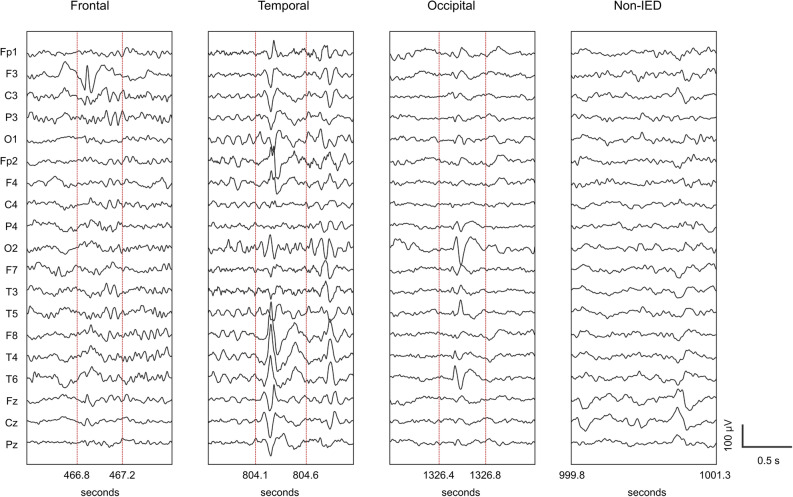
Figure 1
Figure 1
Representative epochs corresponding to focal interictal epileptiform discharges (IEDs) and non-IED.
Figure 2
Figure 2
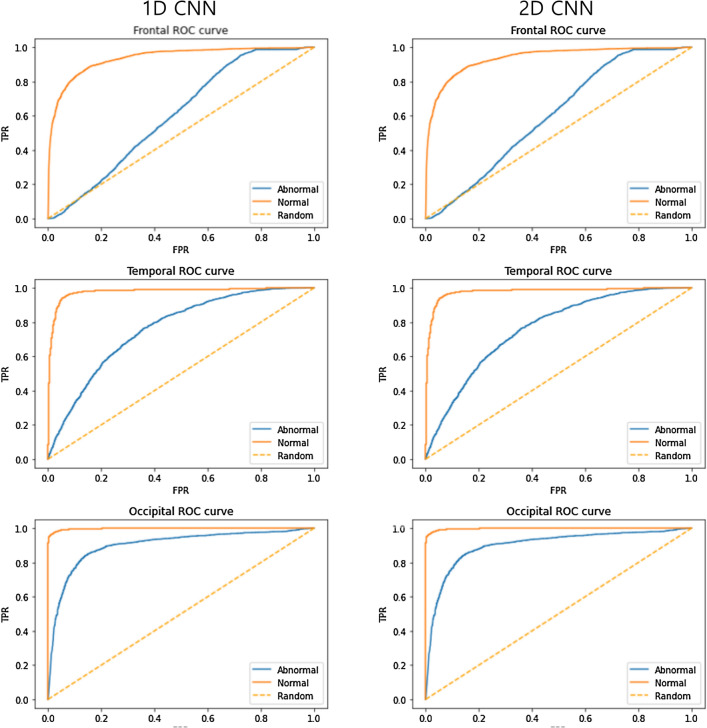
Binary classification performance with receiver operating characteristic (ROC) curves for frontal, temporal, and occipital IEDs. The upper, middle, and lower panels in each column represent the ROC curves of the frontal, temporal, and occipital IEDs, respectively. Abnormal and Normal in each small box indicate the performance using the non-IED epochs from patients and controls, respectively. CNN, convolutional neural network; IED, interictal epileptiform discharge; TPR, true positive rate; FPR, false positive rate.
Figure 3
Figure 3
Confusion matrices for the 1D and 2D CNN-based multiclass classification results with the number of correctly and incorrectly classified focal and non-IEDs. Performance of the three-class (upper panels) and four-class (lower panels) classifications. CNN, convolutional neural network; IED, interictal epileptiform discharge.
Figure 4
Figure 4
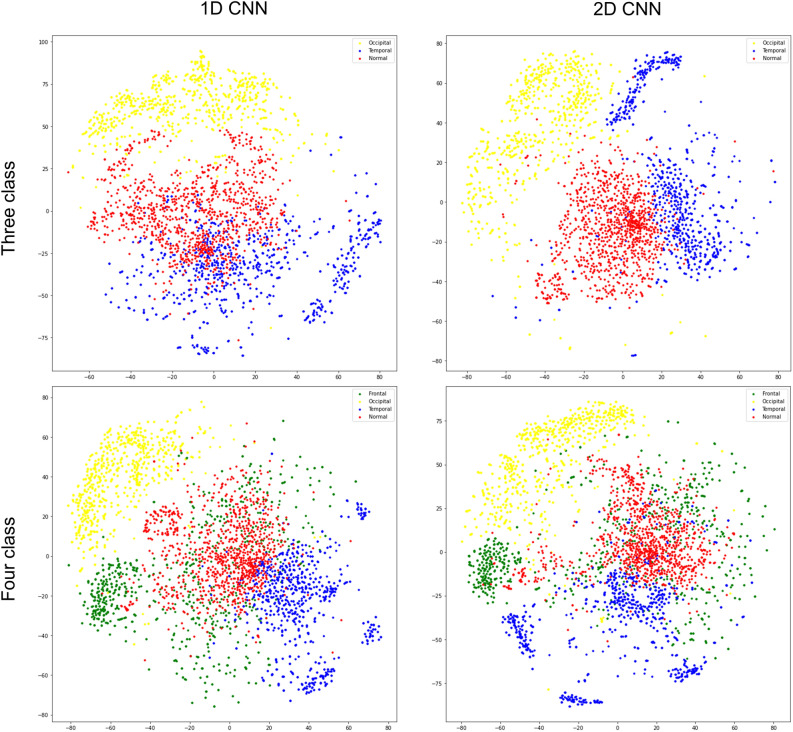
2-dimensional feature visualization for frontal, temporal, occipital, and non-IEDs using t-SNE. Feature visualization for the three-class (upper panels) and four-class (lower panels) classification. Green, blue, yellow, and red dots represent frontal, temporal, occipital, and non-IEDs, respectively. Owing to the large number of epochs (32,709 in the three-class classification and 43,269 in the four-class classification), we randomly selected 1000 of each class for visualization (3000 in the three-class classification and 4000 in the four-class classification). IED: interictal discharge and t-SNE: t-distributed stochastic neighbor embedding.

References

    1. Kural MA, et al. Criteria for defining interictal epileptiform discharges in EEG: A clinical validation study. Neurology. 2020;94:e2139–e2147. doi: 10.1212/WNL.0000000000009439. - DOI - PMC - PubMed
    1. Kural MA, et al. Optimized set of criteria for defining interictal epileptiform EEG discharges. Clin. Neurophysiol. 2020;131:2250–2254. doi: 10.1016/j.clinph.2020.06.026. - DOI - PubMed
    1. Kim SH, Korff CM, Kim AJ, Nordli DR., Jr A practical, simple, and useful method of categorizing interictal EEG features in children. Neurology. 2015;85:471–478. doi: 10.1212/WNL.0000000000001805. - DOI - PMC - PubMed
    1. Grouiller F, et al. With or without spikes: localization of focal epileptic activity by simultaneous electroencephalography and functional magnetic resonance imaging. Brain. 2011;134:2867–2886. doi: 10.1093/brain/awr156. - DOI - PMC - PubMed
    1. Mathias SV, Bensalem-Owen M. Artifacts that can be misinterpreted as interictal discharges. J. Clin. Neurophysiol. 2019;36:264–274. doi: 10.1097/WNP.0000000000000605. - DOI - PubMed

Publication types