


Out of the stable: Social disruption and concurrent shifts in the feral mare (Equus caballus) fecal microbiota
- PMID: 37187967
- PMCID: PMC10175550
- DOI: 10.1002/ece3.10079
Out of the stable: Social disruption and concurrent shifts in the feral mare (Equus caballus) fecal microbiota
Abstract
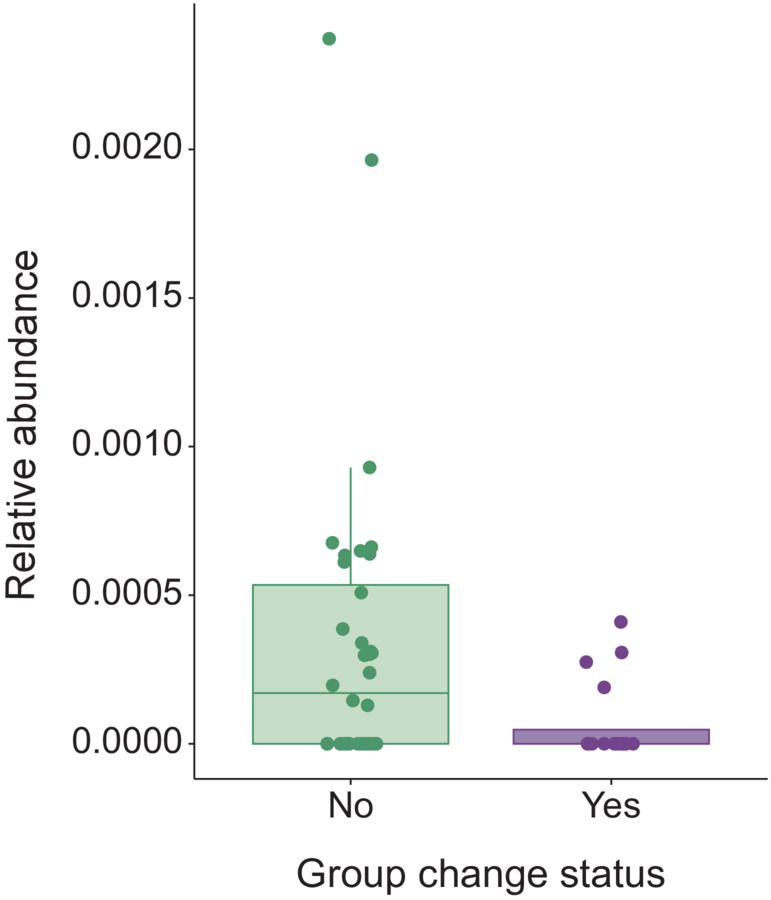
The disruption of animals' symbiotic bacterial communities (their microbiota) has been associated with myriad factors including changes to the diet, hormone levels, and various stressors. The maintenance of healthy bacterial communities may be especially challenging for social species as their microbiotas are also affected by group membership, social relationships, microbial transfer between individuals, and social stressors such as increased competition and rank maintenance. We investigated the effects of increased social instability, as determined by the number of group changes made by females, on the microbiota in free-living, feral horses (Equus caballus) on Shackleford Banks, a barrier island off the North Carolina coast. Females leaving their groups to join new ones had fecal microbial communities that were similarly diverse but compositionally different than those of females that did not change groups. Changing groups was also associated with the increased abundance of a several bacterial genera and families. These changes may be significant as horses are heavily dependent upon their microbial communities for nutrient absorption. Though we cannot identify the particular mechanism(s) driving these changes, to the best of our knowledge, ours is the first study to demonstrate an association between acute social perturbations and the microbiota in a free-ranging mammal.
Keywords: alpha diversity; beta diversity; feral horse; microbiome; microbiota; social disruption.
© 2023 The Authors. Ecology and Evolution published by John Wiley & Sons Ltd.
Figures


References
-
- Altmann, J. (1974). Observational study of behavior: Sampling methods. Behaviour, 49, 227–267. - PubMed
-
- Amato, K. R. , Yeoman, C. J. , Kent, A. , Righini, N. , Carbonero, F. , Estrada, A. , Rex Gaskins, H. , Stumpf, R. M. , Yildirim, S. , Torralba, M. , Gillis, M. , Wilson, B. A. , Nelson, K. E. , White, B. A. , & Leigh, S. R. (2013). Habitat degradation impacts black howler monkey (Alouatta pigra) gastrointestinal microbiomes. The ISME Journal, 7, 1344–1353. - PMC - PubMed
-
- Bailey, M. T. (2012). The contributing role of the intestinal microbiota in stressor‐induced increases in susceptibility to enteric infection and systemic immunomodulation. Hormones and Behavior, 62, 286–294. - PubMed
-
- Bailey, M. T. , & Coe, C. L. (1999). Maternal separation disrupts the integrity of the intestinal microflora in infant rhesus monkeys. Developmental Psychobiology, 35, 146–155. - PubMed
LinkOut - more resources
Full Text Sources
