Review
. 2023 Apr 28:14:1154135.
doi: 10.3389/fphar.2023.1154135. eCollection 2023.

The application of exosomes in the early diagnosis and treatment of osteoarthritis

Affiliations
Review

The application of exosomes in the early diagnosis and treatment of osteoarthritis

Anjing Chen et al. Front Pharmacol. .

Abstract

With the increase in human lifespan and the aggravation of global aging, the incidence of osteoarthritis (OA) is increasing annually. To better manage and control the progression of OA, prompt diagnosis and treatment for early-stage OA are important. However, a sensitive diagnostic modality and therapy for early OA have not been well developed. The exosome is a class of extracellular vesicles containing bioactive substances, that can be delivered directly from original cells to neighboring cells to modulate cellular activities through intercellular communication. In recent years, exosomes have been considered important in the early diagnosis and treatment of OA. Synovial fluid exosome and its encapsulated substances, e.g., microRNA, lncRNA, and proteins, can not only distinguish OA stages but also prevent the progression of OA by directly targeting cartilage or indirectly modulating the immune microenvironment in the joints. In this mini-review, we include recent studies on the diagnostic and therapeutic modalities of exosomes and hope to provide a new direction for the early diagnosis and treatment of OA disease in the future.

Keywords: bone; exosome; immune activation; inflammation; mesenchymal stem cell; osteoarthritis.


Conflict of interest statement

The authors declare that the research was conducted in the absence of any commercial or financial relationships that could be construed as a potential conflict of interest.

Figures
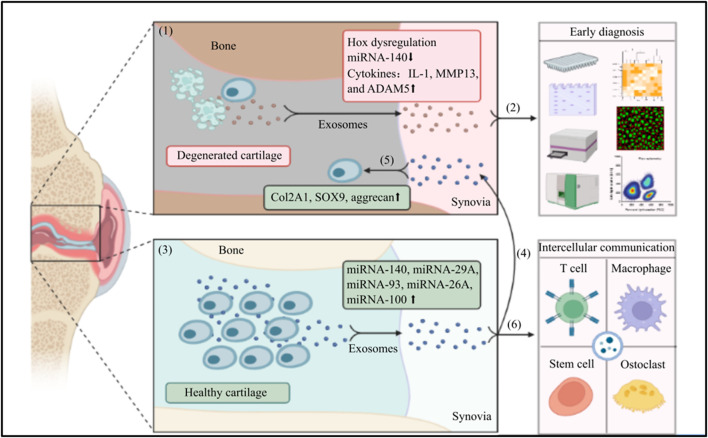
FIGURE 1
FIGURE 1
The application of exosomes in the early diagnosis and treatment for OA: (1) In an OA joint, chondrocytes undergo apoptosis, the structure of cartilage is damaged. Chondrocytes and mesenchymal stem cells in the OA environment intend to secrete exosomes with Hox gene dysregulation, low expression of miRNA-140, and high levels of IL-1, MMP13 and ADAM5; (2) The exosomes are secreted into synovial fluid that can be harvested in a minimally invasive way, the specific phenotype or enveloped component of exosomes are sensitive markers to early diagnose OA and differentiate the pathological stages; (3) In contrast, chondrocytes and mesenchymal stem cells in a healthy joint can secrete exosomes with high expression of various miRNA; (4) The exosomes with specific miRNAs are secreted into the synovial fluid; (5) The synovial fluid derived-exosomes can be harvested and injected in to a OA joint, the wrapped functional miRNAs can increase the levels of Col2A1, SOX9, and aggrecan, to promote the regeneration of cartilage and reverse the progression of OA; (6) Meanwhile, the synovial fluid derived-exosomes can also involve in a intercellular communication with many neighboring cells, e.g., T cell, macrophage, osteoclast, and stem cell to multidimensionally protect the joint harmed by OA. (The graphic components of this illustrative scheme were provided by BioRender.com).

References

    1. Asghar S., Litherland G. J., Lockhart J. C., Goodyear C. S., Crilly A. (2020). Exosomes in intercellular communication and implications for osteoarthritis. Rheumatol. Oxf. 59, 57–68. 10.1093/rheumatology/kez462 - DOI - PubMed
    1. Chen C., Wang R., Chen X., Hou Y., Jiang J. (2022). Targeting CD47 as a novel immunotherapy for breast cancer. Front. Oncol. 12, 924740. 10.3389/fonc.2022.924740 - DOI - PMC - PubMed
    1. Chuang C. H., Kuo C. C., Chiang Y. F., Lee P. Y., Wang F. H., Hsieh C. Y., et al. (2023). Enriched peripheral blood-derived mononuclear cells for treating knee osteoarthritis. Cell Transpl. 32, 9636897221149445. 10.1177/09636897221149445 - DOI - PMC - PubMed
    1. Cosenza S., Ruiz M., Toupet K., Jorgensen C., Noel D. (2017). Mesenchymal stem cells derived exosomes and microparticles protect cartilage and bone from degradation in osteoarthritis. Sci. Rep. 7, 16214. 10.1038/s41598-017-15376-8 - DOI - PMC - PubMed
    1. Crossley K. M., Vicenzino B., Pandy M. G., Schache A. G., Hinman R. S. (2008). Targeted physiotherapy for patellofemoral joint osteoarthritis: A protocol for a randomised, single-blind controlled trial. BMC Musculoskelet. Disord. 9, 122. 10.1186/1471-2474-9-122 - DOI - PMC - PubMed

LinkOut - more resources
