Review
. 2023 Jun;18(6):1814-1840.
doi: 10.1038/s41596-023-00826-7. Epub 2023 May 15.

The ClusPro AbEMap web server for the prediction of antibody epitopes

Affiliations
Review

The ClusPro AbEMap web server for the prediction of antibody epitopes

Israel T Desta et al. Nat Protoc. 2023 Jun.

Abstract

Antibodies play an important role in the immune system by binding to molecules called antigens at their respective epitopes. These interfaces or epitopes are structural entities determined by the interactions between an antibody and an antigen, making them ideal systems to analyze by using docking programs. Since the advent of high-throughput antibody sequencing, the ability to perform epitope mapping using only the sequence of the antibody has become a high priority. ClusPro, a leading protein-protein docking server, together with its template-based modeling version, ClusPro-TBM, have been re-purposed to map epitopes for specific antibody-antigen interactions by using the Antibody Epitope Mapping server (AbEMap). ClusPro-AbEMap offers three different modes for users depending on the information available on the antibody as follows: (i) X-ray structure, (ii) computational/predicted model of the structure or (iii) only the amino acid sequence. The AbEMap server presents a likelihood score for each antigen residue of being part of the epitope. We provide detailed information on the server's capabilities for the three options and discuss how to obtain the best results. In light of the recent introduction of AlphaFold2 (AF2), we also show how one of the modes allows users to use their AF2-generated antibody models as input. The protocol describes the relative advantages of the server compared to other epitope-mapping tools, its limitations and potential areas of improvement. The server may take 45-90 min depending on the size of the proteins.


Figures

Figure 1 ∣
Figure 1 ∣
Outline of the AbEMap protocol using an antigen structure and an antibody sequence as inputs, examples of complex structures generated by PIPER, four examples of results, and comparisons to other servers. A) User inputs the solved crystal structure of the antigen (shown as PyMOL stick figures in purple) and the antibody sequence (shown as purple text) (if structure is unavailable). (B) The antibody sequence is used to find close homologues using BLAST for each of its heavy and light chains. A sample multiple sequence alignment of close homologues is shown for the monoclonal murine antibody 1FGN. L1 & H1 (green), L2 & H2 (blue), and L3 & H3 (red) regions of the complementarity determining regions (CDRs) are highlighted. The list of homologues is filtered using sequence identity and sequence similarity of L3 and H3 regions to the query sequence. (C) The structures for the selected sequences are modelled individually using MODELLER. Aligned regions of the backbone are copied from the template, whereas non-aligned regions are modelled. (D) The residues with the highest likelihood of being in the epitope are highlighted in red in the results page of the server. (E) Billions of antibody-antigen complex conformations are generated by PIPER for the given antibody structure or for each antibody model. The antibody is shown as translucent cartoon and the antigen is shown as cyan surface. (F) The bar plot shows the number of poses in the top 100 models generated by PIPER that are within different RMSD thresholds. For example, 3 models (in the top 100) have RMSD ≤ 2 Å, and 21 models have RMSD between 10 and 12 Å. (G) As examples of visualizing the results, modelled murine anti-tissue factor (PDB ID 1FGN) and tissue factor (PDB ID 1TFH) are shown as surfaces with residues colored from blue to red based on increasing predicted epitope likelihood score. 19 of the 26 epitope residues are in the 30 top ranked residues. (H) Modelled humanized Fab D3h44 (PDB ID 1JPT) and tissue factor (PDB ID 1TFH) shown as surfaces with residues colored from purple to gold based on increasing predicted epitope likelihood score. 20 of the 24 epitope residues are in the 30 top ranked residues. (I) Modelled anti-CCL2 neutralizing antibody (PDB ID 4DN3) and monocyte chemoattractant protein (1DOL) are shown as surfaces with residues colored from orange to green based on a decreasing predicted epitope likelihood score. All 14 of the 14 epitope residues are in the top 30 ranked residues. (J) Modelled anti-shh chimera Fab fragment (PDB ID 3MXV) and sonic hedgehog N-terminal domain (PDB ID 3M1N) shown in surface with residues colored from yellow to red based on increasing predicted epitope likelihood score. 15 of the 24 epitope residues are in the 30 top ranked residues. (K) The distribution of the ROC AUC scores of 28 unbound antibody-antigen complexes for two of the top epitope-predicting servers (SEPPA and BEpro) are compared to that of AbEMap. AbEMap outperforms both in terms of average (red dot), median (middle line), as well as the 25th and 75th quartiles. (L) The F1 and MCC scores of three different methods are compared for homology modelled antibodies when only homologues with <80% sequence identity are used as templates. ClusPro AbEMap takes the ensemble average residue scores from 5 to 10 of the best homologues, and EpiPred is used for epitope prediction with the best homology modelled antibody. AbEMap outperforms EpiPred before and after ensemble averaging the likelihood scores.
Figure 2 ∣
Figure 2 ∣
Epitope mapping performance of four different servers tested on 28 unbound-unbound antibody-antigen complexes in the benchmark set BM5. F1 and MCC scores for ClusPro-AbEMap, SEPPA, EpiPred and BEpro at different cut-off thresholds when the antigen residues are ranked by the obtained scores. The measures are averaged over the 28 complexes. The AbeMap results are slightly better than the ones obtained by SEPPA, and substantially better than the ones obtained by BEPro and EpiPred.
Figure 3 ∣
Figure 3 ∣
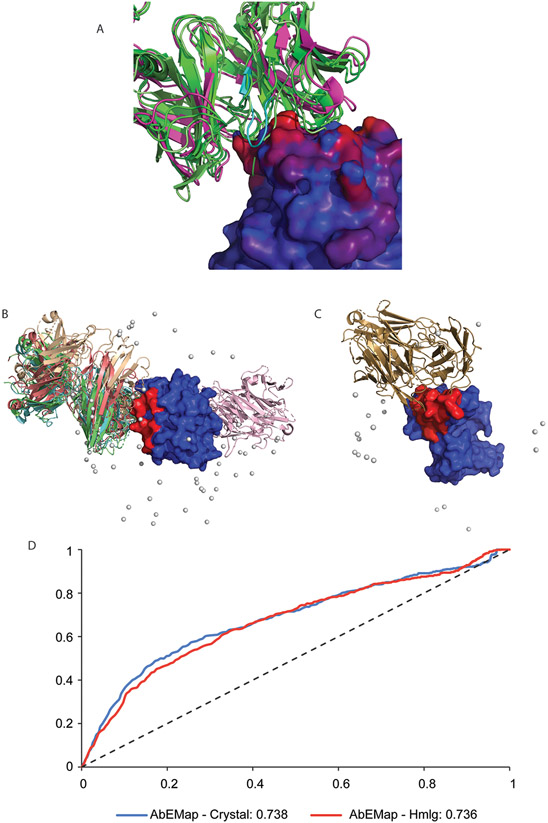
Examples of AbEMap’s applications. (A) The complex of birch pollen Bet V1 (blue surface) with the bound monoclonal antibody (magenta), PDB ID 1FSK. The true epitope residues are highlighted in red, and three of the homology models of the antibody are shown in green. The CDR3 of the heavy chain on the native antibody is highlighted in cyan. (B) Integrin alpha-L 1 domain (blue surface) with true epitope residues (red) is shown with the different poses of the Efalizumab FAB fragment predicted by PIPER. The cluster centers of the top antibody clusters are shown as gray pseudo-atoms. The top cluster’s representative is shown as a cartoon (green). (C) VEGF protein (blue surface) with the true epitope residues (red) is shown with the different poses of the FAB fragment of a neutralizing antibody predicted by PIPER. Similar to (B), the top cluster centers are shown as gray pseudo-atoms and the top ranked cluster representative is shown as a cartoon. (D) ROC plots of AbEMap’s performance with X-ray and homology modeled structures of the antibodies as inputs for the 28 unbound antibody-antigen complexes in the BM5 set. As shown, the use of homology models provides essentially the same accuracy as using the separately solved X-ray structures of antibodies.
Figure 4 ∣
Figure 4 ∣
Comparing AbEMap’s performance on X-ray and homology-modeled antibodies as inputs for 21 new antibody-antigen targets in the benchmark set BM5.5 with EpiPred’s predictions based on X-ray structure inputs alone. The prediction metrics are averaged to obtain the F1 and MCC scores shown. Interestingly, AbEMap performs slightly better with the template-based approach than with the unbound crystals when considering the top ranked 10, 20, or 30 residues. This emphasizes that the homology modeling approach may enhance prediction accuracy when good homologues are found. However, when considering the top 40 and top 50 residues, using the unbound X-ray structure of the antibody performs slightly better than the template based approach.
Figure 5 ∣
Figure 5 ∣
AbeMap initial job submit page. (A) The space to enter in the job name. (B) The 4 character code which specifies the PDB is entered here. (C) The chains to be investigated go here. (D) The FASTA code for the antibody is entered into this textbox. (E) The users MODELLER key is entered here. (F) The PDB IDs to be excluded in forming the homology model go here. (G) Click here to select/deselect masking non-CDR regions. (H) Submit the job by clicking map.
Figure 6 ∣
Figure 6 ∣
AbeMap job submit page after selecting the 'Use PDB' option for the antibody. (A) The 4 character code which specifies the antibody PDB is entered here. (B) If the structure is homology-based select this checkbox. (C) The option to automatically mask non-CDR regions is toggled here. (D) The residues for repulsion are entered here.
Figure 7 ∣
Figure 7 ∣
AbEMap status page. The page shows the job number in the AbeMap que, the job ID, the status of the job, the submission date and time, potential errors, and the number of rotations used during the docking stage. Further details on the job can be viewed by clicking the job number. Next, the page shows the input structures read by the program as cartoons, and the structures after pre-processing. Finally the advanced options selected by the user are shown at the bottom of the page.
Figure 8 ∣
Figure 8 ∣
AbeMap job results page. (A) To view the results scores for the selected model click here (see Figure 9). We recall that using the homology modeling option AbeMap generates multiple models, one for each template. (B) To view all the models for the job select the advanced option. (C) To view models obtained using different coefficient sets, select the coefficients one wishes to view (No VdW; set 003; Reduced attractive VdW; set 005; Antibody Mode; set 007). (D) To download the average PDB file with the likelihood scores in place of thermal factors click here. (E) The figure shows the PyMol generated structure of the antigen in surface view. Blue to red shows increasing predicted likelihood scores.
Figure 9 ∣
Figure 9 ∣
AbeMap job results scores page. (A) To view scores for different coefficient sets, select the coefficients to be viewed here. (B) To download the scores for the selected coefficient click here. (C) The likelihood scores for each amino acid residue in the model are presented here. We recall that for epitope prediction AbeMap uses 1000 structures to calculate the frequency of each antigen surface atom’s occurrence in the antibody-antigen interface, and defines the atomic epitope likelihood score as the Boltzmann weighted atomic interface occurrence frequency averaged over the ensemble of antibody structures. The residue likelihood scores are obtained by summing up the atomic contributions for each residue.
Figure 10 ∣
Figure 10 ∣
Results of epitope mapping for two lysozyme-antibody complexes using each of the three epitope mapping modes in AbEMap (X-ray structure, model, or sequence based). All figures show the hen egg white (HEW) lysozyme in surface view. Blue to red shows increasing predicted likelihood scores. The orange cartoons show the shark single domain antigen receptor (PDB ID 2I24) in the complex 2I25, and the green cartoons show the D1.3 anti-HEW lysozyme antibody (PDB ID 1VFA) in the complex 1VFB. Whenever the cartoon is semi-transparent, the epitope mapping result on the HEW lysozyme is shown for the other antibody. Panels (A), (C) and (E) show, respectively, mapping results for the 2I24 antibody on 3LZT when the antibody 2I24 is defined by its X-ray structure, its AlphaFold2 generated model, and just its sequence. Panels (B), (D) and (F) show, respectively, mapping results for the 1VFA antibody on 8LYZ when the antibody 1VFA is defined by its X-ray structure, its AlphaFold2 generated model, and just its sequence. As shown, the results for the two complexes are similar when using the independently solved X-ray structures. In the 20 top ranked residues AbeMap finds about 50% of the true epitope residues in both cases. Using the Alphafold2 models the results get slightly better for 2I25 but slightly worse for 1VFB. However, the predictions are poor for both complexes when using the internal homology modeling of AbeMap as most predicted antibody residues are in a region of the lysozyme on the opposite side from true antibody binding.
Figure 11 ∣
Figure 11 ∣
Mapping the epitopes for complexes 2W9E and 3MXW. The first complex is a Fab fragment of a therapeutic antibody binding a fragment of a human prion protein. The second complex includes the crystal structure of sonic hedgehog bound to a fab fragment. As for the lysozyme-antibody complexes shown in Fig 10, using the X-ray structures AbeMap finds about 50% of true epitope residues in the 20 top ranked residues (Panels A and B). Using the AlphaFold2 generated models of antibodies AbeMap finds almost the same residues for 2W9E as with the X-ray structure of the antibody, but only four epitope residues for 3MXW, in this latter case representing a major drop in prediction accuracy (Panels C and D, respectively). Using internal homology models and considering the 20 top ranked residues the results are better than with the antibody X-ray structure for 2W9E but worse for 3MXW (Panels E and F). However, the differences are moderate, emphasizing that the use of homology models may provide prediction accuracy similar to those using X-ray structures.

References

    1. Desta IT et al. Proteins. (2022) DOI: 10.1002/prot.26420 - DOI
    1. Porter KA et al. Proteins. 87, 1241–1248 (2019): DOI: 10.1002/prot.25808 - DOI - PMC - PubMed
    1. Kozakov D. et al. Nat. Protoc 12, 255–278 (2017): DOI: 10.1038/nprot.2016.169 - DOI - PMC - PubMed
    1. Padhorny D. et al. PNAS. 113, E4286–4293 (2016): DOI: 10.1073/pnas.1603929113 - DOI - PMC - PubMed
    1. Ngan CH et al. Bioinformatics. 28, 286–287 (2012): DOI: 10.1093/bioinformatics/btr651 - DOI - PMC - PubMed

Publication types