Review
. 2023 Apr 4;11(4):1093.
doi: 10.3390/biomedicines11041093.

Patient Blood Management in Liver Transplant-A Concise Review

Affiliations
Review

Patient Blood Management in Liver Transplant-A Concise Review

Angel Augusto Pérez-Calatayud et al. Biomedicines. .

Abstract

Transfusion of blood products in orthotopic liver transplantation (OLT) significantly increases post-transplant morbidity and mortality and is associated with reduced graft survival. Based on these results, an active effort to prevent and minimize blood transfusion is required. Patient blood management is a revolutionary approach defined as a patient-centered, systematic, evidence-based approach to improve patient outcomes by managing and preserving a patient's own blood while promoting patient safety and empowerment. This approach is based on three pillars of treatment: (1) detecting and correcting anemia and thrombocytopenia, (2) minimizing iatrogenic blood loss, detecting, and correcting coagulopathy, and (3) harnessing and increasing anemia tolerance. This review emphasizes the importance of the three-pillar nine-field matrix of patient blood management to improve patient outcomes in liver transplant recipients.

Keywords: adult and pediatric liver transplant; coagulation; patient blood management; viscoelastic testing.


Conflict of interest statement

Angel Augusto Perez-Calatayud has received honoraria and travel support for consulting and lecturing from Vifor, Werfen, Takeda, Octapharma, and LFB. Axel Hofmann has received honoraria and/or travel support for consulting and lecturing from Celgene, G1Therapeutics, PBMe Solutions, South African National Blood Service, Takeda, Vifor, and Werfen. Klaus Görlinger is now the Medical Director of TEM Innovations/Werfen PBM, Munich, Germany. The rest of the authors declare no conflict of interest.

Figures
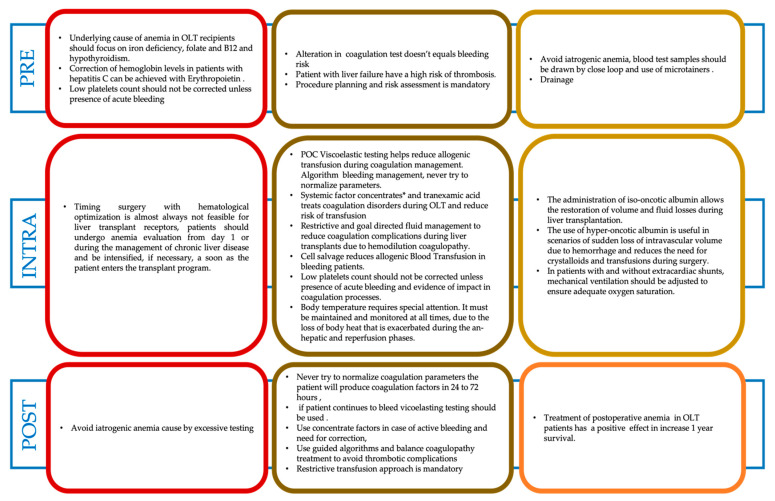
Figure 1
Figure 1
The three-pillar nine-field matrix of patient blood management in liver transplant recipients.
Figure 2
Figure 2
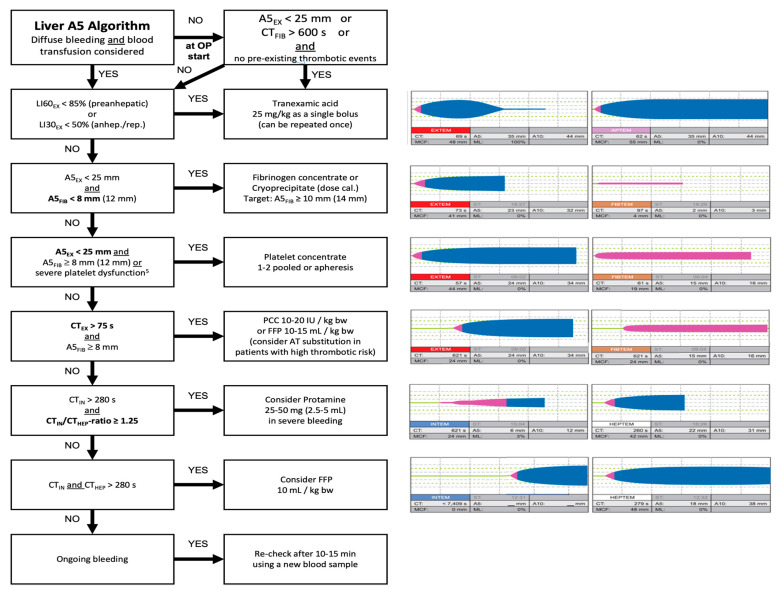
A5EX: amplitude of clot firmness 5 min after coagulation time in EXTEM, CTFIB: coagulation time in FIBTEM (CTFIB > 600 s reflects a flat-line in FIBTEM). ML: maximum lysis (within one h run time), ACT: activated clotting time, CTIN: coagulation time in INTEM, CTHEP: coagulation time in HEPTEM, BW: body weight, A5FIB: amplitude of clot firmness 5 min after CT in FIBTEM, CTEX: coagulation time in EXTEM, PCC: prothrombin complex concentrate, FFP: fresh frozen plasma. LI60: Lysis Index (residual clot firmness in % of MCF) 60 min after CT, LI30: Lysis Index (residual clot firmness in % of MCF) 30 min after CT, IU: international units. AT: antithrombin, Cai2+: ionized calcium concentration, EACA: epsilon-aminocaproic acid, TXA: tranexamic acid, rFVIIa: activated recombinant factor VII. (Courtesy of Klaus Görlinger) Germany [62].
Figure 3
Figure 3
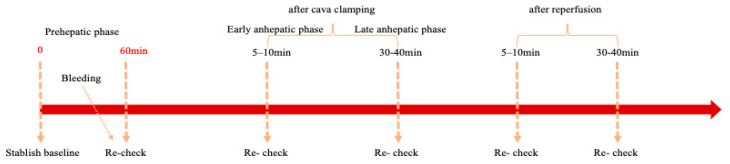
Timing of ROTEM analysis during orthotopic liver transplantation (OLT).

References

    1. Rana A., Petrowsky H., Hong J.C., Agopian V.G., Kaldas F.M., Farmer D., Yersiz H., Hiatt J.R., Busuttil R.W. Blood transfusion requirement during liver transplantation is an important risk factor for mortality. J. Am. Coll. Surg. 2013;216:902–907. doi: 10.1016/j.jamcollsurg.2012.12.047. - DOI - PubMed
    1. McCluskey S.A., Karkouti K., Wijeysundera D.N., Kakizawa K., Ghannam M., Hamdy A., Grant D., Levy G. Derivation of a risk index for the prediction of massive blood transfusion in liver transplantation. Liver Transpl. 2006;12:1584–1593. doi: 10.1002/lt.20868. - DOI - PubMed
    1. Massicotte L., Lenis S., Thibeault L., Sassine M.P., Seal R.F., Roy A. Effect of low central venous pressure and phlebotomy on blood product transfusion requirements during liver transplantations. Liver Transpl. 2006;12:117–123. doi: 10.1002/lt.20559. - DOI - PubMed
    1. Cleland S., Corredor C., Ye J.J., Srinivas C., McCluskey S.A. Massive haemorrhage in liver transplantation: Consequences, prediction and management. World J. Transplant. 2016;6:291e305. doi: 10.5500/wjt.v6.i2.291. - DOI - PMC - PubMed
    1. Holt S., Donaldson H., Hazlehurst G., Varghese Z., Contreras M., Kingdon E., Sweny P., Burns A. Acute transplant rejection induced by blood transfusion reaction to the Kidd blood group system. Nephrol. Dial. Transplant. 2004;19:2403–2406. doi: 10.1093/ndt/gfh333. - DOI - PubMed

LinkOut - more resources