


Evaluating the Development Status of Fluorescence-Guided Surgery (FGS) in Pediatric Surgery Using the Idea, Development, Exploration, Assessment, and Long-Term Study (IDEAL) Framework
- PMID: 37189938
- PMCID: PMC10136979
- DOI: 10.3390/children10040689
Evaluating the Development Status of Fluorescence-Guided Surgery (FGS) in Pediatric Surgery Using the Idea, Development, Exploration, Assessment, and Long-Term Study (IDEAL) Framework
Abstract
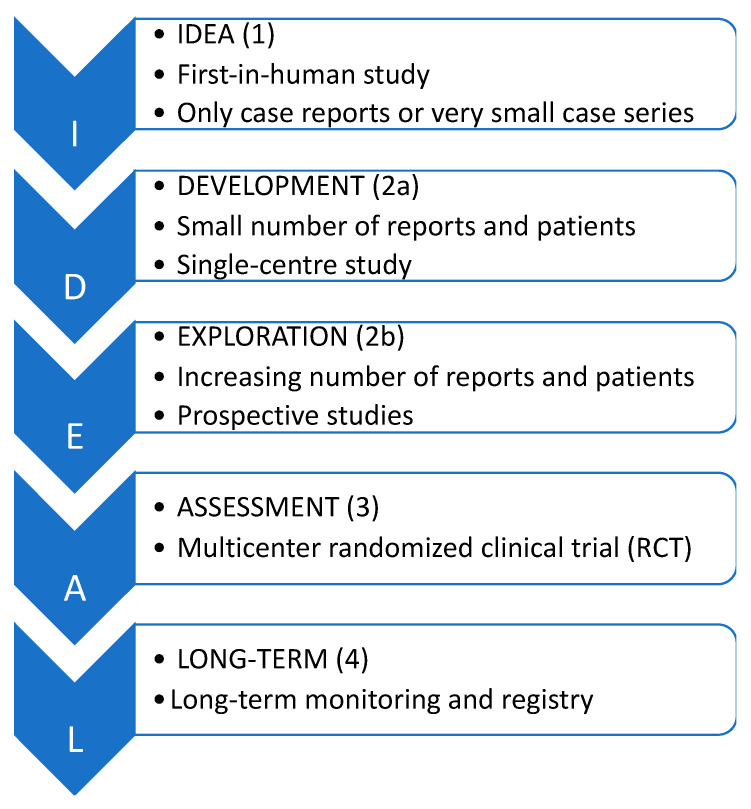
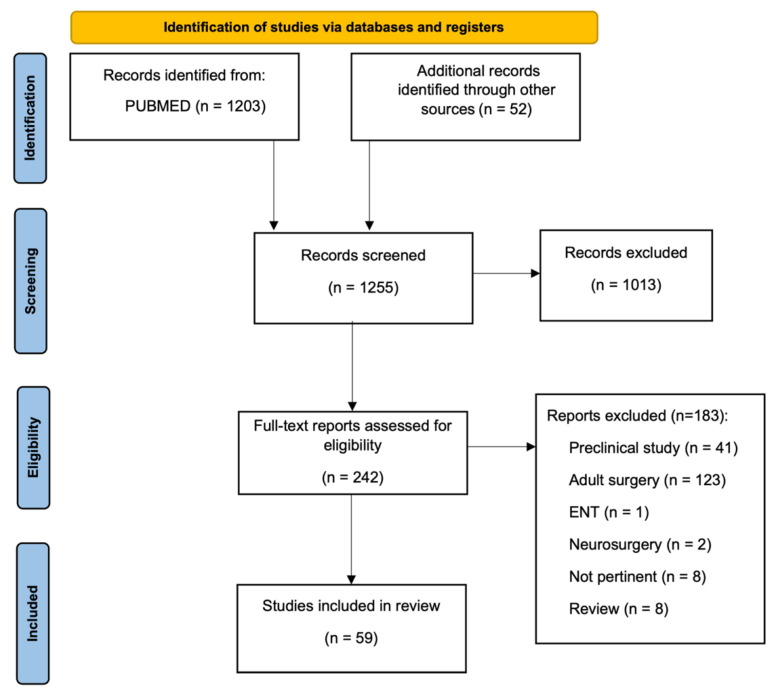
Fluorescence-guided surgery (FGS) is used in many pediatric subspecialties but there are currently no standard guidelines or outcome data. We aimed to assess the current status of FGS in pediatrics using the Idea, Development, Exploration, Assessment, and Long-term study (IDEAL) framework. Clinical papers on FGS in children published from January 2000 to December 2022 were systematically reviewed. The stage of research development was measured considering seven fields of application: biliary tree imaging, vascular perfusion for gastrointestinal procedures, lymphatic flow imaging, tumor resection, urogenital surgery, plastic surgery, and miscellaneous procedures. Fifty-nine articles were selected. For each field of application, the overall IDEAL stage was determined to be 2a for biliary tree imaging (10 publications, 102 cases), 1 for vascular perfusion for gastrointestinal procedures (8 publications, 28 cases), 1 for lymphatic flow imaging (12 publications, 33 cases), 2a for tumor resection (20 publications, 238 cases), 2a for urogenital surgery (9 publications, 197 cases), and 1-2a for plastic surgery (4 publications, 26 cases). One report did not belong to any categories. FGS in children is still in an early phase of adoption and development. We recommend using the IDEAL framework as a guide and suggest developing multicenter studies to define the standard guidelines, effectiveness, and outcomes.
Keywords: IDEAL framework and recommendations; fluorescence imaging; fluorescence-guided surgery; indocyanine green; pediatric surgery.
Conflict of interest statement
The authors declare no conflict of interest.
Figures
References
-
- Ishizawa T., McCulloch P., Muehrcke D., Carus T., Wiesel O., Dapri G., Schneider-Koriath S., Wexner S.D., Abu-Gazala M., Boni L., et al. Assessing the development status of intraoperative fluorescence imaging for perfusion assessments, using the IDEAL framework. BMJ Surg. Interv. Health Technol. 2021;3:e000088. doi: 10.1136/bmjsit-2021-000088. - DOI - PMC - PubMed
-
- Esposito C., Corcione F., Settimi A., Farina A., Centonze A., Esposito G., Spagnuolo M.I., Escolino M. Twenty-Five Year Experience with Laparoscopic Cholecystectomy in the Pediatric Population—From 10 mm Clips to Indocyanine Green Fluorescence Technology: Long-Term Results and Technical Considerations. J. Laparoendosc. Adv. Surg. Tech. 2019;29:1185–1191. doi: 10.1089/lap.2019.0254. - DOI - PubMed
-
- Esposito C., Settimi A., Cerulo M., Escolino M. Efficacy of indocyanine green (ICG) fluorescent cholangiography to improve intra-operative visualization during laparoscopic cholecystectomy in pediatric patients: A comparative study between ICG-guided fluorescence and standard technique. Surg. Endosc. 2022;36:4369–4375. doi: 10.1007/s00464-021-08784-5. - DOI - PubMed
