


Predictors of Clinically Meaningful Results of Bracing in a Large Cohort of Adolescents with Idiopathic Scoliosis Reaching the End of Conservative Treatment
- PMID: 37189968
- PMCID: PMC10136690
- DOI: 10.3390/children10040719
Predictors of Clinically Meaningful Results of Bracing in a Large Cohort of Adolescents with Idiopathic Scoliosis Reaching the End of Conservative Treatment
Abstract
Background: We need good outcome predictors to maximize the treatment efficiency of adolescents with idiopathic scoliosis (AIS). The in-brace correction has shown an important predictive effect on brace failure, while the influence of other variables is still debated. We aimed to identify new outcome predictors from a big prospective database of AIS.
Methods: Design: Retrospective analysis of prospectively collected data.
Inclusion criteria: AIS between 21 and 45°, Risser 0-2, brace prescription during the observation, treatment conclusion. All of the participants followed a personalized conservative approach according to the SOSORT Guidelines.
Outcomes: End of growth below 30°-40°-50°. The regression model included age, BMI, Cobb angle, ATR, TRACE score, real brace wear (RBW), and in-brace correction (IBC).
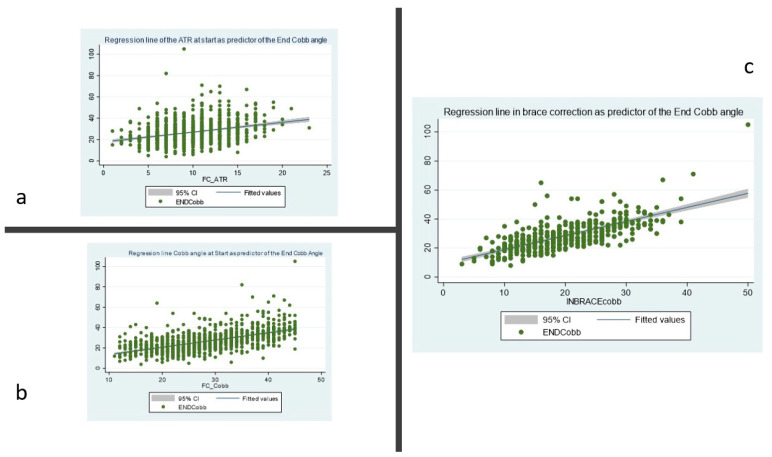
Results: A total of 1050 patients, 84% females, ages 12.1 ± 1.1, 28.2 ± 7.9° Cobb. IBC increased by 30%, 24%, and 23% the odds of ending treatment below 30°, 40°, and 50°, respectively. The OR did not change after the covariate adjustment. Cobb angle and ATR at the start also showed a predictive effect.
Conclusions: The systematic evaluation of IBC in clinics is useful for individuating the patient response to brace treatment more accurately, even in relation to the Cobb angle and ATR degrees at the start. Further studies are needed to increase the knowledge on predictors of AIS treatment results.
Keywords: adolescent idiopathic scoliosis; brace; outcome predictors.
Conflict of interest statement
S.N. declares stocks of ISICO. The other authors declare no conflict of interest.
Figures
References
-
- Lenz M., Oikonomidis S., Harland A., Fürnstahl P., Farshad M., Bredow J., Eysel P., Scheyerer M.J. Scoliosis and Prognosis-a Systematic Review Regarding Patient-Specific and Radiological Predictive Factors for Curve Progression. Eur. Spine J. 2021;30:1813–1822. doi: 10.1007/s00586-021-06817-0. - DOI - PubMed
-
- Negrini S., Donzelli S., Aulisa A.G., Czaprowski D., Schreiber S., de Mauroy J.C., Diers H., Grivas T.B., Knott P., Kotwicki T., et al. 2016 SOSORT Guidelines: Orthopaedic and Rehabilitation Treatment of Idiopathic Scoliosis during Growth. Scoliosis Spinal Disord. 2018;13:3. doi: 10.1186/s13013-017-0145-8. - DOI - PMC - PubMed
-
- Korbel K., Kozinoga M., Stoliński Ł., Kotwicki T. Scoliosis Research Society (SRS) Criteria and Society of Scoliosis Orthopaedic and Rehabilitation Treatment (SOSORT) 2008 Guidelines in Non-Operative Treatment of Idiopathic Scoliosis. Pol. Orthop. Traumatol. 2014;79:118–122. - PubMed
LinkOut - more resources
Full Text Sources
Miscellaneous
