


The Onco-Nephrology Field: The Role of Personalized Chemotherapy to Prevent Kidney Damage
- PMID: 37190182
- PMCID: PMC10136950
- DOI: 10.3390/cancers15082254
The Onco-Nephrology Field: The Role of Personalized Chemotherapy to Prevent Kidney Damage
Abstract
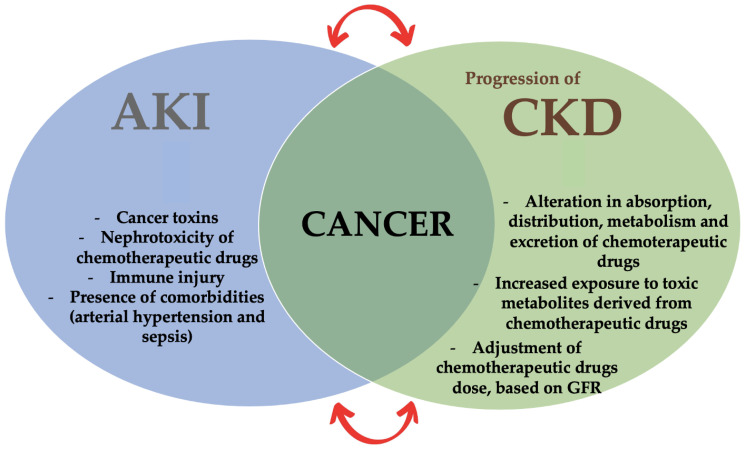
In recent years, the onco-nephrology field has acquired a relevant role in internal medicine due to the growing number of cases of renal dysfunction that have been observed in cancer patients. This clinical complication can be induced by the tumor itself (for example, due to obstructive phenomena affecting the excretory tract or by neoplastic dissemination) or by chemotherapy, as it is potentially nephrotoxic. Kidney damage can manifest as acute kidney injury or represent a worsening of pre-existing chronic kidney disease. In cancer patients, physicians should try to set preventive strategies to safeguard the renal function, avoiding the concomitant use of nephrotoxic drugs, personalizing the dose of chemotherapy according to the glomerular filtration rate (GFR) and using an appropriate hydration therapy in combination with nephroprotective compounds. To prevent renal dysfunction, a new possible tool useful in the field of onco-nephrology would be the development of a personalized algorithm for the patient based on body composition parameters, gender, nutritional status, GFR and genetic polymorphisms.
Keywords: acute kidney injury; chemotherapeutic drugs; chronic kidney disease; predictive algorithm; renal insufficiency.
Conflict of interest statement
The authors declare no conflict of interest.
Figures
References
-
- Launay-Vacher V., Oudard S., Janus N., Gligorov J., Pourrat X., Rixe O., Morere J.F., Beuzeboc P., Deray G., Renal I., et al. Prevalence of Renal Insufficiency in cancer patients and implications for anticancer drug management: The renal insufficiency and anticancer medications (IRMA) study. Cancer. 2007;110:1376–1384. doi: 10.1002/cncr.22904. - DOI - PubMed
Publication types
LinkOut - more resources
Full Text Sources
