Review
. 2023 Jun 1;14(3):858-878.
doi: 10.14336/AD.2022.0916.

Tryptophan Metabolism in Central Nervous System Diseases: Pathophysiology and Potential Therapeutic Strategies

Affiliations
Review

Tryptophan Metabolism in Central Nervous System Diseases: Pathophysiology and Potential Therapeutic Strategies

Yinrou Huang et al. Aging Dis. .

Abstract

The metabolism of L-tryptophan (TRP) regulates homeostasis, immunity, and neuronal function. Altered TRP metabolism has been implicated in the pathophysiology of various diseases of the central nervous system. TRP is metabolized through two main pathways, the kynurenine pathway and the methoxyindole pathway. First, TRP is metabolized to kynurenine, then kynurenic acid, quinolinic acid, anthranilic acid, 3-hydroxykynurenine, and finally 3-hydroxyanthranilic acid along the kynurenine pathway. Second, TRP is metabolized to serotonin and melatonin along the methoxyindole pathway. In this review, we summarize the biological properties of key metabolites and their pathogenic functions in 12 disorders of the central nervous system: schizophrenia, bipolar disorder, major depressive disorder, spinal cord injury, traumatic brain injury, ischemic stroke, intracerebral hemorrhage, multiple sclerosis, Alzheimer's disease, Parkinson's disease, amyotrophic lateral sclerosis, and Huntington's disease. Furthermore, we summarize preclinical and clinical studies, mainly since 2015, that investigated the metabolic pathway of TRP, focusing on changes in biomarkers of these neurologic disorders, their pathogenic implications, and potential therapeutic strategies targeting this metabolic pathway. This critical, comprehensive, and up-to-date review helps identify promising directions for future preclinical, clinical, and translational research on neuropsychiatric disorders.


Conflict of interest statement

Competing interest

The authors declare that they have no conflicts of interest.

Figures
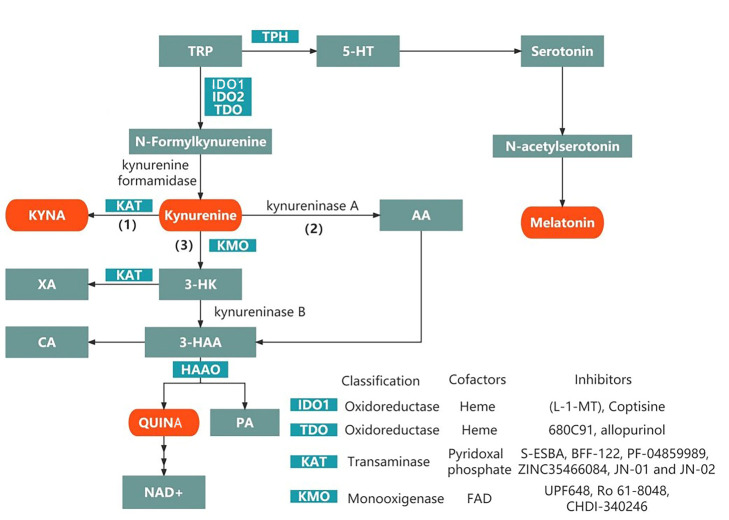
Figure 1.
Figure 1.
Tryptophan metabolism by the kynurenine and methoxyindole pathways. Kynurenine is a central KP metabolite capable of degradation through three specific pathways, shown in (1), (2) and (3) in the schematic diagram, to generate different neuroactive metabolites. Abbreviations: TRP, tryptophan; IDO, indoleamine-2,3-dioxygenase; TDO, tryptophan-2,3-dioxygenase; KAT, kynurenine aminotransferase I-III; AA, anthranilic acid; 3-HK, 3-hydroxykynurenine; 3-HAA, 3-hydroxyanthrenillc acid; KMO, kynurenine 3-monooxygenase; HAAO, 3-hydroxyanthranilate 3,4-dioxygenase; KP, kynurenine pathway; KYNA, kynurenic acid; PA, picolinic acid; QUINA, quinolinic acid; TPH, tryptophan hydroxylase; CA, cinnabarinic acid; XA, xanthurenic acid; NAD+, nicotinamide adenine dinucleotide; 5-HT, 5-hydroxytryptophan; TPH, tryptophan hydroxylase.
Figure 2.
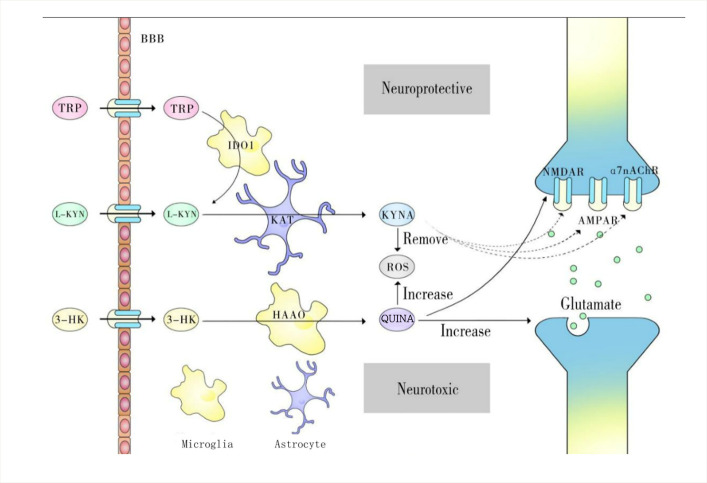
Figure 2.
The main branches of the kynurenine pathway. TRP, L-KYN, and 3-HK can penetrate the BBB. Thus, they are converted to different intermediates in the extracellular space of brain tissue. TRP is converted to L-KYN by IDO1 in macrophages. L-KYN is converted to KYNA in astrocytes. 3-HK is converted to QUINA by HAAO in microglia. In diseases other than SCZ, KYNA is neuroprotective, as it can remove ROS and inhibit NMDARs, α7nAch, and AMPARs. QUIN is neurotoxic, as it can increase ROS formation, increase glutamate production, and activate NMDARs. Abbreviations: TRP, tryptophan; 3-HK, 3-hydroxykynurenine; HAAO, 3-hydroxyanthranilate 3,4-dioxygenase; α7nAChR: α7 nicotinic acetylcholine receptor; AMPAR: α-amino-3-hydroxy-5-methyl-4-isoxazole-propionic acid receptor; BBB: blood-brain barrier; IDO, indoleamine-2,3-dioxygenase; KAT, kynurenine aminotransferases I-III; KMO, kynurenine 3-monooxygenase; KYNA, kynurenic acid; L-KYN, L-kynurenine; NMDAR: N-methyl-D-aspartic acid receptor; TRP, tryptophan; QUINA, quinolinic acid; SCZ, schizophrenia; ROS, reactive oxygen species

References

    1. Comai S, Bertazzo A, Brughera M, Crotti S (2020). Tryptophan in health and disease. Adv Clin Chem, 95:165-218. - PubMed
    1. Generoso JS, Giridharan VV, Lee J, Macedo D, Barichello T (2021). The role of the microbiota-gut-brain axis in neuropsychiatric disorders. Braz J Psychiatry, 43:293-305. - PMC - PubMed
    1. Srivastava S (2016). Emerging therapeutic roles for NAD(+) metabolism in mitochondrial and age-related disorders. Clin Transl Med, 5:25. - PMC - PubMed
    1. Hertelendy P, Toldi J, Fülöp F, Vécsei L (2018). Ischemic Stroke and Kynurenines: Medicinal Chemistry Aspects. Curr Med Chem, 25:5945-5957. - PubMed
    1. Bohár Z, Toldi J, Fülöp F, Vécsei L (2015). Changing the face of kynurenines and neurotoxicity: therapeutic considerations. Int J Mol Sci, 16:9772-9793. - PMC - PubMed

LinkOut - more resources