


Labeling strategies to track protozoan parasite proteome dynamics
- PMID: 37192562
- PMCID: PMC10895934
- DOI: 10.1016/j.cbpa.2023.102316
Labeling strategies to track protozoan parasite proteome dynamics
Abstract
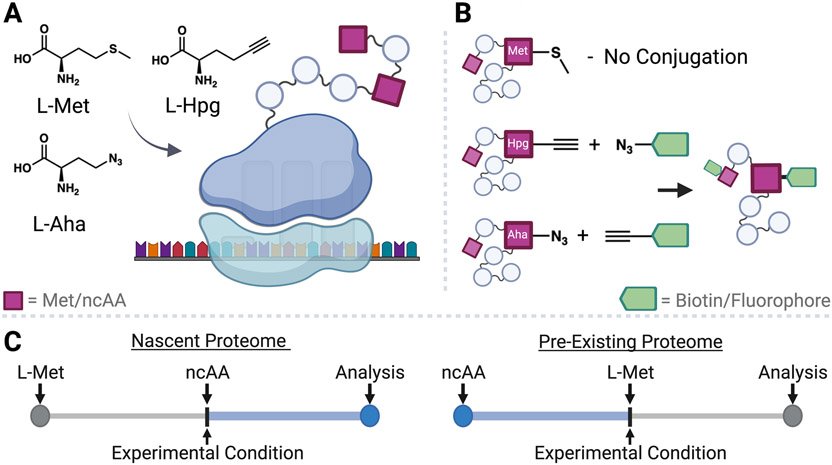
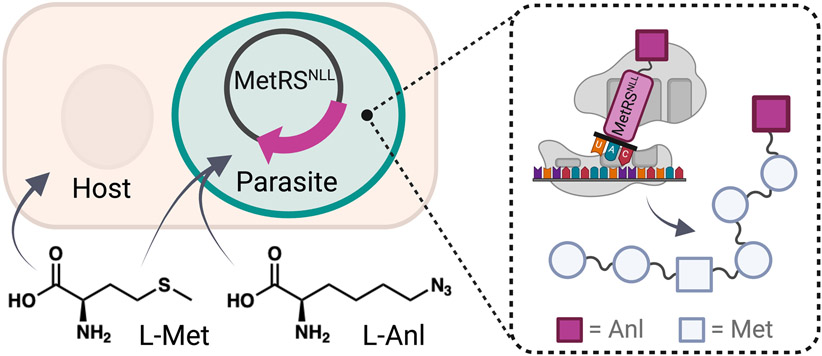
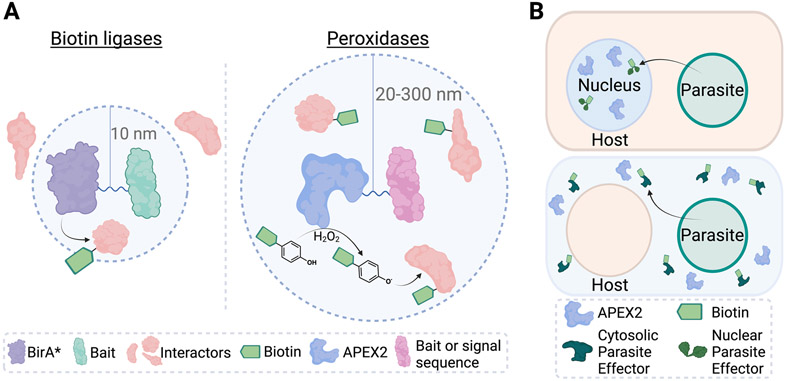
Intracellular protozoan parasites are responsible for wide-spread infectious diseases. These unicellular pathogens have complex, multi-host life cycles, which present challenges for investigating their basic biology and for discovering vulnerabilities that could be exploited for disease control. Throughout development, parasite proteomes are dynamic and support stage-specific functions, but detection of these proteins is often technically challenging and complicated by the abundance of host proteins. Thus, to elucidate key parasite processes and host-pathogen interactions, labeling strategies are required to track pathogen proteins during infection. Herein, we discuss the application of bioorthogonal non-canonical amino acid tagging and proximity-dependent labeling to broadly study protozoan parasites and include outlooks for future applications to study Plasmodium, the causative agent of malaria. We highlight the potential of these technologies to provide spatiotemporal labeling with selective parasite protein enrichment, which could enable previously unattainable insight into the biology of elusive developmental stages.
Keywords: Apicomplexan; Bioorthogonal non-canonical amino acid tagging; Plasmodium; Proximity-dependent labeling.
Copyright © 2023 Elsevier Ltd. All rights reserved.
Conflict of interest statement
Declaration of competing interest The authors declare no competing interests.
Figures
References
-
- WHO: World malaria report 2022. 2022.
-
- Prudêncio M, Rodriguez A, Mota MM: The silent path to thousands of merozoites: the Plasmodium liver stage. Nat Rev Microbiol 2006, 4:849–856. - PubMed
Publication types
MeSH terms
Substances
Grants and funding
LinkOut - more resources
Full Text Sources
Medical
