. 2023 May 16;13(1):7940.
doi: 10.1038/s41598-023-34884-4.

Erosion-inhibiting potential of the stannous fluoride-enriched CPP-ACP complex in vitro

Affiliations

Erosion-inhibiting potential of the stannous fluoride-enriched CPP-ACP complex in vitro

Deena Al Saady et al. Sci Rep. .

Abstract

Currently available anti-erosive agents only provide partial protection, emphasizing the need to enhance their performance. By characterizing erosive enamel wear at the nanoscale, the aim of this in vitro study was to assess the anti-erosive effects of SnF2 and CPP-ACP both individually and synergistically. Erosion depths were assessed longitudinally on 40 polished human enamel specimens after 1, 5, and 10 erosion cycles. Each cycle comprised one-min erosion in citric acid (pH 3.0) and one-min treatment in whole saliva (control group) or a slurry of one of the three anti-erosive pastes (10% CPP-ACP; 0.45% SnF2 (1100 ppm F); or SnF2/CPP-ACP (10% CPP-ACP + 0.45% SnF2)) (n = 10 per group). Scratch depths were assessed longitudinally in separate experiments using a similar protocol after 1, 5, and 10 cycles. Compared with the control groups, all slurries reduced erosion depths after 1 cycle (p ≤ 0.004) and scratch depths after 5 cycles (p ≤ 0.012). The order of anti-erosive potential was SnF2/CPP-ACP > SnF2 > CPP-ACP > control for erosion depth analysis, and SnF2/CPP-ACP > (SnF2 = CPP-ACP) > control for scratch depth analysis. These data provide 'proof of concept' evidence that SnF2/CPP-ACP has superior anti-erosive potential compared to SnF2 or CPP-ACP alone.


Conflict of interest statement

The authors declare no competing interests.

Figures
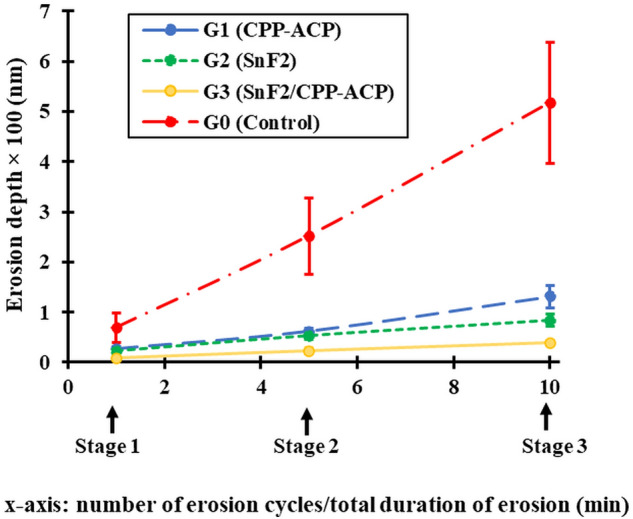
Figure 1
Figure 1
Comparison of the changes in erosion depth ± SD between the four groups from baseline to Stages 1, 2 and 3. Linear mixed-effects modeling showed significant interactions between Group and Stage (p < 0.001). The p values for pairwise comparisons are provided in Table 1.
Figure 2
Figure 2
Comparison of the changes in scratch depth ± SD between the four groups from baseline to Stages 1, 2 and 3. Linear mixed-effects modeling showed significant interactions between Group and Stage (p < 0.001). The p values for pairwise comparisons are provided in Table 1.
Figure 3
Figure 3
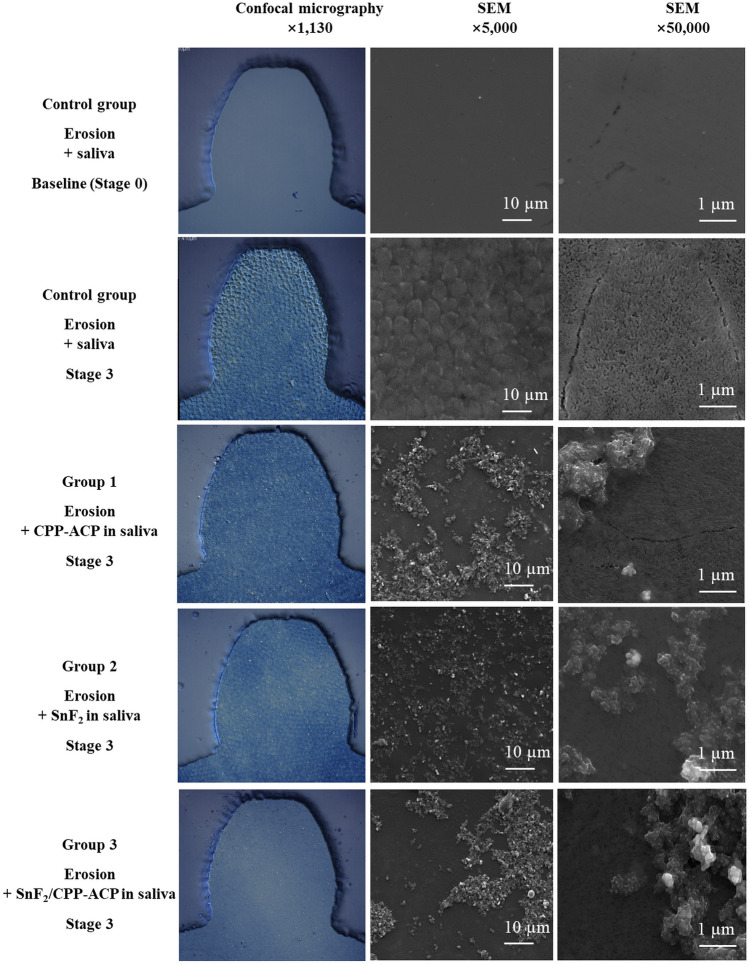
Laser confocal and scanning electron micrographic images showing the appearance of the enamel surfaces of the control group at baseline and Stage 3 and of the three other groups at Stage 3. SEM Scanning electron microscopy.
Figure 4
Figure 4
Flowchart of sampling and experimental design involving 10 erosion cycles to test the effectiveness of three anti-erosive agents in vitro. 3D three-dimensional, G0 control group (subjected to erosion and saliva), G1 Group 1 (subjected to erosion and CPP-ACP in a saliva slurry), G2 Group 2 (subjected to erosion and SnF2 in a saliva slurry), G3 Group 3 (subjected to erosion and SnF2/CPP-ACP in a saliva slurry). Erosion was carried out with 0.3% citric acid (pH adjusted to 3.0), followed by application of anti-erosive slurry (1 g paste mixed in 20 ml saliva).
Figure 5
Figure 5
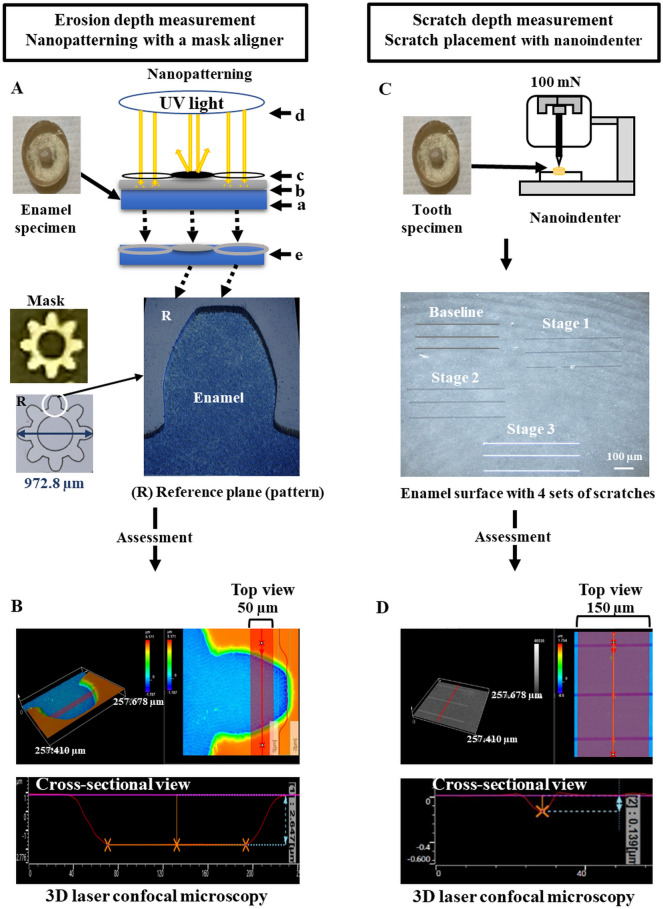
Scheme of the enamel erosion experiments involved in measuring (A, B) erosion depth and (C, D) scratch depth by using 3D laser confocal microscopy. (A) Photolithography (nanopatterning technique) was used to deposit an external reference resin layer on (a) flat, polished enamel surface by (b) spin-coating a layer of ‘positive’ photoresist resin/polymer (AZ 1518) (followed by heating at approximately 38 °C for 5 min), (c) placing a photolithographic mask (transparent soda-lime glass with areas of opaque chrome coating) with 8 U-shaped arms on the resin, and (d) exposing the resin to ultraviolet light for 5 s, which disintegrated the polymer layer that was not covered by the chrome (and the disintegrated polymer was subsequently removed by treating with an alkaline developer for 30 s, washing with water for 30 s and gently drying with air). This produced a positive pattern on the enamel surface with (e) coated regions (with photoresist resin) or uncoated regions (exposed enamel where the resin layer was removed). (B) 3D images (field of view 257.678 µm × 257.410 µm) were acquired to calculate erosion depth across a 50-µm length (top view shows a U-shaped arm and cross-sectional view shows erosion depth measured from the photoresist reference plane). (C) Flat, polished enamel specimens were subjected to scratch placement (3 sets of 500-µm long scratches at 4 different stages) in a nanoindenter using a 20 µm radius tip under a load of 100 mN. (D) 3D images (field of view 257.678 µm × 257.410 µm) were acquired to calculate scratch depth across a 150-µm length (top view shows 3 horizontal scratches in dark purple color, and cross-sectional view shows scratch depth measured from the enamel edges).

References

    1. Ganss C. Is erosive tooth wear an oral disease? Monogr. Oral Sci. 2014;25:16–21. doi: 10.1159/000359931. - DOI - PubMed
    1. Mitic AD, et al. Ultrastructural changes in the cemento-enamel junction caused by acidic beverages: An in vitro study. Microsc. Res. Tech. 2020;83:91–98. doi: 10.1002/jemt.23392. - DOI - PubMed
    1. Schmidt J, Huang B. The pH of bottled water commercially available in Australia and its implications for oral health. J. Water Health. 2022;20:871–876. doi: 10.2166/wh.2022.070. - DOI - PubMed
    1. Bartlett DW, Coward PY. Comparison of the erosive potential of gastric juice and a carbonated drink in vitro. J. Oral Rehabil. 2001;28:1045–1047. doi: 10.1046/j.1365-2842.2001.00780.x. - DOI - PubMed
    1. Shellis RP, Addy M. The interactions between attrition, abrasion and erosion in tooth wear. Monogr. Oral Sci. 2014;25:32–45. doi: 10.1159/000359936. - DOI - PubMed

Publication types

MeSH terms

Substances