Codeine prescription pattern and treatment responses in patients with chronic cough: a routinely collected institutional database analysis
- PMID: 37197516
- PMCID: PMC10183498
- DOI: 10.21037/jtd-22-1857
Codeine prescription pattern and treatment responses in patients with chronic cough: a routinely collected institutional database analysis
Abstract
Background: Codeine has been long used as an antitussive drug in several countries. However, a prescription pattern of codeine, such as dose or treatment duration, has not been reported in detail. Furthermore, there is few scientific evidence on the efficacy and safety. We aimed to examine codeine prescription pattern and explore treatment response in patients with chronic cough in real-world practice.
Methods: This was a retrospective cohort analysis of patients with chronic cough who were newly referred to tertiary allergy and asthma clinics between July 2017 and July 2018. Routinely collected electronic healthcare records (EHRs), including medical notes, prescriptions, and outpatient visits, were analyzed. Codeine prescription records were examined for duration, mean daily dose, and 1-year cumulative dose. Codeine responses were evaluated by manual EHR reviews.
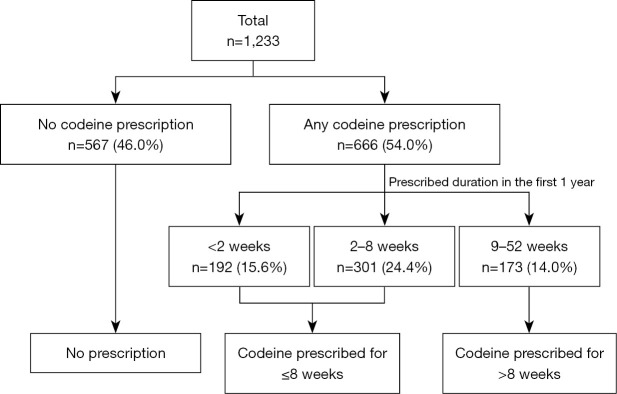
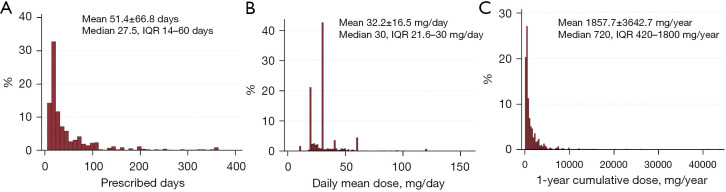
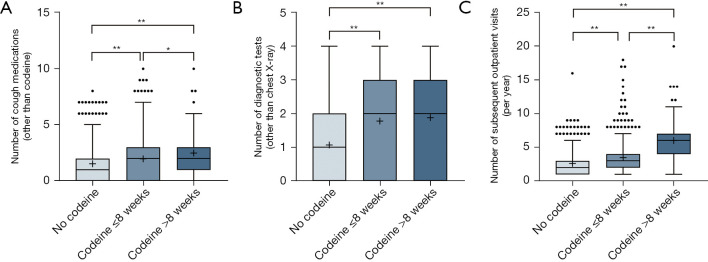
Results: Among a total of 1,233 newly referred patients with chronic cough, 666 were prescribed codeine for a median [interquartile range (IQR)] of 27.5 days (IQR 14-60 days); the median daily dose was 30 mg/year (IQR 21.6-30 mg/year), and the 1-year cumulative dose was 720 mg/year (IQR 420-1,800 mg/year). About 14.0% of patients were prescribed codeine for >8 weeks; they were older and had a longer cough duration, throat abnormal sensation and less dyspnea than patients prescribed codeine for ≤8 weeks or who did not receive codeine. Codeine prescription and duration was positively associated with the number of other cough-related medications, diagnostic tests, or outpatient visits. Cough status change was noted in 61.3% of codeine-prescribed patients (as 'improved' in 40.1% and 'not improved' in 21.2%), but not documented in 38.7%. Side effects were described in 7.8%.
Conclusions: Codeine prescription may be frequent and chronic in real-world practice of patients with chronic cough, despite the lack of robust clinical evidence on the efficacy. High prescription rates suggest unmet clinical needs. Prospective studies are warranted to identify codeine treatment responses and safety, and to build up clinical evidence to guide appropriate use of narcotic antitussives.
Keywords: Codeine; antitussive; cough; real-world evidence; routinely collected data.
2023 Journal of Thoracic Disease. All rights reserved.
Conflict of interest statement
Conflicts of Interest: All authors have completed the ICMJE uniform disclosure form (available at https://jtd.amegroups.com/article/view/10.21037/jtd-22-1857/coif). The series “Novel Insights Into Chronic Cough” was commissioned by the editorial office without any funding or sponsorship. WJS served as the unpaid Guest Editor of the series and serves as the unpaid editorial board member of Journal of Thoracic Disease. WJS declares academic grants from MSD, consulting fees from MSD, GSK, AstraZeneca, and Novartis, and honoraria from MSD, GSK, AstraZeneca, and Novartis. The authors have no other conflicts of interest to declare.
Figures
References
LinkOut - more resources
Full Text Sources