Review
. 2023 May 15;5(2):e00021.
doi: 10.1097/IN9.0000000000000021. eCollection 2023 Apr.

A new frontier for fat: dietary palmitic acid induces innate immune memory

Affiliations
Review

A new frontier for fat: dietary palmitic acid induces innate immune memory

Amy L Seufert et al. Immunometabolism (Cobham). .

Abstract

Dietary saturated fats have recently been appreciated for their ability to modify innate immune cell function, including monocytes, macrophages, and neutrophils. Many dietary saturated fatty acids (SFAs) embark on a unique pathway through the lymphatics following digestion, and this makes them intriguing candidates for inflammatory regulation during homeostasis and disease. Specifically, palmitic acid (PA) and diets enriched in PA have recently been implicated in driving innate immune memory in mice. PA has been shown to induce long-lasting hyper-inflammatory capacity against secondary microbial stimuli in vitro and in vivo, and PA-enriched diets alter the developmental trajectory of stem cell progenitors in the bone marrow. Perhaps the most relevant finding is the ability of exogenous PA to enhance clearance of fungal and bacterial burdens in mice; however, the same PA treatment enhances endotoxemia severity and mortality. Westernized countries are becoming increasingly dependent on SFA-enriched diets, and a deeper understanding of SFA regulation of innate immune memory is imperative in this pandemic era.

Keywords: CD36; ceramide; chylomicron; epigenetics; hematopoietic stem cell; inflammation; innate immune memory; ketogenic diet; macrophages; metabolism; monocytes; oleic acid; palmitic acid; priming; saturated fatty acid; toll-like receptor; trained immunity; western diet.


Conflict of interest statement

The authors declare no conflicts of interest.

Figures
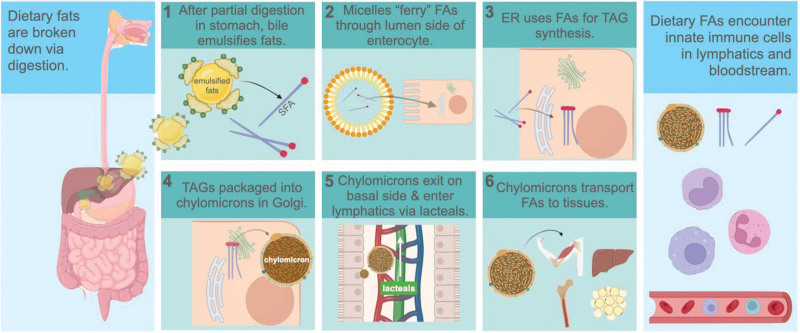
Figure 1.
Figure 1.
Pathway of dietary fatty acids following digestion. Following enzymatic digestion in stomach, (1) bile salts from the gall bladder emulsify FAs and MAGs during entry into the duodenum. (2) FAs greater than 14-carbons in length are packaged into micelles that ferry them into enterocytes from the lumen. (3) FAs are resynthesized into TAGs in the ER, followed by (4) repackaging into chylomicrons within the Golgi. (5) Chylomicrons are carried in vesicles through the lymphatics within chylomicrons, and may encounter monocytes, macrophages, and neutrophils. Figure was created with biorender.com (https://www.biorender.com/). ER, endoplasmic reticulum; FA, fatty acid; MAG, monoacylglyceride; TAG, triacylglyceride.
Figure 2.
Figure 2.
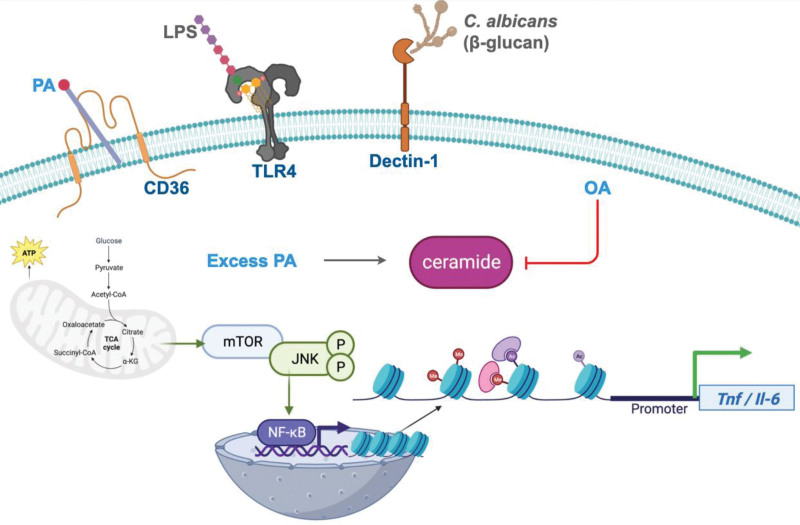
A dietary rheostat for macrophage inflammatory homeostasis and trained immunity. PA enters macrophage through the scavenger receptor, CD36; excess PA increases de novo ceramide; subsequent TLR4 stimulation by LPS enhances intracellular ceramide and activates NF-кB; PA metabolic byproducts induce histone modifications at Tnf/ll-6 promoters; fungal β-glucans signal through Dectin-1 and activate NF-кB; mTOR regulates JNK activation and NF-кB transcription; OA inhibits ceramide and reverses inflammatory polarization. Figure was created with biorender.com (https://www.biorender.com/). JNK, c-Jun N-terminal kinase; LPS, lipopolysaccharide; mTOR, mammalian target of rapamycin; ; NF-кB, Nuclear factor kappa B; OA, oleic acid; PA, palmitic acid; TLR4, toll-like receptor 4.

References

    1. Korbecki J, Bajdak-Rusinek K. The effect of palmitic acid on inflammatory response in macrophages: an overview of molecular mechanisms. Inflamm Res. 2019;68:915–32. - PMC - PubMed
    1. Carta G, Murru E, Banni S, et al. . Palmitic acid: physiological role, metabolism and nutritional implications. Front Physiol. 2017;8:902. - PMC - PubMed
    1. Divangahi M, Aaby P, Khader SA, et al. . Trained immunity, tolerance, priming and differentiation: distinct immunological processes. Nat Immunol. 2021;22:2–6. - PMC - PubMed
    1. Netea MG, Domínguez-Andrés J, Barreiro LB, et al. . Defining trained immunity and its role in health and disease. Nat Rev Immunol. 2020;20:375–88. - PMC - PubMed
    1. Arts RJW, Novakovic B, Ter Horst R, et al. . Glutaminolysis and fumarate accumulation integrate immunometabolic and epigenetic programs in trained immunity. Cell Metab. 2016;24:807–19. - PMC - PubMed