


Determinants of inappropriate antibiotic prescription in primary care in developed countries with general practitioners as gatekeepers: a systematic review and construction of a framework
- PMID: 37197815
- PMCID: PMC10193070
- DOI: 10.1136/bmjopen-2022-065006
Determinants of inappropriate antibiotic prescription in primary care in developed countries with general practitioners as gatekeepers: a systematic review and construction of a framework
Abstract
Objectives: This study aimed to identify determinants of inappropriate antibiotic prescription in primary care in developed countries and to construct a framework with the determinants to help understand which actions can best be targeted to counteract development of antimicrobial resistance (AMR).
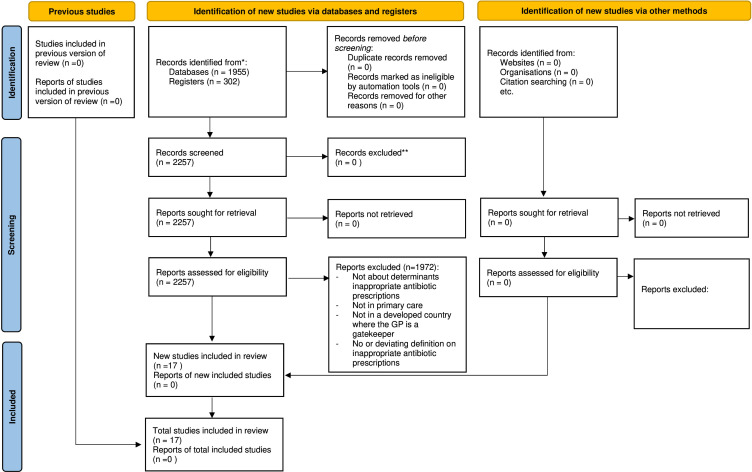
Design: A systematic review of peer-reviewed studies reporting determinants of inappropriate antibiotic prescription published through 9 September 2021 in PubMed, Embase, Web of Science and the Cochrane Library was performed.
Setting: All studies focusing on primary care in developed countries where general practitioners (GPs) act as gatekeepers for referral to medical specialists and hospital care were included.
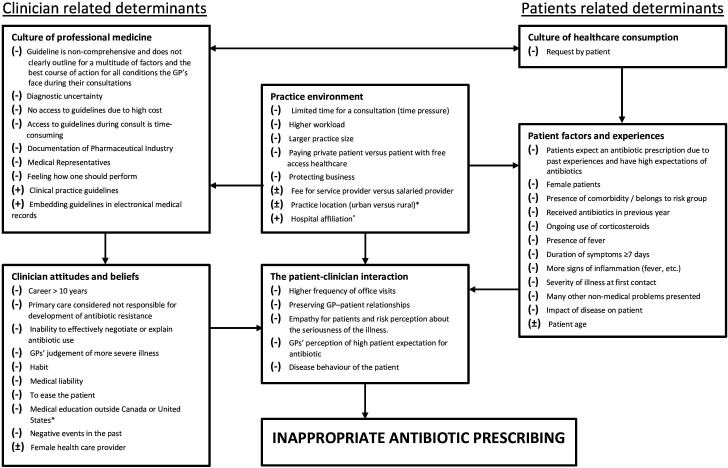
Results: Seventeen studies fulfilled the inclusion criteria and were used for the analysis which identified 45 determinants of inappropriate antibiotic prescription. Important determinants for inappropriate antibiotic prescription were comorbidity, primary care not considered to be responsible for development of AMR and GP perception of patient desire for antibiotics. A framework was constructed with the determinants and provides a broad overview of several domains. The framework can be used to identify several reasons for inappropriate antibiotic prescription in a specific primary care setting and from there, choose the most suitable intervention(s) and assist in implementing them for combatting AMR.
Conclusions: The type of infection, comorbidity and the GPs perception of a patient's desire for antibiotics are consistently identified as factors driving inappropriate antibiotic prescription in primary care. A framework with determinants of inappropriate antibiotic prescription may be useful after validation for effective implementation of interventions for decreasing these inappropriate prescriptions.
Prospero registration number: CRD42023396225.
Keywords: INFECTIOUS DISEASES; PRIMARY CARE; Public health.
© Author(s) (or their employer(s)) 2023. Re-use permitted under CC BY-NC. No commercial re-use. See rights and permissions. Published by BMJ.
Conflict of interest statement
Competing interests: None declared.
Figures
References
-
- Worldwide country situation analysis: Response to antimicrobial resistance 2015 [World Health Organisation]. Available: https://www.who.int/drugresistance/documents/situationanalysis/en/ [Accessed May 2019].
-
- European Centre for Disease Prevention and Control report . Antimicrobial consumption ECDC Website2020. Available: https://ecdc.europa.eu/en/antimicrobial-consumption/surveillance-and-dis... [Accessed Dec 2020].
-
- National Institute for Public health and the . Consumption of antimicrobial agents and antimicrobial resistance among medically important bacteria in the Netherlands in 2020. n.d. Available: https://swab.nl/nl/nethmap
-
- NHG_workgroup . Acute coughing 2011. Dutch society of General practitioners guideline. Available: https://richtlijnen.nhg.org/standaarden/acuut-hoesten [Accessed Jun 2020].
Publication types
MeSH terms
Substances
LinkOut - more resources
Full Text Sources
